
Subscribe
Subscribe
- Latest Legal News
- News
- Law Firms
- Columns
- Interviews
- Law School
- Legal Jobs
- हिंदी
- ಕನ್ನಡ
Several petitions filed as Public Interest Litigation (PILs) raise issues that are highly complex. In the recent past, numerous petitions, often by practising advocates, have been filed to regulate social media platforms and artificial intelligence. Similarly, other complex issues involving pollution and climate change are also the subject matter of such writ petitions.
The PIL is quintessential swadeshi jurisprudence. It enables invoking the vast jurisdiction of the High Courts and Supreme Court under Articles 226 and 32 respectively to grant quick relief in cases that involve public interest. In civil courts, it would take a great deal of time before any meaningful relief is granted. PILs have indeed saved our forests and reduced environmental damage. One shudders to think the state of our environment if we did not have green benches in various High Courts before the formation of the National Green Tribunal. The role of the Supreme Court in environmental matters has been exemplary.
It is now time to draw a red line to determine areas where a PIL would not be suitable.
In a significant and oft-quoted article by Lon L Fuller and Kenneth I Winston - The Forms and Limits of Adjudication - there is an interesting discussion on the “limits of adjudication”. In Part VII of this article (pages 393 to 405), Prof Fuller asks a crucial question: What kinds of tasks are inherently unsuited to adjudication? He then points out that issues which have multiple aspects are not suited for adjudication, but must be left to the legislature.
Prof Fuller examined the ability of courts to determine wages payable to workmen or determine prices to be charged for goods. For example, it would be difficult for courts to decide what should be the selling price of aluminium, as this depends on the raw materials used, the manufacturing process and the demand and supply for this product. Similarly, in the context of wages, it would be difficult for courts to contemplate what should be the minimum wage as it simply may not have the necessary data. Prof Fuller points out that the adjudication process cannot encompass and take into account the complex repercussions that may arise in such cases. He calls such issues as “polycentric” and compares them to a spider’s web. He observes:
"A pull on one strand will distribute tensions after a complicated pattern throughout the web as a whole. Doubling the original pull will, in all likelihood, not simply double each of the resulting tensions but will rather create a different complicated pattern of tensions. This would certainly occur, for example, if the doubled pull caused one or more of the weaker strands to snap. This is a “polycentric” situation because it is “many centered” – each crossing of stands is a distinct center for distributing tensions."
Many matters brought before the court as PILs fall into this polycentric category and are in the nature of a spider’s web. An order passed by the court can have serious consequences and result in unintended collateral damage.
Two examples come to mind. The first relates to the banning of diesel vehicles above 2000 CC and the other is the prohibition of the sale of liquor on highways.
The first case was MC Mehta v. Union of India, (2016). By an order passed in February, 2016, the Supreme Court directed that registration of private cars and SUVs above 2000 CC would be banned in Delhi up to March 31, 2016. The Court further directed that all OLA and UBER taxis should use CNG as fuel by March 31, 2016. This was a classic case of a Supreme Court order failing to contemplate its consequences. The vehicles would have met the mandatory BS-IV standards and left the respective factories for delivery in New Delhi. It was perfectly legitimate to sell these cars as they complied with fuel emission norms. What happens to persons who have paid an advance and are waiting for delivery of their cars? What happens to the car dealers and their employees? The reason given by the Supreme Court was that vehicles of a higher engine capacity were generally used by the more affluent members of society. There was no factual data of the total number of such vehicles, the extent of pollution they could cause and the economic consequences of such a sudden bar.
Another example is the liquor ban. In State of Tamil Nadu v. K Balu (2017), the Supreme Court, under Article 142, banned all states and union territories from granting licences for the sale of liquor along National and State Highways. No liquor shop could be situated within 500 metres from both sides of such highways. All Chief Secretaries and Directors-General of Police were directed to enforce this direction strictly and chalk out compliance within one month. This order created extensive economic damage to the revenues of various states. Substantial hardship was caused to not only licensed liquor shops, but also to hotels and marriage venues along these highways as well. The purpose of this order was to reduce road accidents on account of liquor sales in shops along these highways.
Such a ban was wholly unnecessary. Indeed, the Supreme Court noted in the same order that road accidents and deaths on account of alcohol/drugs was just 3.3% and 4.6% of total casualties. No data was taken of the number of liquor shops on the highways in various states and the economic impact of a ban of 500 metres on both sides of the State and National Highways. The Supreme Court failed to note that in several metro-towns and cities, arterial roads were state highways and most of the larger hotels were located there. By directing a ban “forthwith”, there was complete chaos in hundreds of hotels, marriage halls and liquor shops all over the country.
This ill-advised order was another example of the Supreme Court or High Court entertaining PILs with very little analysis of the economic and other consequences of their orders.
The diesel and liquor bans are two classic examples of a spider’s web. By imposing a blanket ban, the Court rulings created a complicated pattern of tension. Did the ban justify the collateral financial damage? In the end, the order only resulted in economic hardship and there was no evidence that pollution in Delhi, or the number of deaths or accidents were reduced in the respective ban periods.
These bans led to the paradoxical consequence of a statutorily permitted activity becoming judicially impermissible.
In the coming years, rapid changes in technology are bound to lead to misuse and abuse. Well-intentioned individuals and NGOs will file PIL to curb such misuse or abuse involving social media and OTT platforms and AI. It is submitted that in the modern age of complex technology, courts should be hesitant and extremely cautious before passing any order in such matters. The courts must ask whether the issues involved are complicated and polycentric in nature. Does it resemble a spider’s web? If it does, it is best to leave the matter to the legislature or the executive.
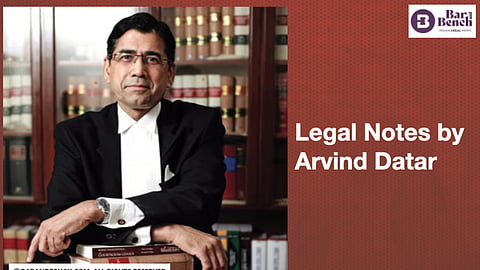
Arvind P Datar is a Senior Advocate.