
Subscribe
Subscribe
- Latest Legal News
- News
- Law Firms
- Columns
- Interviews
- Law School
- Legal Jobs
- हिंदी
- ಕನ್ನಡ
Over the course of its 76-year long history, the Supreme Court of India has passed umpteen legally incorrect and morally unacceptable orders.
Many a time, the Court itself has criticised its past verdicts as being incompatible with constitutional morality or as plainly atrocious, deserving to be "buried ten fathoms deep". Many such orders have been passed in the past decade and will eventually be overruled, sooner or later. Such is the nature of the Court (and the human beings that man it) - Supreme, but not infallible.
However, it is not often that the Court has been criticised for passing orders without hearing the affected parties.
That changed on March 11, when the Bench headed by Chief Justice of India (CJI) Surya Kant made scathing observations against three legal experts - Professor Michel Danino, Suparna Diwakar and Alok Prasanna Kumar.
They were the experts involved in drafting a chapter on "corruption in judiciary” in a Class 8 Social Science textbook released by NCERT.
According to the Court, the three do not have "reasonable informed knowledge about the Indian Judiciary and/or they deliberately and knowingly have misrepresented the facts in order to project a negative image of the Indian Judiciary to students of Class 8, who are at an impressionable age."
It thus directed the Union government and all States and institutions receiving government funds to refrain from associating with these three persons in any manner with the preparation of the curricula or the finalisation of textbooks for future generations.
The order does not give reasons on why the three have been visited with such a consequence. None of the three persons were heard before passing the order.
The legal principle of Audi Alteram Partem is one of the first things taught at law school. It ensures that no person shall be condemned unheard. The order by the apex court flies in the face of this core principle of natural justice.
Under the Indian legal system, punishment can be meted out only for a legal wrong, which has to be established after giving the concerned person an opportunity to present his case. In this case, the Court has not given any detail on what the charges were against the three to warrant a virtual debarment. If the punishment was for contempt of court, the contemnor has to be heard first by bringing charges and affording him an opportunity to defend himself.
The Supreme Court has bypassed these due processes built into the system.
Interestingly, the Court did not stop there. It also directed that action should be taken against "certain elements" on social media for "acting irresponsibly."
"It has come to our attention that after the order dated 26.02.2026 was passed, certain elements on social media have acted irresponsibly, while referring to the contents of the said order. We, accordingly, direct the Government of India to identify such sites/accounts as well as the persons running those sites/accounts and to furnish their full details to enable us to take suitable action. The law must take its own course," the Bench said.
It is not clear which platforms or individuals the Government of India should be identifying and what offence they have committed since "acting irresponsibly" is not an offence under any law.
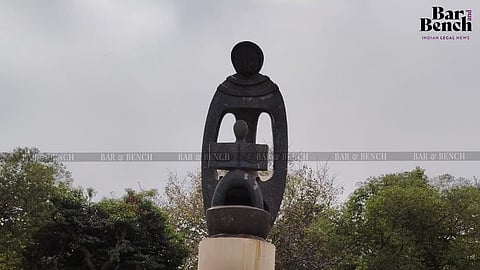
A sculpture in front of the Supreme Court building depicts a mother holding a child, symbolising Mother India protecting the Republic.
The Constitution envisages the Supreme Court as the guardian of fundamental rights, akin to a mother gently rocking the cradle in which the baby (Republic) sleeps.
The order by the top court instead attacks the fundamental rights of citizens.
It behoves the Court to bear in mind that the hand which rocks the cradle shapes the future.