
Subscribe
Subscribe
- Latest Legal News
- News
- Law Firms
- Columns
- Interviews
- Law School
- Legal Jobs
- हिंदी
- ಕನ್ನಡ
A bar association in India is a voluntary professional body of lawyers dedicated to representing members' interests, providing professional support and maintaining ethical standards. These groups act as unions for advocates in specific courts, offering networking and welfare benefits.
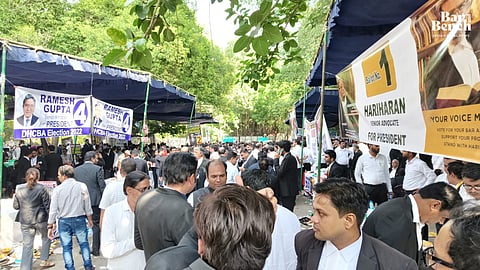
For Indians across the world, the month of March marks the end of the financial year. For lawyers, it also marks the end of the term of their respective bar association and the beginning of a new one. Year after year, Bar elections get more competitive, ugly in terms of money and muscle power and, I dare say, unnecessarily frequent.
The exercise of having annual Bar elections keeps the entire process in constant campaign mode. A new executive body assumes office and preparation to contest the next election begins almost immediately. The fundamental question that arises is do bar associations need to have a term of only one year?
What exactly can an office bearer elected even do in one year? When candidates campaign for their candidacy, they promise big reforms like pay parity for junior lawyers, infrastructure facilities which have not cleared since decades, better welfare programs, more parking facilities in court premises. But what is the strike rate of candidates being able to deliver on these promises in a period of one year?
For stable growth of the Bar, elections across the country should have a term of 2 years. The Institution of Chartered Accountants of India (ICAI) has its Central Council election every 3 years. Our bar associations can perhaps borrow this concept from them.
At first, a term of 2 years would allow a candidate who has won to implement his long-term vision for the Bar. In the whole year, courts functions for somewhere close to 190 days. This is certainly not enough for a candidate to implement long-term infrastructure projects, something which is promised every year to the Bar but is not delivered to for multiple terms. To get required permissions from government authorities to implement infrastructural projects itself takes months, sometimes years. When members of the Bar see that the promises made are way beyond the scope of implementation, they lose faith in the candidate and the overall election process.
A second issue is that as a yearly cycle of the election ends, the candidate who could not secure the required numbers to win already prepares for the next year’s election. The amount of time, effort and money put into the entire campaign seems to be not just for the current year, but also for the subsequent year. The amount of spam calls, messages, letters of appeal that members of the Bar receive makes them wonder if they should really share their personal details like their phone number and office address with the association.
Rule 17 of the Rules and Regulations of the Supreme Court Bar Association (SCBA) Rules read as under:
“17. The Office-Bearers of the Association shall be elected by secret ballot and the other members of the Committees shall be elected by secret ballot by single distributive votes at the Annual Election. No office bearer or member of the Committee shall be eligible to hold any office for more than two consecutive years. Canvassing in any from on the date of polling is prohibited.“
The SCBA has a term of 1 year for its office bearers, but the fact that they have a cooling period after a second consecutive term makes the candidate work first towards his election to the SCBA. The focus on welfare measure for the Bar is overshadowed by the lure to seek a second term to get re-elected.
A third issue is the cleanliness and hygiene of our court premises. Posters, banners, campaign slogans and manifestos stuck throughout the walls of some of our heritage courts degrade them. Though multiple guidelines, warnings are requests are made to candidates not to damage court property, no heed is paid to the authorities issuing them. Months after the elections, posters continue to remain stuck on the walls or torn in the shabbiest manner. As guardians of the Constitution, we sometimes just keep something as basic as our civic sense at the back of our minds.
A fourth issue is the functioning of the court being affected. On the day of the Bar election and even the days leading up to it, court functioning is affected as lawyers are campaigning, unable to appear for matters and dates are given in matters. Benches sometimes rise early as lawyers either take dates or do not appear in matters. In the already debated number of working days of courts in our country, this only reduces the days of effective working.
A two-year term will not only streamline a lot of processes at the Bar, it will also help lawyers get a stable association, one in which they can place greater confidence and participate more meaningfully. Upholding the high standards of the profession is one of the cornerstones of bar associations. To do so, a consistent growth-oriented approach is necessary. The process to have a democratic and welfare-oriented association does not start and end with an election. It is a gradual process with elections being the cornerstone of the entire process. When members of the Bar come together with ideas, thoughts and plans for long-term progress of the Bar, only then will members of the Bar develop faith in the entire process.
A strong, democratic and stable Bar is not only important for the Bar and the Bench but for the litigating community of India to know that no matter what, the guardians of the Constitution of India will continue to protect their rights and remind them of their duties in India.
Shayan Bisney is an advocate practicing in the High Court for the State of Telangana and the Supreme Court of India.