
Subscribe
Subscribe
- Latest Legal News
- News
- Law Firms
- Columns
- Interviews
- Law School
- Legal Jobs
- हिंदी
- ಕನ್ನಡ
In 2014, the Supreme Court delivered its landmark judgment in NALSA v Union of India, recognising transgender persons as a distinct gender category and affirming that gender identity lies at the core of personal autonomy and dignity. The Court held that every individual has the fundamental right to determine their gender identity and directed the State to take legislative and policy measures to protect the rights of transgender persons.
Parliament responded with the Transgender Persons (Protection of Rights) Act, 2019 which prohibited discrimination against transgender persons in education, employment, healthcare, housing and access to public services. It required governments to formulate welfare schemes for their inclusion in society.
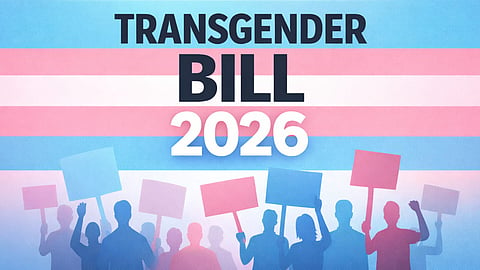
However, the Transgender Persons (Protection of Rights) Amendment Bill, 2026 introduced in parliament earlier this week proposes a fundamental shift in this framework. At its core is a new definition of “transgender person”.
Under the existing law, the definition is broad: it covers anyone whose gender does not match the gender assigned at birth, including trans men and trans women (even without medical procedures), persons who are intersex and genderqueer and those with socio-cultural identities such as hijra or kinner. The amendment replaces this with a much narrower formulation. It limits the category to persons with biological inter-sex variations, those belonging to certain socio-cultural communities and those who have been forced or deceived into assuming a trans identity. Crucially, it adds that the definition shall not include persons whose identity as a transgender person is based only on self-perception.
The accompanying Statement of Objects and Reasons explains the logic. The purpose of the Act was always to protect only those transgender persons who face severe social exclusion because of biological characteristics or entrenched socio-cultural identities - conditions that arise “for no fault of their own and no choice of their own”. Individuals whose identity is based purely on self-perception, the Statement suggests, fall outside this ambit.
This reasoning is constitutionally suspect for several reasons. First, it directly conflicts with the judgment in NALSA. The Court explicitly held that gender identity is rooted in an individual’s deeply felt sense of self and cannot be conditioned on medical procedures or biological characteristics. Self-identification was not a peripheral element of the judgment; it was central to it (see paragraphs 74 and 76).
The Bill also operates retrospectively. The amended definition states that the term “transgender person” shall not include, nor shall ever have been considered to include, self-identifying transpersons. In principle, parliament can enact retrospective legislation in limited contexts but retrospective changes to rights-conferring statutes create obvious difficulties: people organise their affairs based on the law as it exists. In such situations, legislative drafters usually include transitional provisions clarifying the consequences of retrospectivity. No such provision exists in this amendment. Under the 2019 Act, many self-identifying transgender persons might have already obtained certificates of identity. If the law now excludes them, the amendment should clarify what happens to those certificates. Parliament could choose to keep them valid, or withdraw them altogether. The Bill must do one, but it does neither. This is poor legislative drafting and risks creating uncertainty for both administrators and beneficiaries.
Third, the policy justification offered in the Statement of Objects and Reasons - that rights-based legislation cannot allow individuals to “acquire” the status that entitles them to those rights - is conceptually flawed. In fact, most rights-conferring statutes operate precisely in this way. Consider the Special Marriage Act, 1954. It confers a set of legal rights and protections on spouses. Individuals acquire those rights by choosing to marry under that legislation. Or take the Citizenship Act, 1955: the rights associated with obtaining Indian citizenship become available to those who choose to obtain it through the procedure under the Act. In both cases, individuals voluntarily assume a legal status that entitles them to rights and privileges. There is nothing unusual or legally incoherent about such frameworks.
Next, the 2019 Act does not merely create welfare schemes. It also establishes baseline protections against discrimination in education, employment and access to public services. Further, it imposes obligations on governments to facilitate healthcare access, including counselling, gender-affirming medical care and insurance coverage for related treatments. If the concern was that certain welfare benefits should be targeted towards those facing the most severe forms of structural disadvantage, there were less drastic ways to achieve this.
In Chapter IV of the Act, which deals with welfare schemes, governments could have been empowered to design schemes only available to sub-classes within the transgender community - those whose identity is biologically or culturally determined. Instead, the amendment removes self-identifying transgender persons from the statute altogether. It throws the baby out with the bathwater. Even basic protections - such as that against discrimination and the application of newer offences proposed by the Bill - are no longer available to transgender persons who self-identify as such.
The Bill also proposes to delete Section 4(2) of the Act, which currently recognises the right of every transgender person to a “self-perceived gender identity”. That provision was the statute’s clearest reflection of the principle articulated in NALSA. Even if the provision is deleted, the constitutional position does not disappear. The NALSA judgment continues to stand. Individuals remain free, as a matter of constitutional right, to identify their gender.
Aditya Prasanna Bhattacharya is an LLM student at the University of Cambridge.
Swapnil Tripathi leads Charkha, the Constitutional Law Centre at the Vidhi Centre for Legal Policy.