
Subscribe
Subscribe
- Latest Legal News
- News
- Law Firms
- Columns
- Interviews
- Law School
- Legal Jobs
- हिंदी
- ಕನ್ನಡ
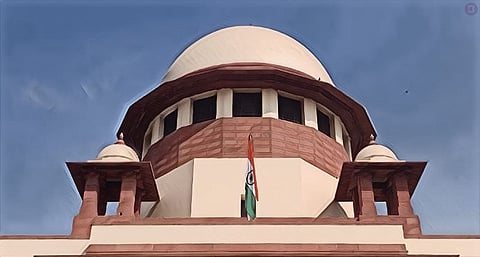
The Supreme Court of India on February 11 issued a circular asking building users not to chew pan masala or tobacco and spit the residue in washbasins, wall corners and drinking water areas within its premises.
The communication, issued by the Administrative Branch, came after instances of spitting inside the Court complex led to blockages and hygiene concerns.
The apex constitutional court of a billion-plus citizens, custodian of fundamental rights and arbiter of federal tensions, had to formally circulate a reminder that indoor plumbing is not a collaborative art project.
One must admire the administrative composure. While Constitution Benches wrestle with questions of democratic structure and individual liberty, somewhere in the same building a quieter constitutional crisis was unfolding - the gradual weaponisation of gutka, one mouthful at a time.
The Republic, it appears, is many things. Hygienic is aspirational.
It is not for lack of law. Across municipal statutes and state enactments - from the Bombay Police Act of 1951 to the Tamil Nadu Prohibition of Smoking and Spitting Act of 2002, spitting in public spaces is expressly prohibited and punishable with fines.
The Kerala Police Act goes further and contemplates penalties for making public places dirty by spitting. During the pandemic, even the Disaster Management Act of 2005 briefly joined the effort, elevating expectoration into a matter of national discipline.
The statute books have long spoken. The sinks and walls however, remain unconvinced.
India’s relationship with paan and gutka, after all, is not merely consumptive; it is expressive. Red streaks on stairwells, government buildings, railway platforms and office corridors have long functioned as an unofficial public art movement - spontaneous, decentralised and admirably bipartisan.
No region claims monopoly. No ideology dissents. It is perhaps the closest the Republic has come to a truly pan-Indian consensus (pun intended).
The aesthetic requires no budgetary allocation, no urban planning clearance, and certainly no cultural policy. It thrives in the absence of oversight. Walls become canvases. Corners acquire character. Public infrastructure is gently reinterpreted through a reddish tint of civic confidence.
It has endured municipal drives, cleanliness campaigns and stern signage requesting restraint. It has survived Swachh Bharat slogans and laminated warnings. It has outlived bureaucratic optimism.
The aesthetic has travelled across cities, across institutions, across decades - scaling ministries, staining court complexes, and occasionally asserting itself in spaces otherwise reserved for solemn constitutional introspection. It was perhaps only a matter of time before it sought admission to the country’s highest constitutional court.
People here are not wayward tourists. These are lawyers, officials, litigants - individuals capable of citing precedents with Latin flourish.
And yet, the washbasins have apparently been drafted into involuntary public interest litigation.
The Court continues to defend dignity, liberty and fundamental rights. It would now also like its sinks to survive. Zero civic sense. Full constitutional access. And somewhere, a drain awaits justice.
It would be easy to laugh, and social media has, with the now-immortal phrase “zero civic sense” doing the rounds with predictable relish. But the humour carries an aftertaste. If the Supreme Court must intervene to protect its washbasins from collateral damage, one shudders to imagine the fate of less constitutionally protected spaces.
The Court, notably, did not treat the sinks as a matter requiring judicial wisdom. It did not philosophise about rights and duties. It merely acknowledged, with bureaucratic dignity, that even the most exalted institutions remain vulnerable to the most pedestrian habits.
Which brings us, inevitably, to the larger constitutional truth that no Bench, however erudite, can adjudicate away.
Because somewhere between the washbasin and the wall corner lies a truth that no bench can overrule - institutions can uphold the Constitution but they cannot manufacture civic sense.
[Read Circular]