In Conversation with Bharti Airtel Group General Counsel Vidyut Gulati on Telecom Regulation, AI and the GC's Evolving Role

Gulati speaks about structuring a legal function for a large conglomerate, the endeavour of keeping legal work in-house, how AI is already changing legal work at Airtel and more.
Vidyut Gulati
Vidyut Gulati
Published on
9 min read
Listen to this article

Vidyut Gulati is Group General Counsel & Director Legal for the Bharti Airtel Group. She joined Bharti Enterprises in 2017 from Cairn Oil and Gas - where she was General Counsel and Member of the Executive Committee - and previously served as a Partner at Shardul Amarchand Mangaldas & Co. 
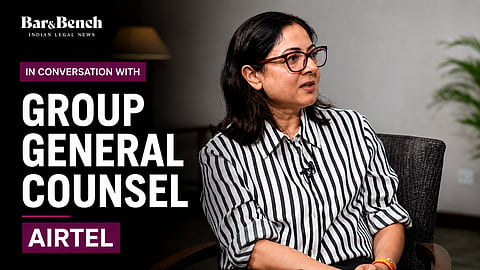
In conversation with Bar & Bench's Pallavi Saluja, Gulati speaks about structuring a legal function across telecom, infrastructure, financial services and real estate, the endeavour of keeping legal work in-house, how AI is already changing legal work at Airtel and more.

[Watch Interview]

Edited excerpts follow.

Pallavi Saluja (PS): You've had quite a journey - starting from a law firm, moving to an in-house role and now with one of India's biggest conglomerates. What drove each of these shifts for you?

Vidyut Gulati (VG): I think it was quite organic. It just unfolded without a whole lot of planning at my end. My foundational years were at law firms and that was intentional, because as a fresher starting off, the learning is immense. People really take the time to teach you. You're exposed to a wide variety of different sectors on an agnostic basis, different kinds of domains.

I began to feel I wanted to do a little bit more. Most of my decisions were driven by my requirement to add value. I just felt at that point in time when I moved in-house, I wanted to do something new. Being closer to business was something which perhaps drove me and it has turned out like that. Just being able to see that side of business with that level of proximity has really changed me as a professional.

PS: Did your perspective of a law firm change once you came to the business side of things?

VG: Absolutely. I started appreciating commercially-minded lawyers a great deal more. Throughout your law firm journey, you're told that theoretical responses don't work and that clients don't want to be told what the statute says, and you should find commercially viable, balanced legal solutions. That point became so much more real to me once I was on the other side. It's why you genuinely value external counsel who understand your business and can offer practical solutions, not just legal ones.

PS: You joined Bharti in 2017 as Director Legal and then took on the role of Group General Counsel in 2021. How did your mandate change once you reached the group level?

VG: For me, it was not so much designation-driven, but more the profile. When I joined the Bharti Group, I was focused on the Chairman's office, so we were looking at many of the strategic transactions and a lot of Africa-driven work, which was more in line with my core experience in M&A, fundraising and the like. So it was very exciting, but more of the same as what I'd done previously.

The shift to the Telco proper - and then across the various businesses under the Airtel Group - meant something quite significant for me: as a transactional corporate lawyer, I had to pivot to litigation, which was really interesting and a bit of an uphill task. If you're a corporate lawyer just switching to litigation at that particular stage, it is challenging, but very invigorating. Learning the entire litigation landscape while managing strategic litigation has been very exciting and rewarding.

Then of course the larger businesses under the Telco itself. We're diversified into various areas, which brought its own nuances. Being in a legacy sector, we do have a lot of long-standing litigation that is critical. A lot of my time does go into that.

PS: Like you said, Bharti operates across telecom, infrastructure, financial services and real estate. How do you structure the legal function across such verticals?

VG: To a great extent, we have fairly mature legal teams across the board. Of course, for newer businesses, we're developing new teams. For example, we have specialised counsel for out data centre, as we do for the NBFC now. Real estate is a relatively mature business; we have a legal team for that. It's more about integrating the teams across the horizon for us, which is where we play more of a role in making sure that there's uniformity in how we approach our business in general. It's really on the emerging businesses side where one gets the opportunity to rebuild.

PS: How large is your legal team? Do you have legal heads for each business unit?

VG: At Airtel center, I have a team of about 25 to 26 odd people. Since we're pan-India, we have a wider legal and regulatory team which constitutes about 40-plus professionals who play a dual role. They also liaison a lot with the teams in various circles and they also act as the legal team.

We do have circle legal heads, if the business is big enough. Like for real estate, they have their own General Counsel. We have a corporate legal team, which is separately headed. We do have a person in charge for Nxtra, which is our data center. But for some of the smaller areas, it's integrated into the broader Airtel legal ecosystem.

If I had my way, I would like to internalise a lot. By and large, the days when everything was pushed out are gone.
Vidyut Gulati

PS: How do you decide what to keep in-house versus what goes to external counsel?

VG: That's a very interesting question. If I had my way, I would like to internalise a lot. By and large, the days when everything was pushed out are gone. You come across some deeply empowered, business-integrated legal teams across major groups and that is very much the model we aspire to. So the endeavour is to internalise everything.

A large part of our contracts mechanism is internalised. Even in litigation, the briefing counsel play a key role, the internal teams are expected to be well-versed in the business side, but also in the legal arguments that we need to ensure are presented in court. Generally, in the Bharti Airtel ecosystem, you'll see a very high degree of ownership and I think that spreads across the legal ecosystem as well.

Of course, there'll be areas where we do need to go external when it's specialised advice or specifically with litigation in certain aspects.

When it comes to selecting external counsel, it's largely driven by experience and merit.
Vidyut Gulati

PS: How do you pick your external counsel or the law firm you're going to work with? Do business folks or management get involved in that decision or is it left completely to you?

VG: It's by and large the legal team's call. It's in our DNA to move really fast. So what happens is that if past transactions have been done with certain law firms, there's that natural inclination even from the business's perspective that let's just go with whom we worked with previously.

When it comes to selecting external counsel, it's largely driven by experience and merit. We do need someone who will prioritise us; we need a partner who's aligned to that way of thinking. Access and availability are also factors that make a big difference. Usually, we are open to diversifying our work; it's about who's the best person in the market to get the deal done.

In Conversation with Vidyut Gulati

PS: Bharti Airtel is a big telecom company. How do you manage regulatory risk?

VG: Telecom as a sector is so heavily regulated and we've been around for so many decades that we've evolved with the regulatory framework, with the economic framework. If you look at how infrastructure in India has developed, I think Airtel has played a very dominant role in developing the backbone of the economy. During COVID-19, the fact that the lights were kept on, everybody was working from home, one didn't realise how important a role this was.

There are also certain things that are past issues and we're going about that as best as we can in terms of how we build mitigants. There's a lot of focus on having an active regulatory dialogue, which is around when the new legislation are being framed - whether it's the Digital Personal Data Protection Act (DPDPA) or the new Telecom Act itself - being able to present our perspective, making sure that the laws also facilitate business from that perspective. I think that's been a very constructive dialogue, having brought that industry perspective into the new legislation so that you minimise regulatory issues going forward, to the extent you can.

I'm sure there will be issues as these laws play out, but I think the focus is trying to see how can you minimise the friction and work. The focus has to be on working together and facilitating business. That's how we look at regulatory risk.

PS: How is Bharti Airtel adapting to new-age regulations, AI, cybersecurity, data protection, etc?

There is active engagement with regulators at the industry level on how implementation should be approached.
Vidyut Gulati

VG: Those are very high priority areas for us, given the kind of business that we're in – cloud security, data centers, the kind of data that we have. We're very conscious of our obligations and from an industry perspective, there are a lot of conversations about how implementation will be undertaken. The aim is to abide by the letter of the law while also ensuring it's a balanced approach.

There is active engagement with regulators at the industry level on how implementation should be approached. There's a fair amount of dialogue, discussion and time we're spending on building the ecosystems to make sure we achieve compliance and balance business requirements.

PS: Is the legal team using any specific legal AI for their work?

VG: Yes. Given the wider ecosystem we operate in, we would be laggards if we weren't. There is a natural push from the legal fraternity - including from law firms that are early adopters - and that is encouraging. Internally, whether it's the IT team or our various other businesses, AI is such an integral part of what is required.

There's a lot of focus on legal AI. We are currently using a couple of service providers, specifically on the contracts side. On litigation, we're still a little wary because there are still glitches around that. The idea is to try and bring in AI and automation to the extent we can. Tools like Provakil, compliance management platforms and IP tracking tools have been genuinely useful in reducing manual dependency. Automation does not eliminate the need for human oversight, but it adds a significant layer of efficiency.

I think we're yet to see the benefits of AI trickling down to the consumers. You're not seeing the legal fees change dramatically, but I'm hoping it's a matter of time. It's one of those things you have to embrace wholeheartedly. We're on our path in terms of an internal legal team, but we're also in an ecosystem that is developing. I am very much in favour of adopting AI as much as we can carefully, with caution.

PS: Do you use it in your work?

VG: I try to. I'll be honest - some of my team members keep me on my toes. They're already producing NotebookLM videos explaining concepts like indemnity and sharing them with the business teams. I find that quite useful - it cuts down the time we would otherwise spend on training. So yes, I use it, but my team is frankly doing a better job of it than I am.

Whether you're joining the legal team or any other function at Bharti Airtel, there are certain core qualities we value: customer obsession, curiosity, an entrepreneurial mindset and a sense of ownership.
Vidyut Gulati

PS: What qualities do you look for in young lawyers who join the company?

VG: Whether you're joining the legal team or any other function at Bharti Airtel, there are certain core qualities we value: customer obsession, curiosity, an entrepreneurial mindset and a sense of ownership. At the end of the day, for any fresher joining, it's about hard work and ambition. It's about how much you're willing to put in. I think the foundational years are so critical; it's the time when you're like a sponge, you're just absorbing everything. The more you're willing to stretch yourself, it goes a long way. Those are genuinely the qualities I look for specifically when we're hiring not just in freshers but at every level.

There's a very high degree of ownership. That truly embodies the Airtel spirit and, to a great extent, that's the mantra we all live by - in legal, in IT, in regulatory, across the board.

PS: Do you go to law schools to hire directly, or do you prefer experience?

VG: We are beginning to do some of that now. Typically, we have hired at the mid-level - like 5-7 years of experience and above - but we are starting to look at earlier-stage candidates and direct law school recruitment as well.

PS: As one of the most prominent women General Counsel in India, what has your experience been navigating leadership in traditionally male-dominated field?

VG: I always say this. Coming from a law firm background, it doesn't strike you as much because you're surrounded by such strong female leaders, such strong female counsel that it doesn't stand out. Yes, moving in-house, there was a bit of a shift, but there's a lot of focus here as well on diversity. You'll see women leaders being consciously brought in at various levels. It's also the culture. I may or may not be the only woman in the room, but I'm never made to feel like it. You can be sitting at every level; it's about the value you're bringing to the table, it's about the conversation you're contributing to. It's really not about anything else.

There is a need to ensure we have a diverse workforce, not just gender-wise. I think beyond a point, it really becomes more about your own qualities and what you're contributing. I have been fortunate enough to be in an ecosystem that supports that. I hope that's something that we can evolve and continue to extend.

Also Read
Bharti Group General Counsel Sameer Chugh leaves, Vidyut Gulati, General Counsel & Director Legal, Bharti Airtel takes over for the group
Vidyut Gulati
Bar and Bench - Indian Legal news
www.barandbench.com