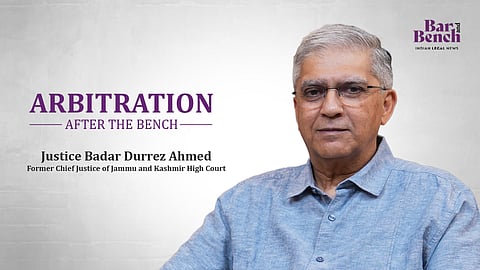

A Section 34 petition is meant to test an arbitral award for limited, defined grounds, not to relitigate it. Justice Badar Durrez Ahmed, who spent 15 years on the Delhi High Court bench hearing exactly such petitions, says the Supreme Court's appetite for detailed reasoning pushed High Court judges to go issue by issue through arbitral awards, regardless of merit.
In this interview with Bar & Bench's Debayan Roy for Episode 4 of After the Bench, Justice Ahmed, now one of India's busiest arbitrators, goes on to call Section 34 a disguised second appeal in practice. He also criticises the composition of the proposed Arbitration Council of India and reveals how he uses AI in his awards.
Edited excerpts follow.
Debayan Roy [DR]: You spent close to 15 years in the Delhi High Court handling one of the most commercially active dockets. Then you retired and became an arbitrator. What did you discover about commercial disputes the moment you sat on the other side of the equation?
Justice Ahmed: When you are a judge in the High Court and you are looking at commercial disputes, things are pretty much baked in by that time. Whereas when you come into arbitration, it's like you are doing original side work once again and everything starts from the very beginning. So that is a major shift. In one jurisdiction, you have a review or appellate jurisdiction, whereas in arbitration it's purely original jurisdiction and it's purely focused on commercial matters. There is not really much of a qualitative difference in appreciating the substantive law, but there is a huge difference in quantitative terms. You have to do a lot of fact marshalling in arbitration, which is not the case when you are sitting as a judge.
DR: The critics of the retired-judge arbitration model in India say that former judges run arbitration proceedings like court proceedings but without the institutional checks. Is that a fair criticism?
Justice Ahmed: First of all, I don't know what you mean by institutional checks, because as a judge, what kind of an institutional check do you have? You only have an appellate authority, that's the Supreme Court, which is the same here. You have a Section 34 or a Section 37 appeal and then the Supreme Court, SLP stage. But the procedures or methodologies of arbitration and court litigation are two different things. If you want to follow the real formalised procedures of court, then of course it's not a very healthy thing in arbitration.
But if you want to adopt your own procedures and try to cut short the entire arbitral process, which you have the freedom to do under the Arbitration Act, then that's the way to go. The criticism is right: if you continue with the baggage of the court and adopt the same system, you might end up basically replacing a courtroom with an arbitration room.
DR: India has been trying to become a credible arbitration jurisdiction for close to 30 years. We have built institutions, we have produced pro-arbitration Supreme Court judgments and yet sophisticated parties with real money at stake still choose Singapore or London. What are we actually getting wrong?
Justice Ahmed: We do not have a court system which supports arbitration, in the sense that there is a lot of interference with arbitration awards and arbitration processes, as a result of which there is a lack of certainty. That does not happen in Singapore or London. Looking at it from the point of the litigant, his interest is not in getting an award. His interest is in getting the money that is given in the award.
Once an award is passed, it goes through an entire court system once again in three tiers - single judge, division bench, Supreme Court and now review and curative as well. The DMRC is a big example here. That prolongs the whole process and it is counterproductive to ADR.
DR: So you are saying that judicial interference is acting to the detriment of the process. What is the way out?
Justice Ahmed: The way out is for the judges to realise, for the courts to realise that once you have gone to a chosen forum, unless the award is absurd to a common, normal individual and is perverse, you don't interfere.
DR: But isn't that subjective, as to whether something is perverse?
Justice Ahmed: No, I think the judges are well-trained. They can differentiate between what is perverse and what is not perverse. They have been lawyers for 25 years; they know what it is. The solution is for the judiciary to adopt a policy not to reappraise the whole thing. I am not blaming the High Courts; it's the Supreme Court that really puts pressure on High Court judges to look into every detail of the award. If the lawyer challenging the award is not able to present a credible challenge to an issue decided by the tribunal, what is the point of going into it in detail all over again, through Section 37, through an SLP? They want the High Court to give detailed reasons for whatever they are saying. There is pressure, and I am not blaming the High Court judges for it.
DR: In your own career of 15 years in the High Court, was there any point where you felt that pressure from the Supreme Court?
Justice Ahmed : Sometimes you do feel that you have to give reasons unnecessarily when there is no reason for giving any further reasons.
DR: Has Section 34 effectively become another Article 136? Because whatever the reasoning, it's so widely worded that having another shot at it basically becomes an appeal.
Justice Ahmed: Because it's so widely worded. Having another shot means basically you are having an appeal, whereas it's not an appeal, it's a petition. It should never be seen as an appeal.
DR: Delhi is theoretically India's premier arbitration seat. It has the New Delhi International Arbitration Centre, it has the Delhi High Court which has the most commercially active docket, it has the most trained intellectual bar in arbitration. But if you are a foreign company contracting with, say, an Indian infrastructure giant, the arbitration clause certainly does not say India as a seat or Delhi as a seat. Why not, and whose fault is this?
Justice Ahmed: There is a larger system to it, in the sense that we don't have a purely dedicated arbitration bar. There are lawyers who are part-time in court and part-time in arbitration. We must develop a totally dedicated bar for arbitration, specialists who know the subject. The second is that in the courts itself, more time is taken once the award is finally a decree, even after the Supreme Court, to execute it. The litigant is not interested in what you write, he is interested in what he gets. And if it takes him 10 years to get it, what's the point?
DR: Emergency arbitration has become standard practice in London, Singapore and at the ICC. India has been slow to recognise it. Is there a principled reason to be cautious, or is this simply institutional conservatism?
Justice Ahmed: I think it's the latter. There is no reluctance as such, but we have been built on the system of full-fledged litigation, so we don't want to go in for a shortcut. For example, there is a huge construction contract dispute and we tell the lawyers, let's forget about oral evidence, let's get on with final arguments straight away. On one side, you have a public sector, on the other a private sector and huge stakes. Public sector lawyers will usually be very cautious; they don't want to get the blame for not going for oral evidence if they lose.
There is this conservatism which is still holding us back from fast-tracking arbitrations. The other thing, to be very frank, is that many arbitrators feel that if you fast-track it, you get nothing out of it, and at the end of the day you still have to write the same huge award, which takes a hundred to a hundred and fifty hours. Writing of the award is one of the most difficult and most time-consuming things that people don't realise.
DR: If a party came to you as an emergency arbitrator needing an order before a transaction closes the following morning, do you have the powers under current Indian law to actually help them?
Justice Ahmed: They can. If it's a prolonged arbitration, ask for a Section 17 order. But if both parties want to come to me and say, please decide by tomorrow, one way or the other, it's for them to give me that jurisdiction. I can do it. It's all in the agreement. They can even agree for a non-reasoned award. Nothing prevents them, unless the parties bestow that authority on me, the Act otherwise requires reasons.
DR: The Indian arbitration market is dominated by a relatively small group of retired senior judges and a handful of senior advocates. Critics say this has produced a concentrated market with high barriers to entry and fees that bear little relationship to the complexity of the dispute. Is that criticism fair?
Justice Ahmed: To a certain extent it may be fair, but I never refuse any court-ordered or court-directed arbitrations, whatever the stakes may be. Sometimes you get very low-value disputes which are highly complex and you can have a very high-value dispute which is very simple, involving just one question. So it depends from matter to matter and the fee structure ultimately averages out. Sometimes you do a low-paying case directed by the High Court - I never refuse that - and it may be a very complex thing, and I may spend much more time on it than on a high-value case requiring only one issue to be decided.
DR: As an arbitrator, where do you draw the line between respecting what the parties agreed to and protecting what the law requires?
Justice Ahmed: Whatever matter comes before an arbitrator or an arbitral tribunal has to be decided within the four corners of law, that's the substantive law of the land. But within those four corners, there is a lot of elbow room which party autonomy can grant to the arbitrator. Procedure is one aspect where the tribunal is in total control. If the parties agree, things can be sped up and simplified. Party autonomy, if I would say, is the sine qua non of arbitration.
DR: : One persistent criticism from foreign parties and counsel is that the evidentiary phase in India is managed too much like Indian court proceedings. Is that fair? And what powers do you actually have to manage evidence efficiently?
Justice Ahmed: The criticism is fair. We do spend a lot of time in recording of oral evidence. In most of my cases, I tell them - everything is documentary, why do you need oral evidence at all? If there is any gap, you can use interrogatories. It has worked many times. But some lawyers insist on oral evidence and they are bound by instructions and probably can't override them. One way out, which I have found, is real-time transcription, so that long-winded cross-examination going on for days and days ends. Just recently, we had a matter in which counsel said he would take 5days to cross-examine. I said, alright, but we will use transcription. And in 3 sessions, it was over.
He couldn't ask any more questions. Because it was real-time, he had to be quick about it. It helps the clients but it may not help the lawyers. They agreed to it. It is happening now more and more frequently. Some of the younger lawyers themselves are suggesting it. Earlier, it was very expensive because people used to come from London or Singapore or Hong Kong, but now it's within India itself.
DR: Parliament legislated the Arbitration Council of India into existence in 2019. The enabling provision sat unnotified for about 4 years, the Council was never constituted and in January 2025, the Supreme Court had to nudge the government on it. What does that silence tell you about how seriously the executive takes its own arbitration reform agenda?
Justice Ahmed: I think they have legislated, but they have not put it into action, as of now. There may be serious concerns about the gradation of institutions and arbitrators. One of the biggest problems in India is subjectivity. How do you grade an institution A above institution B? How do you grade an arbitrator A above an arbitrator B? That subjectivity, if it comes in, will do more damage than good for the system. Unless and until I study it in depth and see how the gradation is to be done, I have a problem with it, because it can lead to very incongruous results. A useless institution may be graded as number one. Then what happens? It brings a bad name to the country and that's the end of the whole system.
DR: The government is India's largest litigant in arbitration, yet the ACI gives the government dominant control over its composition. Singapore's model works precisely because the government does not control SIAC. Is India trying to build a regulator structurally incapable of earning the confidence it is supposed to generate?
Justice Ahmed: I would agree with you on that, because such a body should be autonomous and should not be aligned to any party. The government is the biggest litigant; it should not have any say in the matter. Why not have a committee instead, let it regulate. Why should one of the litigants in the big high-stakes matters be the controlling power there?
DR: You have been in the law for over 40 years. If you could change one thing that would genuinely transform India's arbitration landscape, what would it be?
Justice Ahmed: I think the most important thing would be procedure. We have to cut down on procedure, whether before the tribunal, before the court, or before the executing court. Procedural delays have to be cut down.
DR: And the one thing you are most pessimistic about, the thing you believe will not change regardless of what any amendment says?
Justice Ahmed: We are not professional enough. That's the problem. Lawyers taking adjournments, that's unprofessional, unless some huge calamity has come upon someone. It doesn't look like changing in the near future, unless... it's all parts of a jigsaw puzzle, and one of the most important parts is to have a dedicated arbitration bar.
Suppose I fix a matter for Thursday, Friday and suddenly I'll get an email saying there's a matter fixed before the Supreme Court tomorrow, so please adjourn. In deference to a hearing before the Supreme Court, we do adjourn. What can we do about it? But if it was an arbitration-focused lawyer, probably that wouldn't have happened. That cuts delays. Some lawyers are professional about it and say, no, I've got a hearing fixed tomorrow, I won't take up that brief.
DR: You spoke about using artificial intelligence tools yourself. How does that fit into how you work today?
Justice Ahmed: Claude is there, I have ChatGPT. Coders are all going out of business because everything is being coded by AI. I use a lot of technology. Some awards are being said to be written by AI. That is bad. If an entire award is written by AI without any supervision, that's not right. But help can be taken. I always regard AI as an assistant.
Suppose you get a written submission of 300 pages, you want a quick overview. So you just say summarise and you get that summary and then you go into the depth of each portion. AI is very good at pointing out mistakes for arbitrators, if there are repetitions. For judges and arbitrators, I am giving them a secret: if you want your judgments and awards to be foolproof, run it through AI and say find out mistakes, errors of logic and reasoning and it will point it out to you. I do that, because I don't want any mistakes to remain. And never allow AI to go beyond what you are providing it.
Prompting AI is one of the most important things. You can't say: here are the documents, please write an award and treat that as your award. The decision is yours, it can only be used as an assistant. And it is bound to happen. Lawyers are using it every day. Just the other day, in a very highly contested matter, one of the lawyers told me - why don't you use Claude, because I am using Claude and it's very good for lawyers. I use it sometimes, to summarise, to help aid. They said it's better than ChatGPT, but I don't know that, I haven't compared them.