
Subscribe
Subscribe
- Latest Legal News
- News
- Law Firms
- Columns
- Interviews
- Law School
- Legal Jobs
- हिंदी
- ಕನ್ನಡ
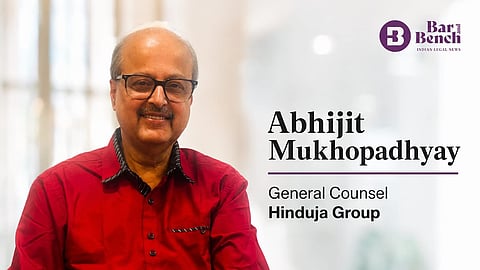
Abhijit Mukhopadhyay is President (Legal) & General Counsel at the Hinduja Group, based in London.
In this interview, Mukhopadhyay speaks to Bar & Bench’s Pallavi Saluja about building a legal career across borders, the challenging role of General Counsel, how pressure accelerates learning and why India is not yet ready to become a hub of international arbitration.
Edited excerpts follow.
Pallavi Saluja (PS): How do you define the role of a General Counsel today?
Abhijit Mukhopadhyay (AM): GCs are an integral part of the business. If the business grows, we grow. Our entire thought process should be centred on helping the business. If the business is indifferent to whether you exist or not, there is a serious problem. The role varies enormously - from organisation to organisation and from person to person. In some organisations, the GC is a central figure. Unfortunately, that is not the case for many others. When that is the case, the in-house lawyer has to expose themselves to the business, so the business starts coming to them for help.
Your acceptability is a combination of many factors. You may be deeply knowledgeable, but the business will say, 'I have no interest in your knowledge – tell me how you are going to help me.' Your ability to deal with people, to become their advisor and to earn their trust is reflected in your personality. I tell people that the best thing is to develop themselves as a brand. When we think of a brand, we think of certain qualities. Therefore, think in terms of the brand and try to see how you can invite those qualities.
PS: How big is your legal team at the Hinduja Group?
AM: I have around 10 heavily qualified people, all double-qualified across different jurisdictions. For me, numbers are not important. I have managed departments of 70-90 lawyers, and the larger the team, the greater the headache of managing people.
Beyond the internal team, I work with lawyers and law firms across jurisdictions. My external activities, such as speaking at conferences and participating in global discussions, have helped me build relationships with people and firms worldwide. If you tell me you have a problem in Lithuania, I know someone who can help! What is remarkable is that 90% of the advice I receive through these relationships costs nothing. Even large law firms provide it freely. It is built on trust and mutual respect, not on a transactional give-and-take.
PS: The Hinduja Group spans an enormous range of businesses. How do you manage the breadth of legal issues that crop up?
AM: It is extremely challenging. The subject matter of discussion will change every minute. Even with so much experience at the beginning, it was very difficult for me to manage because there are thousands of moving parts. When you are asked rapid-fire questions, you can’t say, 'I don't know, let me go and find out.' You have to be on top of everything. It is expected of me to give some general advice instantly.
What has helped me is my external engagement. I mix with people who know more than me and that is instant knowledge acquisition. I also accept speaking assignments on subjects I know little about, because that forces me to learn quickly. When I was asked to speak on the UK-India FTA with 7 days' notice, I had to immerse myself in the subject. My co-panellists were specialists who dealt with it daily. That kind of pressure accelerates learning. The knowledge may not always be directly applicable, but at some point in a business discussion, you can draw on it. The more you participate, the more you attend, the more you engage, the greater your knowledge base.
PS: The Bar Council of India has issued rules on opening the Indian legal market to foreign firms. What is your reading of the situation?
AM: That is not really opening up. There are registration fees and a foreign lawyer cannot stay in India for more than 60 days. How can you conduct an arbitration under those constraints?
The truth is that large foreign law firms have limited interest in entering the Indian market. They are experienced in international business on a scale that Indian firms are still building towards. But I have enormous faith in Indian law firms and their capabilities.
Look at what happened after 1991. There was enormous resistance to opening up. And yet, today, there are 956 Indian companies operating in London alone, employing 150,000 people. The Tatas are the UK's largest private employer. That happened because the market opened. Indians are a remarkable breed - if you allow them to grow, they will compete with anyone.
I have met many outstanding Indian lawyers. Herbert Smith Freehills is taking trainee solicitors directly from Indian law schools on training contracts. Allen & Overy is doing the same. That tells you something about the quality of Indian legal talent. We should not be afraid of opening the market.
PS: Which Indian law firms do you work with regularly?
AM: We work closely with Cyril Amarchand Mangaldas (CAM), Crawford Bailey, Trilegal, Khaitan & Co and Dentons Link Legal, among others. I do not have a fixed preference. We go to whoever has the right expertise for the problem at hand, regardless of firm size. It all comes down to quality, expertise and, of course, fees.
PS: And in the UK?
AM: Everyone. Lord Peter Goldsmith advises the Hinduja family. We work with Herbert Smith Freehills, Linklaters, Pinsent Masons, Osborne Clarke, Stephenson Harwood and many others. My advantage is that I know almost all of them personally. There is no fixed arrangement; we try to get the best out of each relationship
PS: What factors do you consider while deciding on external counsel/law firm and what do you expect from them?
AM: When engaging an external law firm, I usually look into the three Cs: Cost, Competency and Care. I expect the law firm to be competent enough in the chosen area of legal advice needed at a reasonable or flexible cost. They should provide advice in light of what the client wants and not the other way around. These are the fundamentals.
PS: How do Indian law firms compare with their US and UK counterparts today?
AM: They are more or less equal in terms of knowledge, dedication and professionalism. The one area where larger international firms still have an edge is international exposure; they have been in global business for decades. But the quality of lawyers coming out of the national law schools has transformed the profession. Things have changed enormously in the last 30 years.
PS: The General Counsel Association of India has been pushing for GCs to be recognised as legal practitioners. What is your view?
AM: It is a more complex question than it appears. If you are a legal practitioner, you are bound by Bar Council Rules. Our profession is currently unregulated; I can function as a GC without any formal code of conduct or ethics. If GC is to be recognised as a profession, it must be regulated. Calling yourself a legal practitioner without that framework adds little. I understand why the Bar Council is cautious. The deeper meaning of "legal practitioner" needs careful consideration.
PS: How do you see arbitration evolving in India and India becoming a hub for arbitration?
AM: I am not optimistic and I say this with regret. The problems are structural. First, we still have a cultural preference for litigation, for going to court and fighting. Second, arbitration in India has become an extension of court proceedings. We do not have specialist-sector arbitrators that mature arbitration centres have. That's why most of the time judges are there, and they think it is my court and operate it like such. Third, the infrastructure, the venues, the institutional support that places like SIAC and ICC have built simply do not exist here at that scale. India has MCIA, but by sitting in Mumbai, you cannot control the whole arbitration scenario. When Ravi Shankar Prasad was the Law Minister, he made a lot of efforts to make India an arbitration hub, but nothing worked out.
The Supreme Court itself created significant damage a decade ago by asserting the right to intervene in arbitral proceedings. That undermines the entire purpose of arbitration. Now, a new appellate authority is being created, adding another layer of complexity.
India is not yet ready for arbitration. Not because of rules or institutions alone, but because the culture is not there. At the back of our minds, we do not fully believe in it. Until that changes, the ambition of becoming a global arbitration hub will remain just an ambition.
PS: What is the biggest change coming for General Counsel in the next five years?
AM: The biggest challenge of future General Counsel will be to remain relevant in the profession by going out of the with 'out-of-the-box' thinking to help businesses to grow, while navigating through strict compliance regimes. Quite a hard task, but it is achievable by remodeling themselves.
PS: What advice would you give to younger lawyers considering an in-house career?
AM: Think about becoming a brand. Be dependable. When someone gives you a task, be the person who gets it done, no matter what it takes.
My daughter is a qualified solicitor at a large international firm in England. I told her: you have to be different. Recently, she was working until 1 in the morning to meet a deadline. I told her to do it - because that is how you build a reputation. People will see that she is dependable, that if you give her something, it will be delivered. Family will understand. That is how a profile/brand is built.
I have developed my team like this. I give them a problem and they say, 'It’ll be done, leave it with us.' I can spend another three hours with you. I know my team will be working. If there is something that should be done immediately, it will be done.