
Subscribe
Subscribe
- Latest Legal News
- News
- Dealstreet
- Viewpoint
- Columns
- Interviews
- Law School
- Legal Jobs
- हिंदी
- ಕನ್ನಡ
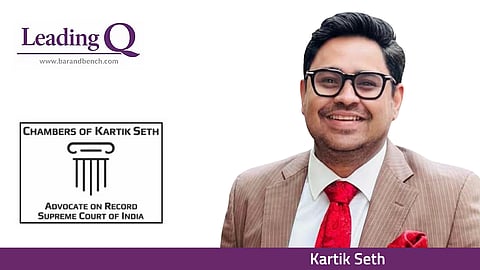
In this Leading Question piece, Kartik Seth reflects on the evolving regulatory landscape, and the role of law in shaping the country’s energy and mining sector.
Question: You have built a practice at the intersection of energy and mining law - two sectors that most lawyers treat as peripheral. What drew you to this space, and what does the India-specific landscape look like today?
Answer: My entry into this space was less by design and more by exposure. Early on, while working on matters involving State utilities and regulatory commissions, it became clear that energy and mining sit at the core of economic activity, despite often being treated as niche or overly technical areas.
That “technicality” is precisely where the real impact lies. Issues of tariff, fuel supply, regulatory assets, or mining linkages directly influence affordability of power, industrial growth, and public finances. That intersection of law, policy, and economics is what drew me in and kept me there.
Over the last 15 years, primarily in a Supreme Court–centric practice in Delhi, I have worked across constitutional, civil, and criminal matters, and appeared before multiple High Courts. That breadth helped me, but it also clarified where my interest truly lies.
For me, law is not meant to be tedious, but it is about clarity of interpretation and application of first principles. Energy and mining sector demand exactly that.
Today, the sector is at an inflection point. There is a strong push towards renewables and storage, but the system still relies heavily on conventional sources, particularly coal and mining-linked generation for grid stability. That tension between policy ambition and operational reality is driving most disputes today.
From where I sit, this is no longer a peripheral area but a centre to how infrastructure, investment, and governance are being shaped in India.
Question: With schemes like the PM-KUSUM Scheme pushing decentralised solarisation, how do you see their legal and regulatory impact- particularly in a state like Rajasthan?
Answer: PM-KUSUM marks a structural shift. In simple terms, it allows farmers to generate solar power on their land or pumps and sell surplus energy to the grid, turning consumers into producers.
Interestingly, this is one of the few models where farmers are willing participants in land use, as it creates a steady income stream without loss of ownership.
From a legal standpoint, decentralization introduces complexity around grid integration, tariffs, contracts, and payment security. The challenge is to ensure this transition strengthens, rather than fragments, the system.
Rajasthan’s progress has been notable, with policy intent matched by execution and the support of the bureaucratic leadership in the energy department.
The focus today is not just on renewable targets, but on integrating them in a manner that is reliable, commercially viable, and legally sustainable.
Question: With battery storage and hybrid projects gaining traction, are our frameworks ready for concepts like “firm and dispatchable power”?
Answer: We are in a phase where technology has moved faster than regulation. Storage and hybrid projects help make renewables more reliable, but the frameworks are still catching up.
The shift is from procuring “energy” to procuring “reliability and availability.” That changes how value is discovered and how risk is allocated.
Much of the upcoming litigation will revolve around this transition, particularly whether we move from a “least cost” to a “least system cost” approach.
Question: Are you seeing any clear trends in how energy litigation is evolving?
Answer: Energy litigation today is far more layered. It is no longer just contractual, but it operates at the intersection of regulatory, financial, and policy considerations.
Courts and tribunals are increasingly moving beyond the four corners of contracts and engaging with first principles, statutory frameworks, and the broader intent of the Electricity Act. At the same time, disputes now carry far wider consequences which impacts the utility finances, public exchequer exposure, and ultimately consumers.
A less discussed, but very real, dimension, particularly in PSU matters is the disconnect between technical and legal decision-making. Engineers and officers-in-charge often have deep subject-matter expertise and, understandably, a strong sense of ownership. However, there can sometimes be a tendency to view litigation strategy through a purely technical lens, or even a degree of scepticism towards legal interventions, especially when it comes to appeals or the need for precise, structured pleadings.
The reality is that courts do not decide matters on technical correctness alone, but they also decide on how that correctness is presented within a legal framework. Bridging that gap is often the most challenging part of these matters. It requires not just legal strategy, but also the ability to align institutional thinking.
In that sense, energy litigation today is not just about arguing cases, it is about navigating systems, shaping narratives, and, increasingly, influencing how future policy and contracts are structured.
Question: How do you approach advocacy in high-stakes matters with significant financial and public impact?
Answer: In high-stakes matters, the instinct is often to argue more. My experience has been that clarity works better than volume. The focus has to be on identifying the core issue, whether it is jurisdictional, statutory, or rooted in first principles, and building the case around that.
That said, I would describe myself as a result-oriented lawyer, and there are situations where an assertive, even aggressive, approach becomes necessary, particularly where the stakes are high and the timelines are tight. The key is knowing when to press and when to exercise restraint.
Equally important is maintaining composure across forums, be it regulatory commissions dealing with tariff and approval of large power projects, the Appellate Tribunal for Electricity (APTEL), or the Supreme Court. A measured and structured presentation, in my experience, ultimately carries more weight than sustained aggression.
What makes this sector particularly dynamic is that electricity disputes rarely remain confined to regulatory issues. They often spill over into arbitration, bringing in challenges under Sections 34 and 37, extensions under Section 29A, and even issues around arbitral fees. This interplay ensures that the work remains both technically complex and procedurally diverse.
Over time, credibility becomes an asset. If the court or tribunal knows that you will assist it fairly, even while advancing your client’s case firmly, that trust makes a meaningful difference, especially in sectors where disputes are recurring and interconnected.
At the same time, the increasing depth of the sector has also brought in healthy competition, which, in my view, is a positive development. It raises the overall standard of the bar. But in a specialised practice, the real competition is rarely external, it is internal.
In a specialised practice, competition is internal, consistency is the real benchmark. You’re only as good as your last matter.
Kartik Seth, Advocate, is the Managing Partner of M/s Chambers of Kartik Seth, Advocate-on-Record, a law firm based in New Delhi, with a practice before the Supreme Court of India and various other forums across the country.