

Chief Justice of India (CJI) Surya Kant on Wednesday said artificial intelligence (AI) can assist mediation by improving efficiency and reducing costs but it can never replace a human mediator because mediation requires judgment, empathy and an understanding of human behaviour.
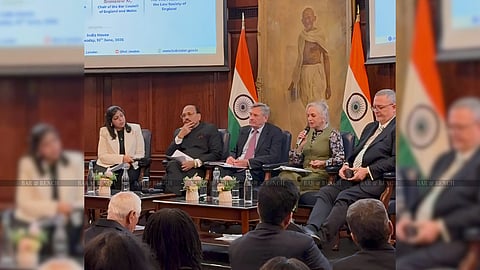
Speaking at a discussion on “Technology and the Future of Mediation” hosted by the Indian High Commission in London, the Chief Justice said AI was already helping speed up mediation through data analysis, issue identification, virtual platforms and other technological tools.
He, however, cautioned against treating AI as a substitute for mediators.
“Mediation involves a lot of pure human exercise,” the Chief Justice said.
He added that a successful mediator must apply both “mind” and “heart”, and warned against efforts to use AI to predict whether mediation would succeed.
According to CJI Kant, AI may help parties assess the strengths and weaknesses of their legal positions and understand the likely outcome of litigation. But using technology to predict the outcome of mediation would undermine the very nature of the process.
“AI should be used for the purpose of identifying or even predicting what is the likelihood of the outcome if you go into litigation. But telling whether you will succeed in mediation or not means you are allowing it to read human behaviour. That goes against the life of mediation,” he said.
The CJI also flagged concerns relating to data privacy, noting that litigants entrust sensitive information to the justice system and such data cannot be freely utilised by AI platforms.
Referring to the judiciary’s ongoing work on artificial intelligence, he said the Supreme Court had recently published draft regulations governing the use of AI across the judicial system.
The discussion took place against the backdrop of growing India-United Kingdom economic ties.
Opening the event, Indian High Commissioner Kumaran Periasamy said the expansion of trade, investment and digital cooperation between the two countries would require efficient and credible dispute-resolution mechanisms.
He noted that technology could make mediation more accessible and effective, but trust-building and human judgment would remain central to the process.
CJI Kant echoed that sentiment while tracing the growth of mediation in India over the past two decades. He said both the judiciary and the government had actively promoted mediation long before the enactment of the Mediation Act, 2023.
Recalling the evolution of the framework, he referred to the establishment of mediation centres across the country, training programmes for judicial officers, the growth of Lok Adalats and initiatives undertaken through legal services authorities.
According to the Chief Justice, one of the biggest changes brought about by the Mediation Act was that mediated settlement agreements are now enforceable in the same manner as civil court decrees.
He also spoke about efforts undertaken after he assumed leadership positions in legal services institutions. At one stage, India had fewer than 30,000 trained mediators despite requiring more than 250,000, he said. This prompted large-scale training programmes and eventually the launch of the “Mediation for Nation” initiative.
“Now I can say proudly that in India, in every street, in every house, in every town, in every village, people talk of mediation, people understand mediation, people prefer mediation,” Justice Kant said.
The Chief Justice also reiterated his preference for mediation over arbitration as the first mechanism for resolving commercial disputes.
According to him, mediation is quicker, more affordable and helps preserve commercial relationships.
While emphasising that arbitration remains indispensable, particularly in international disputes, he expressed concern about the increasing complexity of arbitral proceedings.
“What I have been expressing my apprehension is only that nowadays international arbitration is becoming so complex that even before you start the actual arbitration proceedings, parties start going to court on preliminary issues,” he said.
The consequence, he added, is that litigation often begins before arbitration truly commences.
“In arbitration, passing of award is the beginning of the litigation between the parties. In mediation, when successfully happened, it is the closure of the litigation.” he remarked.
Justice Nicholas Hamblen of the UK Supreme Court broadly agreed with the CJI Kant's assessment of mediation’s growing importance.
Hamblen said mediation had long formed part of the dispute resolution landscape in England and Wales but noted that a significant shift had taken place following the Court of Appeal’s decision in Churchill v Merthyr Tydfil Borough Council.
According to him, courts have moved from merely encouraging mediation to actually directing parties to participate in alternative dispute resolution.
He said mediation offers significant advantages in terms of cost, speed, flexibility and confidentiality, adding that arbitration was increasingly becoming comparable to litigation in both cost and complexity.
Bar Council of England and Wales Chair Kirsty Brimelow KC spoke about the role of lawyers in mediation. Barristers are particularly suited to the process because they are trained to objectively assess the strengths and weaknesses of a case and help parties realistically evaluate risk, Brimelow said.
Drawing on her experience as a mediator in Colombia’s peace process, Brimelow said many disputes that appear to be about money or legal rights often involve deeper questions of trust, dignity and recognition.
On artificial intelligence, she cautioned against over-reliance on AI tools and referred to instances where lawyers had relied on hallucinated case citations generated by AI systems.
Law Society of England and Wales Vice-President Brett Dixon said mediation was increasingly proving its value through online dispute resolution systems.
Referring to data from England and Wales, Dixon said mediation programmes integrated into digital court systems have produced substantial settlement rates while significantly reducing waiting times for trial.
He noted that one of the major challenges facing mediation globally was scale, particularly the availability of sufficient trained mediators. Artificial intelligence, he said, could help improve productivity and eventually assist mediators in working across multiple languages and jurisdictions.
The event was organised by the Indian High Commission in London and was moderated by advocate Tanvi Dubey.