Allahabad High Court raps trial judge for "extraordinary" leniency towards son who threw acid on father

Justice Santosh Rai took exception to the fact that the trial judge convicted the man only for the offence of causing grievous hurt and not the offence of murder.
Allahabad HC
Allahabad HC
Published on
3 min read
Listen to this article

The Allahabad High Court recently criticised a trial court for taking an unduly lenient view in the case of a man found guilty of throwing acid on his father, eventually leading to his death two weeks after the incident [Razzak v. State of UP].
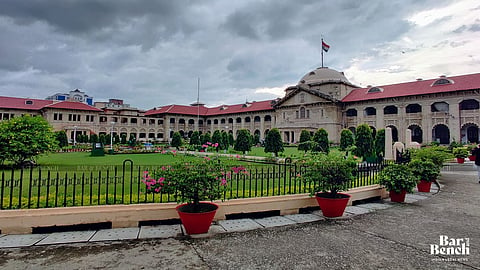
Justice Santosh Rai took exception to the fact that the trial judge convicted the man only for the offence of causing grievous hurt and not the offence of murder.

Nevertheless, the High Court declined to interfere with the man’s 3-year jail sentence since only the accused had challenged the trial court’s verdict of conviction and the State had not sought enhancement of punishment.

The Court, however, did not stop at that. It went on to censure the trial judge for showing what it described as “extraordinary and unwarranted leniency”.

Judicial sympathy cannot override the law, the High Court underscored.

“Judicial discretion is never synonymous with judicial arbitrariness. Sympathy or misplaced leniency has no place where the statute and the evidence demand a reasoned and lawful adjudication,” the Court observed.

Therefore, it dismissed the appeal, rejected the appellant’s plea for probation and directed him to surrender within two weeks to serve the remainder of his sentence.

Justice Santosh Rai
Justice Santosh Rai

The case arose from an incident on September 5, 1981, when the convict, one Razzak, and his father, Gulam Husain, were inside their shared home in Gorakhpur. According to the prosecution, a quarrel broke out between the two during which the appellant poured acid on his father.

After the incident, Razzak allegedly tried to flee but was apprehended by villagers and handed over to the police. Gulam Husain, who had suffered nearly 60 per cent acid burns, remained under treatment for about three weeks before succumbing to septicaemia and exhaustion caused by the injuries.

The trial court originally framed a charge of murder under Section 302 of the Indian Penal Code (IPC). However, it ultimately convicted Razzak only under Section 326 IPC for voluntarily causing grievous hurt by dangerous means and sentenced him to three years’ rigorous imprisonment.

Before the High Court, Razzak claimed the incident was accidental and argued that he had himself sustained burn injuries while trying to save his father. He also sought the benefit of probation, pointing out that the appeal had remained pending for over four decades and that he was now more than 60 years old.

The High Court rejected these submissions, observing that the Razzak's injuries were only superficial, whereas his father had suffered extensive acid burns over vital parts of his body.

It also relied on his father's statement recorded by the investigating officer in hospital. The Court held that it was admissible as a dying declaration under Section 32(1) of the Evidence Act.

The Court further noted that Razzak had admitted in his statement under Section 313 of the Code of Criminal Procedure that acid had been thrown during the scuffle but failed to explain how his father sustained the injuries. The Court also noted that he attempted to flee instead of helping his father or taking him to the hospital.

“The accused Razzak tried to escape from the spot after committing the offence… It also clearly transpires the mala fide conduct and behaviour of the applicant,” the Court observed.

The Court said the trial judge had failed to properly appreciate the evidence and ought to have examined whether the offence attracted Section 302 IPC or, at the very least, Section 304 IPC, instead of convicting Razzak only under Section 326 IPC.

It also found fault with the sentence imposed by the trial court, noting that no fine had been imposed even though Section 326 IPC contemplated imprisonment as well as fine.

The High Court termed the trial court’s approach a “serious miscarriage of justice” and stressed that judicial sympathy cannot override the law.

The High Court nevertheless said it could not convert the conviction to a graver offence or enhance the sentence because the State had not filed any appeal or revision seeking enhancement.

“In the absence of any such appeal… this Court refrains from disturbing the sentence awarded by the trial court or from converting the conviction to one under a higher provision,” it noted.

Accordingly, the High Court dismissed Razzak's appeal, upheld the conviction under Section 326 IPC and directed him to surrender within two weeks to undergo the remainder of his sentence.

It also rejected his plea for probation since the offence had been committed against his own father inside their shared home and had resulted in his death after prolonged suffering.

[Read Judgment]

Attachment
PDF
Razzak v. State of UP
Preview
Bar and Bench - Indian Legal news
www.barandbench.com