Ambedkar’s working Constitution: The hidden archive inside a Mumbai college library
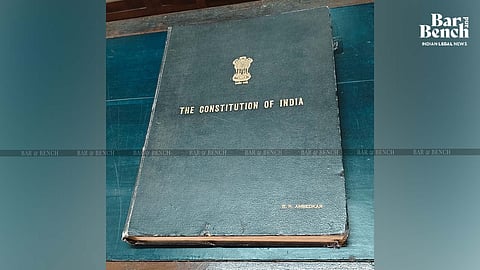
The library at Siddharth College in South Mumbai, a few metres away from the Bombay High Court, has a black‑covered book embossed in gold – “The Constitution of India.”
At first glance, it looks like any other old government volume. Then the name on the bottom right comes into view, “Dr. B R Ambedkar”, and it is clear this is no routine edition.
It is one of the leather‑bound drafts Dr. Babasaheb Ambedkar submitted to the Cabinet before the final text was adopted. He later gifted his own copy to Siddharth College, the first institution under the People’s Education Society he founded in 1945.
The volume is old and fragile and brought out only on request. When it is placed on the table, it feels less like a book and more like a portal into the room where Independent India was being imagined, line by line.
The Constituent Assembly elected the Drafting Committee on August 29, 1947, with Ambedkar as chair. The committee worked for 141 days to prepare the Draft Constitution, which initially contained 315 Articles and 8 Schedules.
On November 4, 1948, Ambedkar introduced the final draft to the Constituent Assembly for its first reading, followed by a five‑day general discussion. The Assembly spent 165 days in deliberations and the final Constitution contained 395 Articles, divided into 22 parts and 8 Schedules, making it the world’s lengthiest written Constitution at the time.
The journey to this library on the second floor of the college building begins outside, under a signboard that still carries the full name of the institution Ambedkar created to democratise higher education – the People’s Education Society’s Siddharth College of Arts and Science, established in June 1946.
The college first ran out of army barracks at Marine Lines. Ambedkar raised public funds and secured a ₹10‑lakh loan from the Nehru government to purchase two old buildings, later renamed Buddha Bhavan and Anand Bhavan.
Today, the library holds nearly 1.4 lakh books on the shelves, including the collections gifted by Ambedkar from his personal library at “Rajgriha”, his residence at Dadar in Mumbai.
Between the high wooden racks, with their glass doors and fading spine labels, a visitor becomes acutely aware of how easily a careless hand could erase an annotation, how quickly humidity could destroy a note that once guided the meticulous mind that drafted the Constitution.
Rows of shelves hold parliamentary debates from London, reports of commissions, constitutional treatises and social‑reform texts.
This is not just material similar to what Dr. Ambedkar read as Chairman of the Drafting Committee – in many cases, these are the very copies he consulted, carried, and quarrelled with, before deciding they belonged in a public institution rather than a private study.
These are books he read, marked, argued with in the margins and finally donated so that generations of students could follow his trail of thought.
Former librarian Shrikant Talwatkar recalls how SS Rege, Siddharth College’s first librarian, acted as Ambedkar’s bibliographic aide during the constitution‑making years, when Ambedkar shuttled between Mumbai and Delhi.
Ambedkar’s relationship with Mumbai went back decades. He studied at Elphinstone College and graduated from the University of Bombay in Political Science and Economics in 1913, and later practised on the Appellate Side of the Bombay High Court from 1923.
While in Mumbai during the drafting years, his work on the Constitution continued during short visits, as he frequented the Fort area where he had earlier practised as a lawyer.
“He also took help from the Asiatic Library, the Government Law College and the Elphinstone College libraries,” Talwatkar says.
“He purchased books from Hansard publications in the UK, which published parliamentary debates. This was to know what the British thought of Indians and what they discussed about them.”
The Hansard debates he depended on, bound in heavy brown volumes, still occupy entire shelves. Below them sit books on history, geography, economics and science.
Talwatkar explains why Ambedkar donated everything:
“He wanted the intellectual upbringing of students. He wanted more and more people to read – students and teachers should read.”
Deeper inside the library stands a locked wooden cupboard that holds the most precious items: around 50–70 bound booklets of Ambedkar’s handwritten notes on several subjects, scribbled years before Independence.
One notebook reveals pages of jottings dated 1934 on the definition of “republic”, with crossed‑out phrases and raw thought experiments that anticipate, almost word for word, the values that would later anchor the Preamble’s “sovereign democratic republic."
Another booklet deals with maternity benefits, drafted at a time when social security for women workers was barely on the global agenda, yet would eventually find expression in India’s constitutional principles on labour and women’s rights.
Together, these slim volumes show how far ahead of his time Ambedkar was – thinking through questions of democracy and welfare long before they entered mainstream political vocabulary, and in ways that still speak to debates on equality today.
Principal Dr. Ashok Sunatkari explains that the preservation of the handwritten notes is a matter of high priority.
“We have used Japanese technology to store these notes. These books and notes are stored in the best condition possible," he said.
The building itself is over 150 years old. It creaks with the weight of history. Glass vitrines and old racks expose treasures to Mumbai’s humidity and dust. Many books are tattered, their spines cracking and pages flaking – a ticking clock on Ambedkar’s educational mission.
“Preserving this heritage of knowledge of Siddhartha College is not only the responsibility of an institution, but the responsibility of the entire nation. The combined collection of such rare books related to the making of the Constitution is rare in the country. Students come from all over the world and India to research," Sunatkari says.
But preservation without proper infrastructure is difficult, especially for a government‑aided college run by a non‑profit.
"Conserving each page requires ₹200 to ₹300, but we have so many books. It is going to cost a lot," he warns.
A Parliamentary Committee on Scheduled Castes and Scheduled Tribes inspected the library and submitted a report demanding a “Babasaheb Granthsmarak”, urging that this heritage collection, linked to education, history and constitution‑making, be protected.
In 2023, the committee asked the State government to provide the required funds.
On October 14, 2025, Maharashtra’s cabinet approved ₹500 crore over five years (₹100 crore annually) for nine PES institutions and two hostels founded by Ambedkar.
“We are yet to receive those funds,” Sunatkari says.
Every year on January 26, the nation celebrates the Constitution coming into force in 1950, after the Assembly’s final meeting on January 24 that year.
Siddharth College library stands today as the Constitution’s unsung vault. It houses a draft. It preserves the sources Ambedkar relied on and embodies his vision of knowledge as the great equaliser.
As visitors walk out past Ambedkar’s garlanded bust outside the library, the quiet hall behind them is a reminder that without timely conservation, the country could gradually lose a rare collection of books and a workshop where democracy was forged.

