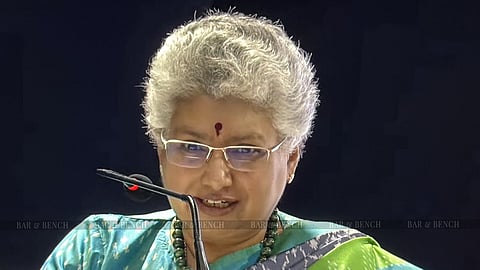
For centuries, the legal profession remained the exclusive domain of male lawyers who benefitted from social networks and professional solidarity, Supreme Court Justice BV Nagarathna said on Thursday..Women too need to build such communities of solidarity to ensure that the progress made thus far in terms of women's presence in law, does not taper off, she opined."The legal profession can be intensely competitive but the most enduring progress has come when women refused isolation and chose solidarity over scarcity. For generations men in the legal profession have benefited from social networks of familiarity, recommendation, and professional sponsorship. There is, in fact, almost a kind of brotherhood, an exclusive male club, which lies in this inherited ease of belonging, the confidence of moving through systems where they almost naturally fit in," she said. .The apex court judge pointed out that most women enter the profession without much support and hence, there needs to be a sisterhood in the profession to uplift women lawyers."For women by contrast they have entered the profession without such a network and ease in most cases. That is why sisterhood in the profession is very important. Sisterhood in the profession is not a slogan but a conscious intellectual and professional commitment to ensuring that access does not end with individual achievement", she said. In this regard, the judge urged senior lawyers to mentor junior advocates regardless of their gender.She also highlighted the diminishing burden on women lawyers as more generations break through the profession saying,"The first generation of women in law had to prove they deserved to enter the portals of the law courts. We know what happened earlier. The next had to prove they deserved to be heard. The next generation had to prove that they could be senior advocates. Then they had to prove that they could argue the most important Constitutional and commercial cases. With each successive generation the burden becomes a little less onerous - from fighting for entry to demanding recognition to reclaiming leadership".Sisterhood in the profession is not a slogan but a conscious intellectual and professional commitment to ensuring that access does not end with individual achievement.Justice BV Nagarathna.Justice Nagarathna was speaking at the launch of Senior Advocate Indira Jaising's new book, 'The Constitution is my Home'.On Jaising, Justice Nagarathna observed that the senior lawyer had not only achieved great professional success but also reshaped institutions and the real life of citizens. "Very few people alter the vocabulary of public life and Ms. Jaising has done that to a great extent. After her interventions, terms like workplace equality, sexual harassment, domestic violence, women's inheritance, and power imbalance have entered the mainstream of Indian jurisprudence," Justice Nagarathna said. .Before the Supreme Court judge took the stage to deliver her remarks, Jaising engaged in a brief conversation with journalist Sreenivasan Jain where she spoke about gender justice, majoritarianism, the bar, the bench, and the enduring nature Constitution of India. On the title of the book, Jaising said, "The Constitution is a very personal home. In this country, the first question everyone asks is “Where are you from?” I found the answer. I said to myself I belong to the Constitution of India."All governments have tried to shake the foundation of the Constitution, she said, pointing to the emergency and then to the current scenario which she categorised as much more dire. "During the emergency it was the Constitution itself that was used to oppress the general public. They invoked the emergency provisions. It's much easier to find a written text, a written document, to challenge it. What's happening now is that without changing the written text, every other form of transformation is happening. Which is why it is much more difficult to deal with and therefore I don't believe that we can just characterise it as an undeclared emergency. An emergency, for God's sake, is an emergency. What's an emergency? It's temporary. We've gone past the temporary stage", she explained. To Jain's question on whether she believes the judiciary may step in, Jaising said that as an eternal optimist, she believes that there will come a time when judges will say "enough is enough"."The thing is that when you hit rock bottom there's nowhere else to go to except up. There is going to be a point of time where judges are going to say, "Enough is enough." At the end of the day you're dealing with their power and no one likes their power taken away," she said..There is going to be a point of time where judges are going to say, "Enough is enough."Senior Advocate Indira Jaising.While Jain asked a few questions touching on the Sabarimala reference case in which Jaising herself appeared before the 9-judge bench of the Supreme Court, she declined to go into too much detail as the matter is sub-judice."In the courtroom I said: I just either show me one text which says women can't enter temples or you tell me that women are not welcome in the house of God," she said.However, she expanded on her thoughts on gender justice in general, observing that the judiciary's record is a mixed bag."On the one hand you do have judgements like Vishakha, which have declared the right to be free from sexual harassment as a fundamental right as part of the right to work. But you have this very strange contradiction where if the law is kind of sanitised of all reality then it is fine, but the minute you get into a real flesh-and-blood person who comes before you, then all your stereotypes come into reflection", she said.Jaising said that she has always maintained that when it comes to the issue of violence against women, they find more justice when they are dead than alive."You will find long lectures when you have a dowry death but when she's alive and she's going to court and she's saying "protect me" then you might hear arguments like "Oh you're misusing the law." So this is a strange phenomenon that we really seem to be very concerned about a woman after she's dead but not in her lifetime. I find it very painful and have tried to resist it all along," she said. .Jain and Jaising also discussed a recent case where a Supreme Court bench of Justices Nagarathna and Ujjal Bhuyan expressed serious reservations about its own earlier judgment delivered by another Bench denying bail to activist Umar Khalid in the Delhi riots case."It is extraordinary but it is a matter of celebration. The problem is that the Supreme Court was not disciplined about its own judgments. They are bound by three-judge bench judgments, which is why you saw this observation a few days ago where the judges themselves are pointing out the fact that we need a discipline of law," Jaising said.Jaising also underscored that only a strong bar would be able to keep the judiciary in check. "In my opinion, it is only a strong bar which can keep a judiciary in check. The tragedy is that we do not have a strong and militant voice of the bar in this country. I can't be expected to carry the whole burden of dealing with the judiciary on my shoulders. I refuse to. I don't wish to be a victim," the Senior Advocate said. .The tragedy is that we do not have a strong and militant voice of the bar in this country.Senior Advocate Indira Jaising.[Live coverage of book launch]