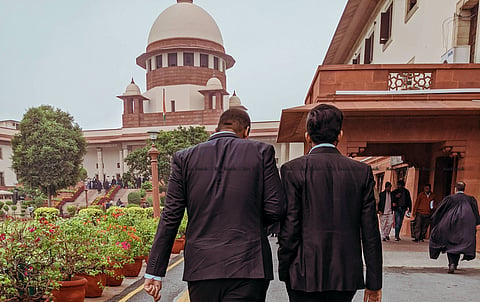
Banks cannot blacklist advocates by putting them on caution list: Supreme Court

The Court said banks may remove lawyers from their own panels but cannot declare them professionally incompetent across the banking sector; only Bar Councils can examine allegations of professional misconduct.
Supreme Court Lawyers
Published on
4 min read
Listen to this article

The Supreme Court on Tuesday held that banks cannot effectively blacklist advocates across the banking sector by placing their names on the Indian Banks’ Association’s (IBA) caution list merely on allegations of negligence or an erroneous legal opinion [Ajay Vijh v. Indian Banks Association & Ors.].

A Bench of Justices PS Narasimha and Alok Aradhe ruled that while banks are free to remove lawyers from their own panels if dissatisfied with their services, they cannot publicly brand them as professionally incompetent or negligent by circulating their names to other banks.

The Court held that questions relating to an advocate’s professional conduct fall exclusively within the jurisdiction of the Bar Councils under the Advocates Act.

“Banks have the choice of disengaging a legal professional and also to remove his/her name from the panel if the services are not up to the mark, but an action in the nature of public declaration to all other banks about the conduct, competency or incompetency of an advocate is clearly beyond their power and jurisdiction and clearly illegal,” the Court said.

Justice PS Narasimha and Justice Alok Aradhe

The judgment came in an appeal filed by advocate Ajay Vijh, who challenged his inclusion in the IBA’s caution list after Canara Bank accused him of negligence while rendering a title opinion for a loan transaction.

The Court directed the bank and the IBA to immediately remove Vijh’s name from the caution list.

The dispute arose after Canara Bank alleged that Vijh’s 2015 legal opinion failed to notice that a portion of land offered as collateral for a ₹2 crore loan had already been sold. This exposed the bank to financial risk.

Although the bank removed him from its panel in 2019, it also forwarded his name to the IBA, following which he was placed on the caution list under the category “Third Party Entities Involved in Fraud” with the remark that he had given a wrong legal opinion and acted negligently.

According to Vijh, this resulted in the termination of his empanelment with other banks and severely affected his professional reputation.

The Allahabad High Court dismissed his writ petition (under Article 226 of the Constitution) on the ground that the IBA was not “State” under Article 12 of the Constitution.

The Supreme Court today reversed this decision. It held that the High Court had adopted an unduly narrow view of its writ jurisdiction.

The Bench said that the challenge was not merely against a contractual decision by a bank but against an industry-wide mechanism that had serious consequences for an advocate’s right to practise the profession under Article 19(1)(g) of the Constitution. It reiterated that Article 226 extends beyond statutory authorities and can be invoked wherever actions carrying a public law element affect legal rights.

On the merits, the Court examined the RBI circulars governing the IBA’s caution list and held that they were intended only to alert banks about third parties involved in fraud or other dishonest conduct affecting the banking system.

It held that the framework could not be extended to cases involving alleged professional negligence or an erroneous legal opinion.

“Fraud, by its very nature, imports an element of mens rea and deliberate intention and design to defraud. An erroneous legal opinion or an omission in the course of due diligence, absent any allegation of dishonest intent or deliberate facilitation of illegality, cannot be elevated to the level of fraud,” the Court observed.

The Bench emphasised that banks remain free to discontinue engaging advocates if they lose confidence in them. However, they cannot use the RBI’s fraud-prevention framework to circulate adverse remarks about a lawyer’s competence to other financial institutions.

The Court further held that allegations of professional negligence or misconduct against advocates must be dealt with only under the disciplinary mechanism established by the Advocates Act.

It observed that allowing banks or banking associations to determine an advocate’s professional competence would undermine the legal profession’s independence and its statutory system of self-regulation.

“If the Bank is of the opinion that the appellant is guilty of professional negligence or misconduct in discharge of legal duties as an advocate, the appropriate remedy is to place the relevant material before the competent State Bar Council,” the Bench said.

Also Read
Supreme Court urges BCI to establish national legal academy for lawyers
Supreme Court Lawyers

At the same time, the Court clarified that its decision should not be read as insulating advocates from accountability.

It acknowledged that banks have legitimate concerns about the quality and reliability of legal opinions, particularly in high-value financial transactions. However, it said the solution lay in strengthening the disciplinary framework under the Advocates Act rather than creating parallel mechanisms that effectively blacklist lawyers.

Accordingly, the Court directed the Bar Council of India to undertake a performance audit of the disciplinary mechanisms of the State Bar Councils and the BCI to assess their efficiency, transparency and credibility.

It also reiterated its earlier direction asking the BCI to institutionalise Continuing Legal Education for advocates and consider establishing a National Legal Academy on the lines of the National Judicial Academy.

The matter will next be taken up on August 31, when the Court will consider the progress made by the BCI on those directions.

[Read Judgement]

Attachment
PDF
Ajay Vijh v. Indian Banks Association & Ors.
Preview
Bar and Bench - Indian Legal news
www.barandbench.com