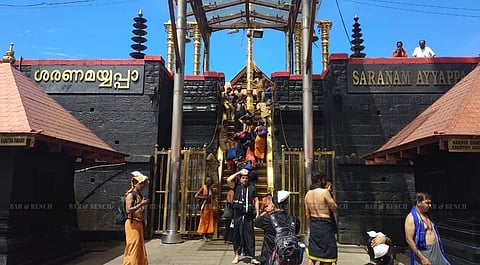
The Central government Tuesday in the Supreme Court advocated for greater freedom in religious practices and asked whether courts are the appropriate forum to determine what constitutes an essential religious practice..The submissions were made before a nine-judge Constitution Bench during the hearing of a reference arising out of the Sabarimala review case.A Bench of Chief Justice of India (CJI) Surya Kant along with Justice BV Nagarathna, Justice MM Sundresh, Justice Ahsanuddin Amanullah, Justice Aravind Kumar, Justice Augustine George Masih, Justice Prasanna B Varale, Justice R Mahadevan and Justice Joymalya Bagchi was hearing the matter.The 9-judge Bench is examining seven important legal questions concerning religious rights and freedoms in India. Its verdict will have a major impact on various individual cases including whether women can be allowed to enter the Sabarimala temple in Kerala..Solicitor General Tushar Mehta, who appeared for the Central government, argued that Court should not take any decision by considering Hinduism, lslam or Christianity alone as one particular broad denomination. He added that the breadth of a religion and plurality of faiths in India will have to kept in mind."The sheer breadth and plurality of religions in this country. We are not dealing with a single religion. India has a proud plurality of faiths - Hindus, Muslims, Christians and others. Importantly, there is internal plurality within each religion," Mehta said.On Hinduism, Mehta said that philosophically, it may be described as a way of life, but for constitutional purposes it is a religion. He added that its several sub-denominations were not considered properly in the previous court decisions."It is also capable of being a denomination, and further contains several sub-denominations. Each of these has its own identity, yet all are referable to the broader Hindu fold. I submit that this aspect has not been adequately presented thus far.".Mehta also said that Article 25 must be interpreted while keeping in mind the Preamble, particularly the part conferring liberty of thought, expression, belief, faith and worship.He questioned whether Court can determine or examine an essential religious practice. He contended that a Court cannot decide what is superstition or a religious practice."The unnecessary doctrine of essential religious practices was introduced, but how do you decide what is essential? It is a matter of faith. It is a matter of belief. To determine whether something is essential or not, one would first have to undertake a judicial review of religious scripture. One would have to understand the scripture in the manner in which it is meant to be understood. That, in my respectful submission, is not possible unless one attains that level of spiritual understanding. We would not be in a position to state with certainty what exactly Prophet Muhammad said, or what Lord Jesus said, or what the Vedas or the Upanishads say, and how they are to be understood," the Central government counsel submitted before the Constitution Bench..The reference being heard by the Constitution Bench is connected to the top court's September 2018 verdict in which a 5-judge Constitution Bench, by a majority of 4:1, allowed women of all ages to enter the hilltop shrine in Kerala. That decision overturned the tradition that restricted the entry of women of menstruating age. The ruling triggered widespread protests across Kerala and led to dozens of review petitions being filed by various individuals and organizations before the apex court.In November 2019, the Supreme Court pronounced its judgment on the review petitions but did not decide the matter one way or the other.It held that larger issues pertaining to the Essential Religious Practices Test, interplay between Articles 25 and 26 on one hand and Article 14 on the other and the conflict between the judgments in the Shirur Mutt case and Durgah Committee case will have to be decided by a larger Bench.Hence, the matter was referred to a 9-judge bench..The 9-judge Bench is now examining the following larger legal questions:Ambit and scope of religious freedom;Interplay between rights of people under Article 25 and the rights of religious denominations under Article 26 of the Constitution of India;Whether rights of religious denomination are subject to other provisions of Part III of the Constitution;Scope and extent of morality under Articles 25 and 26 and whether it includes Constitutional morality;Whether religious denominations enjoy fundamental rights;Meaning of expression "section of Hindus" under Article 25(2)(b);Whether a person not belonging to a religious group can question practice of that religious group by filing a PIL..Arguments Today.SG Mehta today argued that the top court in its previous decision in Sabarimala case did not consider the origin of Articles 25 and 26."Neither in Shirur Mutt nor until the Sabarimala judgment has the full journey of Articles 25 and 26 been examined in this manner. I submit that three crucial aspects have not been noticed," he said.He argued that the Court must keep in mind the breadth of the religions and examine whether it has the necessary expertise to go into the subject."Several issues arise and the question would be whether the Court has the necessary expertise to go into these questions," Mehta said.Mehta added, "If a religious head states that something is a matter of faith and the followers abide by it, the question whether such a faith exists is something which the Court can examine using accepted judicial tools. However, the rationality or scientific basis of that faith cannot be gone into."Mehta further contended even if something appears unscientific or illogical to a legally trained mind, the remedy lies with the legislature. Even in the case of a social evil, the remedy is under Article 25(2)(b), which permits the legislature to enact laws for social welfare and reform, he said."The entire guarantee under Article 25 is subject to public order, morality and health, and to the other provisions of Part III. Even a practice which was in existence at the time the Constitution came into force can be subjected to reform under Article 25(2)(b)...the reform law. The legislature may regulate it, restrict it, or even prohibit it, depending on what is considered necessary for social welfare or reform," it added.Mehta further said that even a civil suit would be a proper course for determining whether something is an essential religious practice. However, he clarified that the constitutional courts can also intervene in certain cases. "I am not for a moment suggesting that Articles 32 or 226 would never apply. My submission is only on the extent of judicial review, and also on justiciability and the appropriate forum. For instance, if someone claims that human sacrifice is an essential religious practice and approaches this Court under Article 32, Your Lordships need not examine whether it is religious or essential. If it directly violates public order, morality or health, it can be rejected on that ground alone," Mehta said..Mehta cited the example of ecclesiastical courts in Pakistan and some other countries, stating that judges with legal expertise sit along with ulema there."Together, they decide whether something forms part of a religious practice and, if required, whether it is an essential part of that practice," he added.Mehta today also questioned the Sabarimala judgment, observing the practice against the entry of women should not be viewed as a violation of right to choice."If I go to a mazaar or a gurdwara, I am required to cover my head. I cannot say that this violates my dignity or my right of choice. Similarly, when we go to Ajmer Sharif, we cover our heads. When we go to a gurdwara, we do so as well. Nobody treats that as a violation of bodily integrity," he said.Mehta will continue his submissions on Wednesday..India puts women on high pedestal, not patriarchal like West thinks: Centre to Supreme Court in Sabarimala reference.[Read Live Coverage on X]