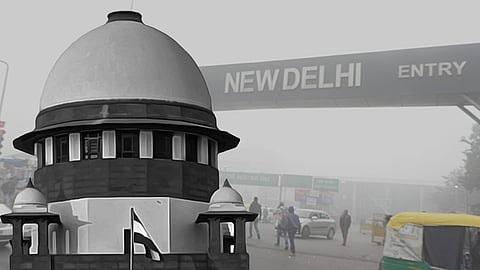
The Supreme Court on Tuesday came down heavily on the Commission for Air Quality Management (CAQM) for dragging its feet over tackling Delhi’s air pollution crisis [MC Mehta v. Union of India]. .A Bench of Chief Justice of India (CJI) Surya Kant and Justice Joymalya Bagchi said that the statutory body seemed to be “failing in its duty” by asking for two months to identify the main causes of worsening air quality.It said that the Commission could not keep deferring the issue while the National Capital Region (NCR) continued to choke. “CAQM appears to be in no hurry to identify causes of worsening air pollution or AQI. Thus we issue directions to expedite the identification of causes and long-term solutions,” the Court ordered.The CAQM was directed to convene a meeting of experts within two weeks, prepare a report based on their deliberations and make it public before the next hearing..The hearing began with the Chief Justice noting that the amicus curiae had filed a report outlining long-term measures. The CJI observed that while the Court did not intend to play “super expert,” it would continue to serve as a forum to ensure that expert views are translated into concrete action.When Additional Solicitor General (ASG) Aishwarya Bhati, appearing for the Central government, requested for two months' time for the CAQM to examine core pollution sources, the Bench expressed strong disapproval. “It is being said that heavy vehicles are contributing to it and then there is construction in NCR area. People need housing. So we have to see if construction is contributing. If CAQM wants to come now after two months, it is not possible. That is like it’s failing in its duty,” CJI Kant said. .The Court noted that vehicular pollution alone now contributed to nearly 40 per cent of Delhi’s air quality index (AQI) problem. The amicus pointed out that while a 2022 CAQM report had conducted an extensive exercise, its findings were never made public.The CJI said that the common perception that farmers bear the blame for poor air quality was misplaced.“Somehow, the entire blame falls on farmers. During the pandemic, there was maximum stubble burning and that was the only period when people in Delhi saw blue skies,” he remarked.He added that long-term planning must focus on viable alternatives rather than knee-jerk bans.“We have to see long-term plans so that if something is stopped, the alternative should be equally strong. Like we say buses create pollution, but can you afford to stop the transport?” he asked..The Court also criticised the CAQM for failing to publicly identify “provocative areas” responsible for the AQI decline despite receiving multiple expert reports over the years.“We don’t want credit for any ideas. We are only seeing issues which an expert body can determine. Why do they need a direction from us and why are they unable to disclose that after examining all reports, these are the most provocative areas?” it queried.According to the Court, the CAQM’s own findings had revealed wide differences among experts on how much each sector contributed to Delhi’s air pollution. For instance, the transport sector alone had been variously blamed for anywhere between 12 and 40 per cent of the emissions.“This Court has been taking up the matter intermittently and implementing expert advice from time to time. It was in that context that the CAQM was asked to design long-term measures."It also noted that the Delhi government had filed an affidavit asserting that toll plazas were an essential revenue source and should be allowed to continue, an argument that the Gurgaon administration had supported.However, the Bench said that the CAQM could not keep waiting for consensus among competing interests..The amicus suggested practical solutions such as faster transition to electric vehicles, stronger public transport systems and higher environmental compensation charges for polluting vehicles. CJI Kant agreed, adding that power plants and construction sites must also be held accountable.“CAQM being the statutory body is obligated to bring certain domain experts under one umbrella and have a unanimous opinion for identification of causes for worsening AQI. This should not take much time as IIT and other expert bodies have already carried out such exercises," he said..The Court suggested that once causes are identified, the findings should be shared through public awareness campaigns so that citizens can voluntarily contribute to improvement measures.It further directed the CAQM to formulate a long-term plan addressing all key sources of pollution, including toll plazas, construction dust and vehicular emissions.“We are conscious of the fact that there cannot be a one-road mandate for introducing electric vehicles without analysing consequences on public exchequer. Thus a long-term action plan is needed. CAQM must realise that delay in finding solutions will lead to further complications.".During the hearing, Senior Advocate Rakesh Dwivedi, appearing in another matter, observed that private cars remained the main reason for Delhi’s persistent smog.The Chief Justice agreed, saying,“Car now is seen as a status symbol. There are a lot of ambitious plans of the government. One is that the metro will drop passengers inside the Supreme Court premises.".The matter will be heard next after the CAQM submits its report..[Read Live Coverage]