

Supreme Court judge Justice PS Narasimha on Friday observed that the core concepts of contract law may need reconsideration as developments such as artificial intelligence and smart contracts begin to influence how contractual obligations are understood.
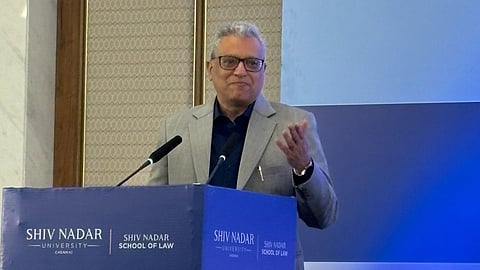
The judge was speaking at the launch of "A Historical Introduction to the Indian Contract Act", a book by Shiv Swaminathan, Dean of the School of Law at Shiv Nadar University, whose scholarship focuses on private law and the historical foundations of contract law.
Speaking at the event, Justice Narasimha said emerging technologies raise questions about how foundational contractual ideas such as proposal, promise and consideration should be interpreted.
“As artificial intelligence is going to take over and smart contracts begin to operate, how we understand concepts such as proposal, promise, consideration and agreements enforceable through law will have to be revisited,” he said.
Justice Narasimha added that the book being launched encourages lawyers and judges to examine the intellectual foundations of the Indian Contract Act rather than treating it merely as a settled body of doctrine.
“Don’t be misled by the name of the book. 'Historical Introduction to the Contract Act' is not a simple history of contract law at all. Much less is it even an introduction. It is, in a way, a biography of Indian contract law,” he said.
He noted that although the statutory text of the Contract Act has largely remained unchanged, the way courts interpret it has evolved.
“The text remained as it is, but its interpretation changed,” he observed.
Justice Narasimha went on to note that scholarship such as Swaminathan’s can help courts revisit how fundamental contractual concepts are understood.
“Every expression, be it a proposal, be it a promise, be it a consideration, an agreement enforceable through law, we need scholars such as Shiv to redefine them and ensure that we do not stray away from the original requirement of abiding by the rule of law,” he said.
During his address, Justice Narasimha also referred to a book authored by political psychologist Ashis Nandy, while reflecting on the intellectual legacy of colonialism.
“Ashis Nandy’s 'The Intimate Enemy' very clearly tells us that the reality, even after colonialism is over, (it) is the mindset which we need to overcome and move away from,” he said.
The judge also spoke about the possibility of drawing from Indian philosophical traditions in legal interpretation. Recalling an exercise involving scholars of Indian and Jain philosophy, he said lawyers had explored whether Indian logical frameworks could be applied to interpret provisions of the Indian Evidence Act.
“At one stage, I had read a little bit of Indian logic and Jain logic and wondered how such an interpretation could be applied to the Indian Evidence Act,” he said.
According to him, interpreting a Western legal text through Indian logical traditions produced markedly different perspectives.
“For the first time, we had finished interpreting a Western text through an Indian logical framework. It was phenomenally different,” he said.
Justice Narasimha further observed that the distinction between private law and public law is increasingly blurred in modern governance. Contracts relating to sectors such as spectrum allocation, airport development and highways often raise broader public law concerns.
“These are contracts affecting public law. There needs to be nuance in how we interpret contract law, and there also needs to be nuance in administrative law,” he said.
The author of the newly launched book, Shiv Swaminathan, explained that the book traces how key concepts of Indian contract law evolved from nineteenth-century English jurisprudence and how Indian courts later interpreted them.
“The central argument of this book can be summed up in two simple points. The drafters did not need to simply glorify nineteenth century English law… Second, even though the drafters sought to move away from English law, the Indian courts just kept on applying English law,” he said.
The panel discussion on the book was moderated by Professor Umakant Varottil. Apart from Swaminathan, Senior Advocate Gaurav Pachnanda, and contract law scholar Neelima Bhadbhade were panelists.
They discussed the relevance of historical scholarship on contract law for modern legal practice and teaching. Pachnanda said practitioners often face uncertainty because Indian contract jurisprudence lacks a consistent theoretical foundation.
“One of the biggest challenges that I face as a practitioner in commercial law is the lack of consistency in the theoretical basis on which our contract law has evolved,” Pachnanda said, adding that historical analysis could help courts and lawyers develop a clearer framework for precedent.
Bhadbhade highlighted the importance of doctrinal scholarship in an area often overshadowed by constitutional law. She said the book’s historical method could prompt scholars, judges and lawyers to revisit established interpretations.
“Any teacher, any student, any researcher, any lawyer or a judge will definitely want to re-look at the concepts having read what he has written in the book. It makes you think,” Bhadbhade said.