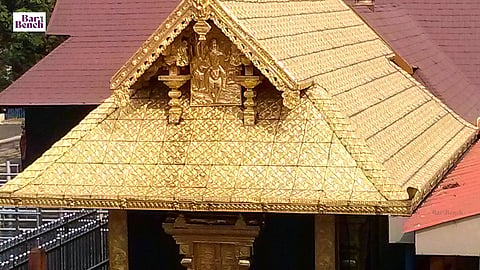
The Central government on Thursday told the Supreme Court that some temples restrict entry for men as well, arguing that the restriction at the Sabarimala temple in Kerala is not based solely on gender..Solicitor General Tushar Mehta, appearing for the government, submitted that the Supreme Court's 2018 judgment throwing open Sabarimala to women of all age groups had proceeded on an assumption that men were considered superior and that women were on a lower pedestal."I have given instances of temples where men are not allowed. Because it is a Devi Bhagwati temple, there are certain faiths and beliefs. There are temples, details of which I have mentioned, where male priests are under a religious mandate to wash the feet of female devotees. There are temples like the Pushkar temple, the only Brahma temple in the country, where married men are not allowed. There is also a temple in Kerala where the system is that men will go dressed as women. I have read in detail, they go to beauty parlours, and their lady family members help them dress in sarees and other things. Only males go there. So it is not a question of male-centric or female-centric religious beliefs. In the present case, it happens to be woman-centric," Mehta saidThe submission was made before a 9-judge Constitution Bench which is examining various legal questions concerning religious rights and freedoms in India. A Bench of Chief Justice of India (CJI) Surya Kant along with Justice BV Nagarathna, Justice MM Sundresh, Justice Ahsanuddin Amanullah, Justice Aravind Kumar, Justice Augustine George Masih, Justice Prasanna B Varale, Justice R Mahadevan and Justice Joymalya Bagchi is hearing the matter..During today's hearing, Justice Nagarathna said that everybody must have access to every temple and matha. She clarified that her remarks were independent of the Sabarimala controversy."If you say: 'it is my practice, it is a matter of religion that only my section, my denomination must attend my temple and none else', that is not good for Hinduism," the judge said.Justice Kumar said that such stance would divide the society.Senior Advocate CS Vaidyanathan, who was arguing when the judges made the remarks, said there are temples, including the private ones, where they don't allow outsiders."Denominations also... if they want only for the denominations, they can't seek funds from the State or the private donor or from public because they are not dependent on footfall from others. Question is whether it is contrary to the Constitutional prohibition? If it is not contrary to public order, morality and health, what would be the realistic consequences," he added.Vaidyanathan further said that only Hindu temples will be disadvantaged if it is said that Article 25(2)(b) - enabling provision providing for social welfare and reform or the throwing open of Hindu religious institutions of a public character to all classes and sections of Hindus - can affect even Article 26(b) which lays down the right to manage its own affairs in matters of religion.Justice Nagarathna said Article 25(2)(b) was there only because of history of Hindu society. CJI Kant also said that the argument may not hold up."These arguments probably will not survive for two reasons. One, what you are arguing is directly in the teeth of the language of Article 25(2)(b). Directly in the teeth of it. Assuming Article 25(2)(b) applies, you are using the argument that it will have no effect on Article 26. But Article 26 itself is subject to public order, morality and health. Article 17 (abolition of untouchability) is on principle of morality," the CJI said.Vaidyanathan responded that if a law passes the muster of those three, then he has nothing further to say. Justice Nagarathna added,"Another way of looking at it is this. If we restrict it to a particular denomination, it may itself be contrary to morality under Article 26." .Background.The reference being heard by the Constitution Bench is connected to the top court's September 2018 verdict in which a 5-judge Constitution Bench, by a majority of 4:1, allowed women of all ages to enter the hilltop shrine in Kerala. That decision overturned the tradition that restricted the entry of women of menstruating age.The ruling triggered widespread protests across Kerala and led to dozens of review petitions being filed by various individuals and organizations before the apex court.In November 2019, the Supreme Court pronounced its judgment on the review petitions but did not decide the matter one way or the other.It held that larger issues pertaining to the Essential Religious Practices Test, interplay between Articles 25 and 26 on one hand and Article 14 on the other and the conflict between the judgments in the Shirur Mutt case and Durgah Committee case will have to be decided by a larger Bench.Hence, the matter was referred to a 9-judge bench.The Court began hearing the case on Tuesday. Its verdict will have a major impact on various individual cases including whether women can be allowed to enter the Sabarimala temple in Kerala.On the first day, Central government advocated for greater freedom in religious practices and asked whether courts are the appropriate forum to determine what constitutes an essential religious practice. On Wednesday, the Court asked whether judiciary has no jurisdiction in religious matters..Arguments Today.Additional Solicitor General (ASG) KM Nataraj argued that religious rights under the Constitution are well-linked, protected and regulated under the scheme of Articles 25 and 26. "There is a three-tier mechanism to protect, connect and regulate these rights. The first part of Article 25(1) guarantees an individual right. The second part, Article 25(2), provides the regulatory mechanism. Article 26 relates to institutional rights," Nataraj explained. Nataraj argued that determination of essential religious practices is unworkable in the Indian religious landscape. "Given the diversity and plurality, the principle of essential religious practice cannot be uniformly applied," he added.He called for limited judicial interference in such matters, stating that religious practices are to be internally assessed. "External examination is impermissible. Judicial review on whether a practice is essential, and to what extent courts can enter into such matters, has a very limited scope," Nataraj said.Nataraj also said that a deity’s right is an integral part of the devotee’s right and is protected under Articles 25 and 26. "If a devotee has a right, it relates to the deity; if the deity has a right, it relates to the devotee," he remarked..Nataraj also contended that the right to practice religion under Article 25(1) includes not merely internal belief but also the external manifestation of religion through practice and propagation. "It has two facets—internal faith and its external manifestation. Both are equally protected," he said.Justice Amanullah asked whether the external manifestation should always be protected."How can it be? It is fine internally, yes, that is yours. The moment your external manifestation affects the rights of others, then how can it be protected? That has to be tested," the judge said.In response, Nataraj said,"Subject to Part III. Part III immediately steps in." Justice Amanullah said that then it cannot be argued that whatever internal belief one carries, the external manifestation of it will also be protected..Senior Advocate CS Vaidyanathan, appearing for review petitioners, said that when Hindus want to visit a particular temple, the sampradaya attached to that temple must be followed."Now, take the case of Ayyappa. We do not have that rigid system. All Hindus are Hindus. But interestingly, in Sabarimala, no distinction is made. There is no bar on Christians or Muslims entering. They can also go. But they must have faith and belief in the divinity of Ayyappa," he added.Vaidyanathan also submitted that one may belong to one sampradaya or follow one math, but nothing prevents them from going to another math or to a temple belonging to another sampradaya as long as they respect the traditions. "Under Article 25, you may have your individual belief. You are entitled to that. But if you want to go to a temple or an institution belonging to a particular sampradaya, then you must believe in that sampradaya, be part of that sampradaya, and follow its practices," he further said.Vaidyanathan also addressed whether the right under Article 26(b), which lays down the right of a denomination to manage its own affairs in matters of religion, be subjected to any law made pursuant to Article 25(2)(b)."There is no prohibition in regard to making any law for social reform. Like for example of somebody say there should be Uniform Civil Code... it can be. It is for legislature to decide. Article 25(2)(b) expressly creates a kind of exclusion only in regard to the individual rights and not in regard to denominational rights," he added.The matter is listed for hearing next on April 14..[Read Live Coverage on X]