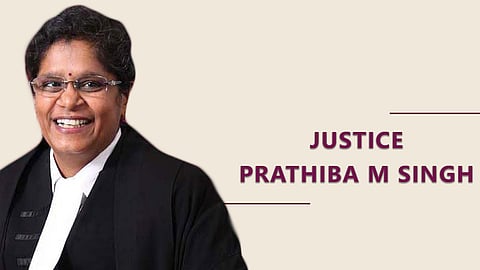
The issue of raising the pecuniary jurisdiction of Delhi’s district courts has divided not only the Bar, but also the High Court judges’ committee constituted to examine the proposal..Five of the six judges in the committee - Justices V Kameswar Rao, Nitin Wasudeo Sambre, Dinesh Mehta, Vivek Chaudhary and Navin Chawla -recommended raising the district courts' monetary threshold to ₹10 crore from the existing limit of ₹2 crore. Justice Prathiba M Singh disagreed with her colleagues and submitted a separate 484-page report, stating that the district courts' jurisdiction should be increased to ₹5 crore instead..Read the story on the five judges' recommendation here. .The judges' committee was constituted after the Coordination Committee of the District Courts Bar Associations of Delhi, in a representation dated May 23, 2025, asked that the pecuniary jurisdiction of the Delhi High Court be raised from ₹2 crore to ₹20 crore, meaning civil suits below that value would be heard by district judges rather than the High Court. In her report, seen by Bar & Bench, Justice Singh agrees with several parts of the majority view that an increase is overdue given the last revision was more than a decade ago, that the pecuniary limit for civil judges should rise to ₹25 lakh and that intellectual property matters at the district court level should be routed to senior designated judges under rules modelled on the Delhi High Court's 2022 IP Division framework. However, she questioned the data used to justify the increase to ₹10 crore, the calculation of disposal rates at the High Court and district courts, the impact on the High Court’s Intellectual Property Division (IPC) and several other aspects. .Justice Singh’s observations are summarised below:.Delhi High Court will become “rich man’s court”.Justice Singh describes the High Court's Original Side as "the jewel of this Court," pointing to features such as e-filing, video-recorded evidence, confidentiality clubs, and remedies like Mareva injunctions and dynamic injunctions that have developed there.Registry data cited in the report shows that nearly 74% of the roughly 13,244 civil cases pending on the Original Side are valued between ₹2 crore and ₹5 crore and fewer than 10% exceed ₹20 crore. She argues that pushing the threshold to ₹10–20 crore would filter out all but the highest-value litigants, turning the High Court into a forum only the wealthy can afford, while smaller domestic litigants, individual innovators and MSMEs would effectively lose access.“The intention ought not to be to convert the Delhi High Court to only a rich man's Court as only such litigants who can afford to pay the court fee after increase of pecuniary jurisdiction would be able to approach the Delhi High Court but not others,” she says. .Impact on IPR cases.Justice Singh notes that the Delhi High Court's dedicated IP Division has been widely acknowledged in India and internationally.She warns that raising the threshold to ₹10 crore or ₹20 crore, without a court fee cap, would make litigation prohibitively expensive for small brand owners, startups and researchers since a suit valued at ₹10 crore to ₹20 crore would attract court fees of roughly ₹10–20 lakh at the prevailing ad valorem rate, leaving only large companies able to afford access. Justice Singh also points out that India's IP regime already draws scrutiny from foreign observers, including the US Trade Representative's annual Special 301 Report, and cautions that diminishing the High Court's IP Division could invite further adverse comment.“The clear and effective steps taken by the Delhi High Court for IP adjudication would be set at naught if the pecuniary jurisdiction is increased to ₹10 crores or ₹20 crores,” the report adds. .Lack of infrastructure in district courts.Justice Singh argues that any increase in jurisdiction should wait until district courts, especially commercial courts, catch up on infrastructure. She notes that functioning video-conferencing and live transcription are not yet available in a systematic way at the district level, that some judges use personal phones and laptops for virtual hearings and that judicial officers who have already been recruited remain unposted for lack of courtrooms. “It is therefore imperative that the District Courts are equipped with adequate infrastructure and technological tools as are available at the Delhi High Court, before increasing the pecuniary jurisdiction. Each District Commercial Court must, at a minimum, be equipped with dedicated Video Conferencing infrastructure for recording evidence of outstation and foreign witnesses, functional transcription facilities, and hardware and software necessary for digital filing, automated listing, and hybrid hearings,” the report states. .Inflation as metric to raise pecuniary jurisdiction .A central plank of the majority's case for ₹10 crore was inflation over the past decade. Justice Singh's takes issue with this. Using official inflation data compiled from the Ministry of Statistics, she calculates the average annual inflation rate for 2016–2025 at 4.78%. Applying that rate to the existing ₹2 crore threshold, she arrives at a figure of roughly ₹3.19 crore for 2026, far below both the ₹10 crore recommended by the majority and the ₹20 crore originally sought by the district courts' bar bodies. Her own recommendation of ₹5 crore, she notes, already builds in some headroom beyond what inflation alone would justify..Disagreement on disposal rate.The majority report used comparative disposal rates to argue that district courts are faster than the High Court, citing figures of around 40.9% (and 57.14% for commercial cases) for district judges versus 29.88% (27.41% for commercial cases) for the High Court. Justice Singh disputes this, citing the Case Clearance Rate (CCR), the metric published on the Delhi High Court's own website. Her figures for 2018 to 2025 put the average CCR at 85.15% for the High Court, 83.32% for district courts and 90.48% for family courts. She argues that these numbers are broadly comparable rather than showing the High Court trailing far behind. She suggests the majority may have used a different formula that factors in opening pendency.Justice Singh adds that this data "requires to be thoroughly scrutinised" before being used to justify a ₹10 crore threshold..Impact on arbitration cases, including international arbitration.At present, arbitration disputes valued above ₹2 crore, including applications for interim relief, challenges to arbitral awards and anti-suit injunctions in international arbitration are supervised by High Court judges. The Delhi International Arbitration Centre (DIAC), which the report describes as one of the busiest arbitration institutions in the country with about 8,000 pending cases, is administered by a committee of High Court judges. Raising the pecuniary threshold, Justice Singh writes, would shift supervision of most of these cases to the district courts, which she says may not yet be "arbitration-friendly".“Faith in arbitration processes which exists due to supervision by the Delhi High Court would be considerably eroded,” she adds. .Loss of court fee revenue.Because court fees in Delhi are charged as a percentage of a suit's declared value, Justice Singh's report warns that raising the threshold without a corresponding fee cap would change litigant behaviour in a way that costs the exchequer money. Citing data furnished by the Delhi High Court registry, she notes that disputes currently valued just above ₹2 crore - which generate roughly ₹2 lakh in court fees - would, after the change, likely be filed at much lower valuations before the district courts instead.The valuation "anchor" that presently pushes litigants to value suits above ₹2 crore in order to reach the High Court would disappear, she writes. .Pending cases .Justice Singh said that the majority's recommendation that the transfer of pending cases from Delhi High Court to district court after the pecuniary jurisdiction is raised will be dealt with "as per law" is too vague and risks confusion. She recommends the High Court instead clarify explicitly that pending matters will stay on the Original Side..Recommendations.Finally, Justice Singh recommends raising the district courts' pecuniary jurisdiction to ₹5 crore, not ₹10 crore, paired with a ₹5 lakh cap on court fees. She also suggests that pending High Court cases not be transferred and exclusive IP-focused commercial courts must be constituted at the district level, headed by senior district judges. She also advocates for applying rules adapted from the High Court's own IP Division and equipping district courts with technological and physical infrastructure.