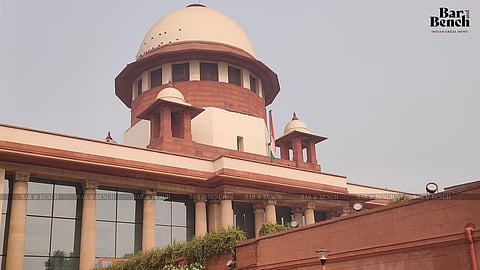
High Courts cannot question fiscal policies of municipal bodies in PIL: Supreme Court

"The writ jurisdiction of the High Court cannot be exercised in public interest for questioning the economic/fiscal policy or reforms sought to be undertaken by the Government," the Court said.
Supreme Court
Supreme Court
Published on
4 min read

The Supreme Court has held that High Courts cannot sit in judgment over policy decisions taken by municipal bodies, including on the revision of property taxes, unless such decisions are shown to be arbitrary or unconstitutional [Akola Municipal Corporation & Anr. vs. Zishan Hussain Azhar Hussain & Anr.].

A Bench of Justices Vikram Nath and Sandeep Mehta set aside a 2019 Bombay High Court order that had quashed the Akola Municipal Corporation’s decision to revise property taxes after nearly two decades.

The top court said that such matters lie squarely within the domain of local self-government institutions.

It underscored that such policies are not open to judicial interference unless they are shown to be unconstitutional. No such perversity or illegality was found in the present case.

"... judicial interference by way of public interest litigation is available only if there is injury to public because of dereliction of constitutional obligations on the part of the Government. The writ jurisdiction of the High Court cannot be exercised in public interest for questioning the economic/fiscal policy or reforms sought to be undertaken by the Government or its functionaries," the Court held in its December 8 ruling.

Justice Vikram Nath and Justice Sandeep Mehta

The case arose from a public interest litigation (PIL) petition filed in 2018 by a local doctor and municipal corporator, Dr. Zishan Hussain, before the Bombay High Court. Dr. Hussain challenged the Akola Municipal Corporation’s decision to revise the property tax for the period 2017–2022. He alleged that the revision was done “without following due process” and claimed that the increase was arbitrary.

The Corporation countered that property tax was its main source of income and that the rates had remained unchanged since 2001, despite rapid urban growth. It explained that the revision was based on a detailed process involving the Town Planning Department and a door-to-door property survey conducted through an external technical consultant.

The Corporation also clarified that the revision was not a new tax, but a reassessment of property values to reflect changes in use, construction, and infrastructure over 16 years.

The High Court, however, quashed the Corporation’s resolutions on the revised rates, and in a review petition reiterated its view that the increase was procedurally improper.

Aggrieved by this, the Corporation approached the Supreme Court.

The Supreme Court noted that the Corporation had detailed how the revision process was carried out transparently. The Court observed that municipalities depend on such revenue to perform essential public duties like waste management, sanitation, and maintenance of civic infrastructure.

The Bench said that without regular revision of taxes, municipal bodies would become “defunct and non-functional.” It explained the rationale behind municipal autonomy.

“Municipal bodies are entrusted with extensive and multifaceted responsibilities that bear a direct and immediate nexus to the daily lives, welfare and safety of citizens. Their functional efficacy, financial stability and administrative independence are integral to the discharge of these statutory obligations,” the Court said.

The Court criticised the High Court for entertaining the PIL and substituting its own opinion for that of the Corporation. It said the petitioner, being a corporator himself, could not have disguised a personal grievance as a public interest matter.

The Bench noted that the High Court’s interference went beyond its constitutional mandate.

“The High Court exceeded the well-settled limits of judicial review in effectively substituting its own opinion for that of the Corporation. Matters of tax revision fall squarely within the domain of the Corporation, and the High Court ought not to have reassessed the merits of the policy decision as if it was sitting in appeal,” the Court said.

The judgment cited earlier Constitution Bench decisions to reinforce that courts must not enter into questions of policy wisdom. 

The Bench further found that the PIL had effectively bypassed the statutory appeal mechanism under the Maharashtra Municipal Corporations Act. It said such petitions cannot be used as a “subterfuge” to challenge fiscal decisions outside prescribed remedies.

The Court concluded that the Akola Municipal Corporation was justified in revising property tax rates after 16 years, emphasising that the increase was long overdue and essential for public welfare.

“The Corporation, having kept taxes stagnant for almost 16 years, was under a statutory obligation to revise the rates. Had the exercise been done regularly, the cumulative increase would have been much higher than 40%,” the Bench said.

Holding that the High Court’s interference was unsustainable, the Court allowed the appeals and restored the Corporation’s resolutions revising the property tax.

The appellant (Akola Municipal Corporation) was represented by Senior Advocate Vinay Navare along with advocate Suhaskumar Kadam and Black & White Solicitors.

The respondents were represented by Senior Advocate AIS Cheema along with advocates Kunal Cheema, Kritika Gakhar, Rushabh Tripathi, Shubham Chandankhede, Aarti Gupta, Aaditya Aniruddha Pande, Anagha S Desai, Siddharth Dharmadhikari, Shrirang B Varma, Bharat Bagla, Sourav Singh, Aditya Krishna, Adarsh Dubey, Chitransha Singh Sikarwar, Satyajit A Desai, Sachin Singh, Pratik Kumar Singh and Sanchit Agrahari.

[Read Judgement]

Attachment
PDF
Akola Municipal Corporation & Anr. vs. Zishan Hussain Azhar Hussain & Anr.
Preview
Bar and Bench - Indian Legal news
www.barandbench.com