
Subscribe
Subscribe
- Latest Legal News
- News
- Law Firms
- Columns
- Interviews
- Law School
- Legal Jobs
- हिंदी
- ಕನ್ನಡ
Even in arbitrations led by experienced and proactive tribunals, institutional backing remains indispensable, Arbitration Bar of India (ABI) President and Senior Advocate Gourab Banerji said at a London International Disputes Week 2026 panel.
Speaking at a panel discussion featuring representatives from leading arbitral institutions, Banerji said that the role of institutions extends beyond branding and becomes critical in ensuring procedural discipline and handling contingencies.
Adding that institutions play a key role in situations involving defaults, challenges or non-participation by parties, he said,
"Even with an experienced and proactive tribunal, the support of any good institution makes a difference.”
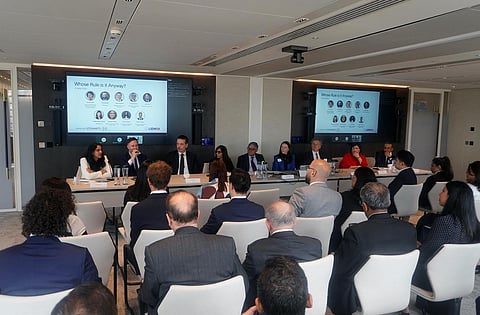
The panel, moderated by Sherina Petit, head of International Arbitration and India Practice at Stewarts, and Dhiraj Nair, partner at JSA, brought together representatives from leading arbitral institutions. The session was co-hosted by Stewarts and JSA.
Members of the panel included persons from the London Court of International Arbitration (LCIA), the International Chamber of Commerce (ICC), the Singapore International Arbitration Centre (SIAC), the Dubai International Arbitration Centre (DIAC) and the Mumbai International Arbitration Centre (MCIA). They formed a part of a broader discussion on institutional arbitration, costs and procedural safeguards.
Banerji emphasised that while parties often focus on the tribunal, institutions provide an important layer of accountability.
"The tribunals who are competent are sometimes very busy, so you need somebody to keep you in check," he said.
On whether an arbitral institution’s brand affects outcomes, Banerji said there is no fixed ranking among institutions and that the choice depends on the nature of the case.
"It's horses for courses. I think it depends on the nature of the case and then you pick the institution. You can't say...I pick X Y Z, there's no grading there."
He added that factors such as the seat of arbitration and the nature of the dispute should guide the choice. Citing an example, Banerji noted that disputes involving Indian parties and an Indian seat may be better suited to domestic institutions such as MCIA.
Echoing similar concerns, David Joseph, a barrister at Essex Court Chambers, said that institutions play an important role in improving efficiency, particularly in addressing delays that continue to affect arbitration proceedings.
"Some of these arbitrations are taking too long and it takes too long to get a a tribunal constituted. It takes too long from the end of the hearing to the actual award itself. These are areas where I think all of us in the community are responsible. I think that is probably where, I would say, institutions should be focused next."
Joseph added that institutional arbitration has become the dominant model because it inspires confidence among parties, but also acknowledged persistent inefficiencies in the system.
“Institutional arbitration has taken hold…it is by far and away the most popular means of parties drawing up an arbitration agreement,” he noted.
They were responding to a question posed by Petit on whether, in a case with a highly experienced tribunal in an ad hoc arbitration, the “seal” or involvement of an institution still makes a meaningful difference.
On another question relating to the value of scrutiny and administrative oversight of arbitral awards, Banerji described institutional review as indispensable.
"Somebody is there to check your calculations, all the formal bits get ticked off...I think it's very helpful...It is necessary. It’s not even desirable, it’s necessary,” he said.
His comments came amid a broader discussion on the varying levels of scrutiny applied by institutions such as the ICC and the LCIA, and the balance between oversight and efficiency.
Joseph broadly echoed the importance of improving institutional processes, suggesting that greater focus is needed on reducing delays in constitution of tribunals and issuance of awards.
He also observed that while parties ultimately seek cost-efficient and thorough adjudication, institutions can influence timelines and procedural effectiveness.
"The client wants a cost efficient process. It wants a tribunal that's really really going to dig into the the the weeds of the case and actually get a thorough examination of the merits. But they also want them time efficient...that is where the choice of an institution does make a difference,” he noted.