Institutions must remember the human being behind every dispute: CJI Surya Kant at former CJI BR Gavai's book launch

At the launch of former CJI BR Gavai’s book, The Voice of Justice: Justice Gavai Speaks, the Chief Justice said constitutional promises become meaningful only when institutions retain their human face.
Former CJI Gavai Book Release
Published on
2 min read
Listen to this article

Chief Justice of India (CJI) Surya Kant on Tuesday said constitutional promises become meaningful only when institutions remember the human being behind every dispute and ensure that the law retains its human face.
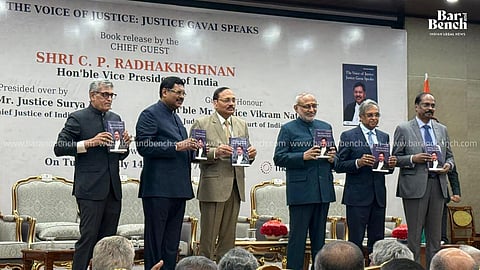
The CJI made the remark while speaking at the launch of former Chief Justice of India BR Gavai’s book, The Voice of Justice: Justice Gavai Speaks, held at the residence of Vice President of India CP Radhakrishnan, who was the chief guest at the event.

Also speaking on the occasion were Justice Gavai himself and Justice Vikram Nath of the Supreme Court while Professor S Shivakumar, who edited the volume, introduced the book.

Describing the book as “an intellectual record of constitutionalism in motion”, the CJI said speeches often reveal the constitutional concerns and institutional values that judgments, by their very nature, cannot always express.

“The first is the insistence that the Constitution is not self-executing. Its promise becomes real only when institutions remember the human being behind the dispute.” he said.

Former CJI Gavai Book Release

Justice Kant said Justice Gavai’s speeches consistently emphasised access to justice, free legal aid, compassion in justice delivery and the need to view fundamental rights and social justice as complementary constitutional values rather than competing ones.

He said the book also reflected on emerging issues such as technology, legal education, arbitration, climate concerns, judicial collaboration and public confidence in courts, while asking how legal institutions could remain principled, accessible and humane in a changing society.

“They offer an insistence that the law retain its human face even while modernising, that courts remain accessible even while managing complexity, and that constitutional morality must not remain a phrase reserved for judgments but should inform institutional dharma in everyday life.” he added.

Vice President Radhakrishnan described the book as “an important constitutional and institutional document” and said institutions derive their strength not merely from constitutional authority but also from public trust and constitutional culture.

“An institution’s true character is revealed not by the powers vested in it, but by the wisdom guiding the exercise of those powers.” he said.

Justice Gavai said he had initially been reluctant to publish a compilation of speeches delivered on different occasions but hoped the book would encourage students, lawyers, judges and scholars to engage more deeply with constitutional ideas.

“Judgments necessarily decide disputes before the courts. Speeches however permit a judge to participate in a wider constitutional conversation.” he said.

Justice Vikram Nath described the volume as “timely and long overdue”, saying it offered readers a fuller picture of the person behind the judgments.

“Judgments necessarily speak in the disciplined language of law. Speeches, however, often tell us a lot more about the judge, the values he holds, the institutions he believes in, and the society he hopes to help build.” Justice Nath said.

The event was attended by sitting and former judges of the Supreme Court and High Courts, Attorney General R Venkataramani, Solicitor General Tushar Mehta, members of the Bar and legal academia.

Bar and Bench - Indian Legal news
www.barandbench.com