
Subscribe
Subscribe
- Latest Legal News
- News
- Law Firms
- Columns
- Interviews
- Law School
- Legal Jobs
- हिंदी
- ಕನ್ನಡ
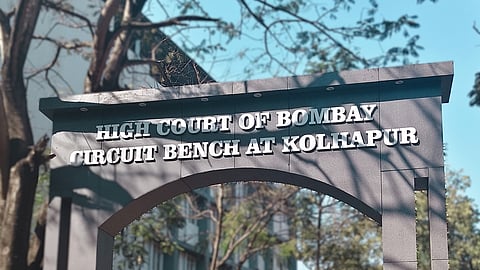
The Kolhapur circuit bench of the Bombay High Court, located just a few metres from the famed Mahalaxmi Temple, doesn’t intimidate; it welcomes. The stone façade from 1874 carries the dignity of history without the chill of authority.
Inside, advocates greet each other in Marathi, proceedings move quickly but never hurriedly. Litigants from remote talukas fill the grounds, many entering a High Court for the first time.
Five months since its inauguration, Maharashtra’s fifth High Court seat has become a quiet experiment in access to justice. It blends heritage with efficiency.

Former Bombay High Court Justice TV Nalawade, himself from Kolhapur, captured the sentiment best:
“Our matters are matters of the poor. In Mumbai, they are often lost among the big ones. In Kolhapur, the poor have both wisdom and now a court.”
That sentiment runs through every interaction from the Bench - a belief that justice is no longer distant, but something that lives within the tightly-knit community.
Situated in the heart of Kolhapur city, the Bench operates from the renovated heritage district court building, once home to the Supreme and High Courts of the princely state under Chhatrapati Shahu Maharaj.
Built in 1874, the structure remained unused after the district court shifted, until a ₹46 crore restoration by the public works department and local authorities revived it.
The complex now houses a division bench courtroom, two single-bench courtrooms, chambers, a mediation centre and modern record facilities.
The adjoining Radhabai Building serves as the Registrar’s office.
The site carries deep historical resonance, with jurist and reformer MG Ranade first presiding as Kolhapur’s district judge here in 1867.
This is a temporary arrangement and the State has already earmarked land at Shenda Park for a permanent High Court campus.
The Bench was established under Section 51 of the States Reorganisation Act, 1956, which permits additional sittings of High Courts with approval from State and Governor.
Inaugurated on August 17, 2025, by then Chief Justice of India BR Gavai, the circuit bench was described as “the culmination of a 40 to 45 year struggle” and a reaffirmation of the constitutional promise of accessible justice.
Justice Gavai noted he had chosen to inaugurate the Bench just after Independence Day “so that people could get freedom from their problems in getting justice.”
He also lauded the public works department for completing the restoration within 25 days, calling it a feat worthy of entry into the Guinness Book of World Records.
The Kolhapur circuit bench emerged from decades of persistent advocacy by lawyers and litigants from six western Maharashtra districts: Kolhapur, Sangli, Satara, Solapur, Ratnagiri and Sindhudurg.
The demand, at first centred around convenience and affordability, evolved into a movement for decentralised justice.
Kolhapur was chosen after a detailed study by then Chief Justice Mohit Shah, who found that it could serve six districts, covering more than half the area under the Principal Seat, with over 50 talukas located 300 to 500 km from Mumbai.
Local bar associations also supported the move. Competing claims from Jalgaon, Pune, Nashik and Amravati fell away on grounds of distance and regional consensus.
On August 1, then Chief Justice of the Bombay High Court and now Supreme Court Justice Alok Aradhe issued a notification to constitute the circuit bench at Kolhapur.
The change has been transformative.
“Over 250 lawyers who earlier practised only in the district courts now appear before the High Court here,” said Bar Council of Maharashtra & Goa (BCMG) member Shrikant Jadhav.
Filings from the six districts are now at par with those in Mumbai, he added, “and disposals are often faster because clients can afford to litigate locally.”
In just four months, from August to December 2025, the Bench received 4,830 filings and disposed of 4,568, covering individual crimes, property disputes and co-operative matters.
The pace defies the old tarikh pe tarikh stereotype, said former BCMG chairman and present member, advocate Sangram Desai.
“Many appealable orders were never challenged because litigants couldn’t afford Mumbai travel. Now, cases are being revived and local PILs are holding administration to account.”
For all its success, the Bench faces hurdles. Over 250 staffers transferred from other benches are awaiting housing and pay adjustments.
Recruitment remains frozen until permanent status is achieved, though State-wide hiring has begun. Judges themselves often assist with listings and hearings to keep matters moving.
Concerns also surfaced from judges who served at the apex level. Former Supreme Court Justice AS Oka, who was elevated from the Bombay High Court, questioned whether the Bench’s establishment followed due process.
He remarked that regional sentiment and political pressure could not alone solely justify setting up a new bench.
He also pointed to pathetic infrastructure across trial courts and a judge population ratio below 25 per million, asking if limited resources might be better spent at the grassroots.
Nevertheless, operations have remained steady. The Kolhapur Bench’s cases are now fully integrated into the Bombay High Court’s e-courts system.
On December 18, 2025, the Supreme Court dismissed a legal challenge to its creation, paving way to make the circuit bench a permanent one in due course. The Bench now stands on firm legal ground and the debates have shifted topics like capacity and infrastructure.
What sets Kolhapur apart is its warmth. The rapport between Bar and Bench is not performative, but genuine.
Senior Advocate Narendra Walawalkar described it as “a rare blend of firmness and empathy.”
He recalled a recent felicitation ceremony where the judges’ exchanges with senior advocates were full of emotion and mutual respect; something he had never seen in Mumbai.
Judges here are not only adjudicating matters, but also mentoring. Justice Karnik and his colleagues have encouraged young advocates to transition gradually to High Court practice, allowing them space to learn at their own pace.
Practice in taluka courts and the High Court is completely different, Desai admitted. To bridge that gap, the Bar Council has been arranging trips for local lawyers to observe proceedings and encouraging them to watch live streams.
“We want our young lawyers to see senior counsel argue, to see judges confront them. We are building a new generation of lawyers here,” he said.
Walawalkar said that the juniors were being polished through real High Court experience.
Judges at the bench have set an unexpectedly brisk rhythm. Matters are often heard within days of filing and disposed of within a month.
As of December 1, 2025, pendency stood at 65,732 cases relocated from the six districts that had long burdened Mumbai.
Till December 2025, the division bench was led by Justice Karnik, who presided for first two months with Justice Sharmila Deshmukh and thereafter with Justice Ajit Kadethankar.
Justices Shivkumar Dige and SG Chapalgaonkar led the two single-judge benches till December.
The benefits extend beyond the Bar. Police officers who once traveled overnight for bail hearings now reach the High Court within hours.
“Earlier, an officer from Sindhudurg or Satara would travel 12 hours just to miss the hearing,” Desai said.
“Now, they can be here in three hours. The system itself is breathing easier.”
Justice Nalawade sees the Bench as a model of sustainable decentralisation.
“What once cost a litigant ₹2.5 lakh in Bombay now takes ₹15,000 here. Lawyers from small towns are rising. They should have chambers and Shenda Park must evolve into a full-fledged campus.”
He also argued that local lawyers possess deep factual and doctrinal command, skills honed through years assisting Mumbai counsel.
He believes that the circuit bench will soon need at least 17–18 judges to meet the growing docket and land should be allotted accordingly to meet the growing demand.
For now, the Kolhapur circuit bench functions from a building that once symbolised princely-state justice.
Its arches still stand and now echo with the footsteps of first-generation High Court advocates from the grassroots level.