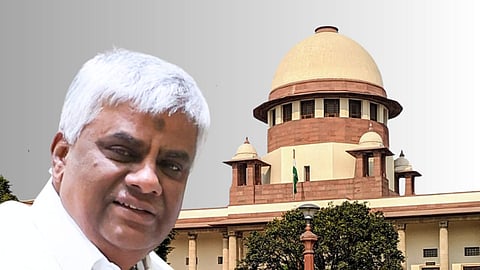
The Supreme Court on Monday issued notice in an appeal filed by the Karnataka government challenging the discharge of Janata Dal (Secular) leader MLA HD Revanna in a sexual harassment case filed against him by a former domestic worker..A Bench of Justices JB Pardiwala and K Vinod Chandran issued notice on the State's plea today.A Bengaluru trial court had discharged HD Revanna from the case after noting that there was a four-year delay in filing the complaint. The December 2025 trial court order was passed after the Karnataka High Court granted Revanna partial relief on his plea to quash the case altogether. In a November 2025 ruling, the High Court had held that while the allegations against Revanna could amount to the offence of sexual harassment, they did not amount to the graver offence of outraging a woman's modesty. The matter was then remanded to the trial court, which discharged Revanna the following month. The Karnataka government has now challenged this turn of events before the Supreme Court.During today's hearing, the Bench expressed deep dissatisfaction with how the charges were handled by the courts below."How can the High Court change the charges? The court took cognisance. Now you have been discharged from Section 354 (outraging woman's modesty) also?" asked the Court. .The sexual abuse allegations against HD Revanna and his son Prajwal had emerged after over 2,900 videos depicting the sexual assault of several women were circulated on social media.On April 28, a first information report (FIR) was registered against Prajwal Revanna and HD Revanna under Sections 354A (sexual harassment), 354D (stalking), 506 (criminal intimidation), and 509 (insult to modesty of woman) of the Indian Penal Code (IPC) at the Holenaraseepur town police station, Hassan district. The criminal case was registered on a complaint filed by one of the victims.HD Revanna faced two criminal cases - one involving allegations of sexual assault and the other involving allegations of kidnapping. He has been granted bail in both cases.At the stage of filing the chargesheet, the police also added the charge of Section 354 of the IPC.Revanna eventually moved a quashing plea before the Karnataka High Court. He argued that the case against him ought to be quashed as the complaint was filed beyond the three-year limitation period prescribed for the cited offences. Because the complaint was lodged after a four-year delay, his counsel argued it was legally unsustainable.The Karnataka High Court granted him partial relief. It quashed the trial court's decision to take cognisance of the Section 354 IPC charge added by the police in its chargesheet and remanded the matter back to the trial court to consider whether the case was barred by limitation with respect to the remaining offences. The trial court was called to decide whether the delay could be condoned under Section 473 of the Code of Criminal Procedure (CrPC), which permits courts to extend deadlines if the delay is properly explained.Howeber, the trial court held that it was not a fit case to condone the delay and proceeded to discharge HD Revanna from the case. .The Karnataka government has now challenged the discharge before the apex court..[Read Live Coverage]