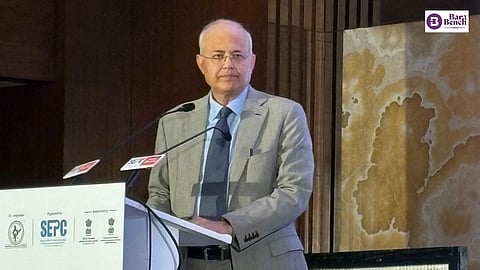
Supreme Court judge Justice Manmohan on Friday described the Kesavananda Bharati judgment as India’s “most significant” contribution to the global rule-of-law discourse. .He credited the basic structure doctrine evolved in this judgment as having been crucial for the survival of the Constitution of India and judicial independence. He observed that the 1973 verdict set constitutional boundaries that the Parliament “cannot cross”, which have now evolved into a guarantee for democratic continuity.“The amending power gives liberty to innovate, but not to destroy the basic structure. It has ensured democracy is firmly entrenched and has restrained institutions involved in governance,” he said.He further noted that the judgment entrenched unalterable norms such as the separation of powers and the rule of law, which have allowed constitutional endurance.“This basic structure doctrine (evolved in the Kesavananda Bharati judgment) has ensured that the Constitution has survived in this country for 75 years. Normally, if you study the life of a Constitution, the lifespan is about 20 years," he went on to point out. Justice Manmohan added that the basic structure doctrine now shapes investor confidence.“When the investor comes, he wants to be assured that the contract entered into will be enforced by an independent judiciary,” he said, calling the separation of powers as being something that is integral to commercial certainty..Justice Manmohan also recounted an incident from his days of legal practice, when a foreign solicitor once asked him whether senior government officials in India could be approached to influence a verdict in his client's favour.“My answer was no. We have a clear separation of powers. No executive can influence the judiciary," he said. Justice Manmohan also linked the constitutional evolution in India to contemporary judicial decisions such as those in the electoral bonds case, observing that courts continue to insist on transparency and accountability in political finance..Justice Manmohan was speaking at the inaugural session of the International Bar Association (IBA) India Litigation and ADR Symposium, on the theme, "Will the rule of law and the justice delivery system in India offer a competitive edge over other developing economies? Can uniform laws and justice delivery mechanisms drive us towards a borderless world?".Attorney General for India (AG) R Venkataramani also spoke at the event. He told the audience that the rule of law and access to justice now operate as mutually reinforcing constitutional commitments. Justice delivery must reach citizens in a meaningful form rather than exist as a mere institutional structure, he said. “Access to justice is an integral part of the rule of law," he added. He said India’s constitutional architecture reflects convergence between fundamental rights and directive principles, producing what he described as a seamless breadth of constitutional values.The Attorney General, however, went on to observe that India should rethink adversarial litigation and build a stronger culture of mediation and arbitration.“The more we try to make good an adversarial system, the more problems we have with it. We need courts replicated on new models," he said. .Former UK Attorney General Lord Peter Goldsmith cautioned that the rule of law should not be confused with rule by law. Singapore International Commercial Court president Justice Philip Jeyaretnam spoke of how international commercial courts are building cross-border certainty and jurisprudence that arbitration cannot.The symposium, hosted by the India Working Group of the International Bar Association, featured discussions on constitutional safeguards, justice system reform, mediation culture, digitisation of courts and comparative dispute resolution frameworks.