
Subscribe
Subscribe
- Latest Legal News
- News
- Law Firms
- Columns
- Interviews
- Law School
- Legal Jobs
- हिंदी
- ಕನ್ನಡ
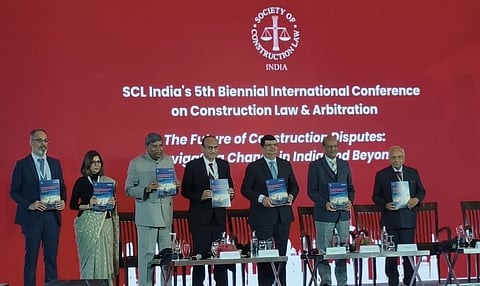
Khaitan & Co, in collaboration with the Society of Construction Law (SCL) India, has launched a whitepaper titled “Delay and Disruption under the Global Frameworks: A Framework for Structured Construction Dispute Resolution in India”.
This publication proposes a clear, unified and globally benchmarked framework for analysing delay and disruption claims in India. It advocates for adoption of internationally recognised standards, including the SCL Protocol, AACE RP 29R-03 and FIDIC frameworks to Indian contractual conditions, and claim assessment.
Key recommendations of the whitepaper include:
Adoption of globally aligned principles for delay attribution, concurrency analysis, and disruption evaluation
Strengthening of programme management through contemporaneous records, regular schedule updates, and early-warning mechanisms
Integration of SCL and AACE methodologies within FIDIC-style contract administration for consistent EoT and cost assessments
Establishment of institutional guidelines to promote methodological consistency among tribunals and experts
Increased use of technology-driven evidence—BIM, P6 data, 4D modelling, photogrammetry—to enhance objectivity in arbitral decision-making
Speaking on the launch, Sanjeev Kapoor, Senior Partner, Khaitan & Co stated,
“Dispute resolution must keep pace with the scale and complexity of India’s infrastructure ambitions. A structured and transparent methodology for claims assessment strengthens trust, reduces friction, and enhances efficiency across the entire project lifecycle.”
Gaurav Juneja, Partner, Khaitan & Co added,
“Indian construction arbitrations are often affected by a lack of uniform methodology for delay and disruption analysis. This whitepaper collates the best internationally aligned frameworks that could bring much-needed clarity, discipline, and predictability to the sector.”
Ratan K Singh, Senior Advocate and Chairman, The Society of Construction Law – India said,
“This collaboration brings to light global best practices in the Indian context. Having a structured delay and disruption analysis framework can dramatically reduce the time, cost, and uncertainty associated with construction disputes.”