

Chief Justice of India Surya Kant on Friday criticised the increasing complexity, cost and exclusivity of modern international arbitration, saying that a process created as an alternative to litigation was beginning to acquire the same defects it was meant to avoid.
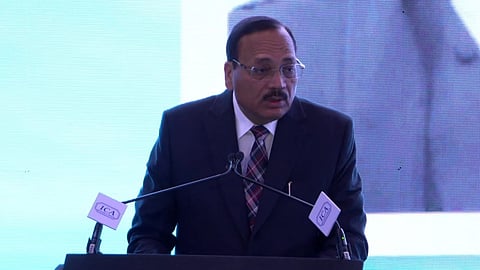
He said "Arbitration was built to be the answer to the pathologies of formal litigation, and it is seemingly acquiring each of those very failings. In other words, the remedy has come to resemble the disease it was designed to kill."
The CJI was speaking at the 4th International Conference of the Indian Council of Arbitration (ICA) on arbitrating Indo-UK commercial disputes in London. The conference, held during London International Disputes Week 2026 at Church House, focused on ADR as a catalyst for strengthening the Indo-UK economic partnership.
The event was also attended by Master of the Rolls and Head of Civil Justice of England and Wales Sir Geoffrey Vos, Deputy High Commissioner of India to the United Kingdom Karthik Pandey, Vice President of the Law Society of England and Wales Brett Dixon, ICA President Dr NG Khaitan and ICA Director General Arun Chawla.
Justice Surya Kant said arbitration must ask with candour where it may have drifted from its founding purpose and what must be done to restore that purpose.
He said arbitration did not begin as a creature of statute and did not spring into life with the English Arbitration Act of 1889, India’s first arbitration legislation of 1899 or the New York Convention of 1958. Those instruments, he said, merely recognised, regularised and regulated a practice that commerce had already developed over centuries.
Referring to medieval merchants at the trade fairs of Champagne and India’s ancient panchayat system, the CJI said arbitration was rooted in the idea that disputes must be decided by persons who understand the trade and the realities of those involved.
“Justice is most legitimate when it is chosen freely, delivered by someone who understands your world, and proportionate to what is actually at stake," he said.
He said the difficulty begins when the machinery overwhelms the purpose.
“If arbitration becomes too expensive, too slow, too closed, or too formal for the parties it is meant to serve, then the institution must look within.”
Justice Surya Kant said international arbitration today faces structural challenges, including concentrated appointment patterns, heavy pleadings, multiple procedural rounds, long hearings and fee structures that many users find difficult to bear.
He clarified that repeat appointments in high-value arbitration were not by themselves evidence of impropriety, since expertise is often built through reputation. However, concentration could create a perception that arbitration was distant and difficult for others to enter.
The CJI also cautioned against stretching party autonomy beyond its intended purpose.
“Party autonomy was never intended to mean that parties are entitled to engineer the identity of the decision maker most likely to favour their position.”
He said party autonomy meant the right to insist on an independent, impartial and fair process capable of inspiring confidence.
Turning to the Indo-UK economic corridor, Justice Surya Kant said the India-UK Free Trade Agreement was an unquestionably historic moment. However, he added that ambitions are realised in contracts, not communiqués.
He said the next wave of Indo-UK trade would be carried not only by conglomerates, but also by pharmaceutical suppliers, fintech firms, clean energy businesses, digital platforms and mid-market manufacturers.
“If our ADR mechanisms work only for disputes large enough to justify high fee or large legal teams, that might fail the very commercial partnerships that they are meant to support.”
Sir Geoffrey Vos said AI-driven arbitration and ADR could offer advantages of cost and speed, but cautioned that AI tools must be trained and tested on materials relevant to the states of the parties involved.
Karthik Pandey said India-UK trade stood at approximately £47.9 billion and that the ambition of doubling bilateral trade by 2030 appeared within reach.
Brett Dixon said India had taken important steps to position itself as a leading arbitration hub. Arun Chawla said arbitration had become the “silent infrastructure of globalisation.” Dr NG Khaitan said India’s growth, legal reforms and lower arbitration costs made it an attractive venue for dispute resolution.
Justice Surya Kant concluded that arbitration did not need another ceremonial tribute to its past, but a serious recommitment to the reason it came into being.
“We must ensure that arbitration is not a privilege of scale, but an instrument of justice.”