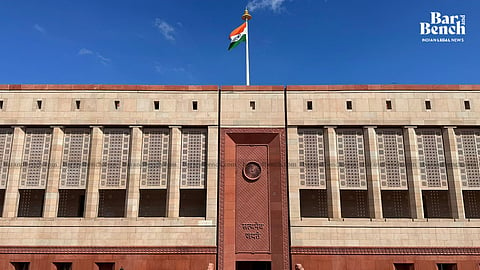
The Lok Sabha on Friday rejected the Constitution (131st Amendment) Bill, 2026, which had proposed to increase the strength of the House of the People from 550 to 850 members..The bills failed on account of not getting the requisite 2/3rd majority in the Lok Sabha required for a Constitutional amendment.While 278 of the 489 members in attendance voted in favour of the bill, 211 voted against it. After the Constitutional amendment bill failed to pass, the government proceeded to withdraw the Delimitation Bill, 2026 and Union Territories Laws (Amendment) Bill, 2026.The development marked a significant setback to the government’s plan to overhaul India’s electoral framework..The three Bills introduced by the Union government—the Constitution (131st Amendment) Bill, 2026, the Delimitation Bill, 2026, and the Union Territories Laws (Amendment) Bill, 2026— were part of a coordinated legislative effort to enable a nationwide delimitation exercise after decades.The immediate trigger for these changes was in the constitutional requirement to eventually realign representation with population. While the Constitution originally envisaged periodic readjustment of seats after each census, this process was effectively put on hold through amendments beginning in 1976, which froze the allocation of Lok Sabha seats among States based on the 1971 Census. This freeze, later extended until after the first census post-2026, meant that India has not undertaken a full redistribution of seats between States for nearly five decades..The Constitution (131st Amendment) Bill, 2026 provided the enabling constitutional changes—expanding the Lok Sabha’s strength, removing the freeze on seat allocation, and allowing representation to be recalculated based on updated census data.The Delimitation Bill, 2026 was to operationalise this framework by providing for the constitution of a Delimitation Commission to carry out the exercise of allocating seats, redrawing constituencies, and determining reservations.The Union Territories Laws (Amendment) Bill, 2026 proposed consequential changes to laws governing Delhi, Puducherry and Jammu & Kashmir to align them with the revised constitutional and delimitation framework.The legislative package was also linked to the implementation of one-third reservation for women in Parliament and State Legislative Assemblies, which was to take effect after the delimitation exercise was completed.The opposition parties, while in support of the women's quota, has asked for its implementation independent of delimitation.Many politicians from the south took strong objection to delimitation alleging that it will reduce the voice of the southern States in the parliament since the proportional representation of south, which has lesser population, will decline in parliament.They alleged that the women's reservation law has been tied up with delimitation as a ploy to push the passage of the latter law, so that the strength of the Lok Sabha from Hindi speaking States in the north India go up thereby giving an unfair advantage to the ruling BJP which has a stronger political foothold in the north.The southern parties and Congress had therefore made it clear that they will oppose the Constitutional amendment and delimitation.