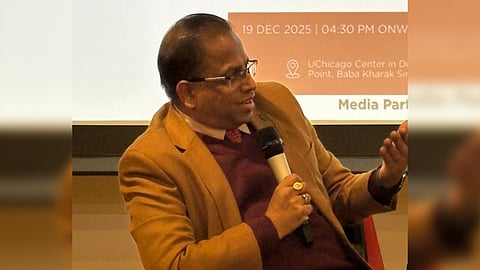

Supreme Court Justice KV Viswanathan on Friday said that Swadeshi jurisprudence reflects the confidence of Indian constitutionalism to engage with global legal ideas, while firmly rejecting any “slavish adherence” to foreign doctrines that do not align with India’s constitutional text, principles and social realities.
Speaking at a panel discussion titled Blueprints of Liberty: Comparative Powers in Constitutional Democracy, Justice Viswanathan emphasised that Indian courts are ultimately interpreting the Constitution of India. He added that comparative jurisprudence can only be drawn upon insofar as it “comports with our social milieu, our established principles and our text.”
The discussion was jointly organised by the Palkhivala Foundation and the University of Chicago’s Delhi Center. It featured Attorney General for India R Venkatramani, Delhi High Court Chief Justice Devendra Kumar Upadhyay, Professor Tom Ginsburg of the University of Chicago and Senior Advocate Meenakshi Arora. The session was moderated by Advocate Payal Chawla.
Justice Viswanathan emphasised that constitutional interpretation is an evolving exercise and cannot be treated as complete or closed.
“You can’t say enough is enough. It’s the Constitution that you are interpreting. It can’t be fossilised. It is an organic law,” he said.
Highlighting the uncertainty of future challenges, he added,
“We don’t know what situations will present themselves and how much in the era of artificial intelligence the natural one will be tested."
Explaining why Indian jurisprudence has historically engaged with ideas from multiple jurisdictions, Venkatramani said that constitutional doctrines and democratic institutions cannot remain static.
“Every doctrine and every institution has a tendency to expand. If institutions and doctrines don’t expand, they become static,” the Attorney General observed.
He added that engaging with ideas from different traditions enriches constitutional understanding rather than weakening it, and warned against turning constitutional interpretation into a closed exercise.
Chief Justice Upadhyay also spoke about the breadth of the High Courts’ powers under Article 226 of the Constitution and how that jurisdiction has been used to protect dignity and fundamental rights.
Recalling what he was taught as a student of constitutional law, Justice Upadhyay said,
“The House of Lords in England could do anything, but they could not change a man into a woman. Indian High Courts under 226 can do even that.” He explained that the language of Article 226 gives High Courts “a lot of play in the joints”, allowing judges to innovate while remaining within constitutional bounds.
He said Article 21 has continued to expand to protect dignity in situations not expressly provided for in the Constitution. Referring to the Hathras incident in Uttar Pradesh, Justice Upadhyay said that a rape victim’s body was cremated by the administration without allowing her family to perform last rites.
“Instead of giving her a dignified last rites, they just burned that body,” he said.
The High Court, he noted, intervened to frame safeguards recognising dignity even after death.
Professor Ginsburg offered a comparative perspective, contrasting the philosophical foundations of the American and Indian Constitutions.
“In many countries of the world, the cardinal value in the constitution is dignity, human dignity...That’s a word that doesn’t appear in much American jurisprudence. Our cardinal value is liberty.”
“We’re very libertarian,” Ginsburg added, explaining that American constitutional law often treats rights as absolutes rather than balancing them through proportionality. He cautioned that developments in the United States tend to influence courts elsewhere, noting,
“Some of the decisions are getting cited for what I would say are the wrong reasons.”
Senior Advocate Raju Ramachandran, raising a question on electoral rights, pointed to the tension between statutory classifications and constitutional values.
“The right to vote is being held to be a statutory right. But the overarching constitutional principle is universal adult suffrage,” he said.
Responding to this, Senior Advocate Meenakshi Arora drew on her experience as former standing counsel for the Election Commission of India and referred to the Supreme Court’s decision on NOTA.
“There was a privacy that was attached to it. The man would never get identified who has cast that particular vote,” she said.
She explained that electronic voting introduced new privacy concerns, particularly in rural settings.
“When you use an electronic voting machine, there is that sound that goes off recording whether you voted or not. So his privacy was compromised,” Arora said.
“So we use this aspect of privacy to bring in NOTA onto the balloting machine,” she added, emphasising that voting rights cannot be divorced from constitutional values such as dignity and privacy.