"A soft voice and an iron resolve": Justice Revati Mohite Dere to begin new innings at Meghalaya High Court

From Haji Ali and Shakti Mills to queer rights and police accountability, Justice Revati Mohite Dere brings a decade of rights‑driven, no‑nonsense judging to the Meghalaya High Court.
 Justice Revati Mohite Dere
Justice Revati Mohite Dere
Published on
7 min read

"The work of a judge is not just to interpret law, but also to uphold people’s faith in the judiciary," Justice Revati Mohite Dere said in her farewell speech, days before she took oath as the Chief Justice of the Meghalaya High Court.
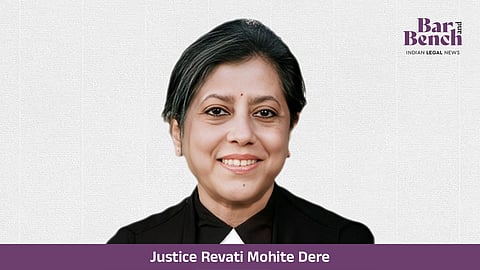
The Central government notified her transfer on January 1 after the Supreme Court Collegium made the recommendation on December 18 last year. She took oath at the Meghalaya High Court on January 10. She became only the second woman to head the Meghalaya High Court.

She was one of the senior-most women judges of the country’s second-largest High Court, who moved to lead a comparatively smaller institution with a sanctioned strength of just four judges.

According to sources familiar with the matter, Justice Dere could be considered for elevation to the Supreme Court in the coming months, given her seniority and the apex court’s emphasis on gender representation.

During a full court reference to bid her farewell at the Bombay High Court, she said that being a judge was a "calling" for her and "not just a profession".

Early years

Born in Pune, Justice Dere studied at Symbiosis Law College, ranking second in the University of Pune. She belonged to the first batch of students from the five-year law programme in her college. She then went on to pursue an LL.M. at the University of Cambridge on a Cambridge Commonwealth Trust Scholarship.

After returning to India, she practised at the Bombay High Court - first under her father Senior Advocate Vijayrao A Mohite and later with former Advocate General and judge Raja S Bhosale - before serving as public prosecutor and government pleader for Maharashtra.

Senior advocate Vijayrao A Mohite
Senior advocate Vijayrao A Mohite Instagram - Divya Chavan (Grand daughter)

She credits her parents, particularly her father, for raising three daughters with the same expectations and opportunities as any son.

Her elder sister Vandana Chavan is a leader in the Nationalist Congress Party (Sharad Pawar faction) and a former Rajya Sabha Member of Parliament. Her twin sister Vinita Kamble is a lawyer and author, and the wife of late IPS officer Ashok Kamte, an Ashok Chakra awardee killed in the 26/11 Mumbai terror attacks.

(L to R) Chief Justice Revati Mohite Dere, former Rajya Sabha MP Vandana Chavan, author & lawyer Vinita Kamte
(L to R) Chief Justice Revati Mohite Dere, former Rajya Sabha MP Vandana Chavan, author & lawyer Vinita KamteVandana Chavan Facebook account

During her farewell full court reference held on December 8, Advocate General of Maharashtra Milind Sathe recounted an incident from 1985, where during a conference in Pune, he witnessed a young girl discussing the pros and cons of the five-year law course with seniors.

“That young, bright girl is today poised to be Chief Justice of the Meghalaya High Court. True to the meaning of her name, she has shown empathy, compassion and kindness in abundance to everyone and in her decision-making process,” he said.

Advocate General Milind Sathe

Justice Dere was appointed as an additional judge of the Bombay High Court on June 21, 2013 and made a permanent judge in March 2016.

Here, we look at some of the cases she has dealt with as a judge.

Gender justice and equality

Justice Dere consistently read equality and dignity into the Constitution, challenging patriarchal norms in both public spaces and marital relations.

As a junior judge on a division bench in 2016, Justice Dere played a pivotal role in the landmark ruling that allowed women unrestricted access to the inner sanctum of Mumbai’s Haji Ali Dargah. The Court struck down the gender‑based ban as violative of Articles 14, 15 and 25 of the Constitution.

Her stance on sexual violence has been uncompromising. In 2019, she was on the bench that refused to interfere with the death penalty awarded to repeat offenders in the Shakti Mills gang-rape case and denied the convicted police personnel in the case an early release.

In 2021, upholding a man’s conviction for fatally assaulting his wife with a hammer, she rejected claims of grave and sudden provocation, noting that a wife is not a chattel or an object and that such defences reflect “deep‑seated patriarchal notions of wives as property rather than equal partners.”

Justice Dere also pressed for reform of Section 498A IPC, suggesting that the Union government should consider making the non‑compoundable offence compoundable with court permission, in cases where parties have settled their dispute.

Investigative agency accountability

The judge treated encounter cases and custodial violence as rule of law failures, demanding transparency and FIRs.

During the hearing of the Sohrabuddin Sheikh encounter case, the Bench led by Justice Dere repeatedly questioned why the Central Bureau of Investigation (CBI) had not challenged the discharge of senior IPS officers while actively opposing relief only for lower‑ranking officials, highlighting concerns of selective prosecution. She also questioned the CBI’s sincerity in protecting numerous witnesses who were turning hostile in the trial.

She headed a Division Bench refusing bail to Pradeep Sharma in the Antilia terror scare case, noting probe gaps including his unexplained presence at the Mumbai Police Commissioner’s office in March 2021.

In the Badlapur alleged fake encounter case of 2024–25, she warned against delayed FIRs despite magisterial findings. She reasoned that the judicial system’s credibility was at stake and compelled registration under contempt threat.

In the ICICI–Videocon case, her Bench questioned CBI delays after lodging the 2019 FIR. She also granted interim bail to former ICICI Bank CEO Chanda Kochhar and her husband Deepak Kochhar on grounds of illegal arrest.

Chanda Kochhar and Bombay Hgih Court

Justice Dere’s jurisprudence often expanded the protections under Article 21, pushing back against investigative excess. In 2022, her Bench held the right to sleep and blink as part of Article 21, directing the Enforcement Directorate (ED) to record statements during reasonable hours after overnight interrogation allegations.

Queer and juvenile rights

Her rulings protected queer couples and children, demanding police sensitisation and speedy trials.

In a case involving a same-sex couple whose families attempted to use kidnapping complaints to separate them, Justice Dere’s bench directed Maharashtra to frame guidelines on handling missing and kidnapping complaints involving same‑sex couples. The Court asked the State to consult LGBTQIA+ community members and refer to protocols framed by the Madras High Court.

LGBTQIA+
LGBTQIA+

In 2022, she directed Protection of Children from Sexual Offences (POCSO) courts to complete the examination of minor victims as expeditiously as possible so that their fading memory does not advantage the accused.

As Juvenile Justice Committee chair, she reformed Dongri Observation Home.

“Her vision was to ensure that home produces a conducive environment for the overall development of the children who are in need of the care and protection. I have seen photographs of the centres and it is just like some three-star hotels”, Additional Solicitor General Anil Singh said.

Senior Advocate Anil Singh

At the inauguration of an additional Juvenile Justice Board in Yerawada in 2025, Justice Dere stressed the need to channel juveniles’ energy positively - through sports, counselling, de‑addiction and grievance mechanisms. She suggested that such models be replicated across observation homes.

President of the Bombay Bar Association and Senior Advocate Nitin Thakker said that the judge was someone with a soft voice and an iron resolve.

“She taught us that one does not need to be loud to be heard, and one does not need to be harsh to be tough”, he said during the farewell reference.

Systemic infirmities and free speech

She directed an inquiry into a leak of judicial documents when BJP leader Kirit Somaiya shared a magistrate’s order and FIR in a case against NCP leader Hasan Mushrif on social media before the accused received certified copies.

Through her administrative role and cases that dealt with prisons, she pressed for humane conditions in jails and systemic improvements in justice‑delivery infrastructure, including better facilities for women inmates and children staying with undertrial or convicted mothers.

Justice Dere also defended press freedom. Quashing a 2018 gag order in the Sohrabuddin Sheikh case, her bench called the press “the most powerful watchdog of society” and affirmed open criminal trials subject to narrow exceptions.

Senior Advocate Nitin Thakker

Controversies

Her tenure has not been without controversy. In April 2025, Bombay‑based lawyer Nilesh Ojha held a press conference making serious allegations of corruption, bias and political links against Justice Dere. This prompted a five‑judge bench of the Bombay High Court to take suo motu cognisance and direct removal of what it termed a “scandalous” video from online platforms.

A second criminal contempt was initiated in September 2025 after Ojha made fresh scandalous and scurrilous remarks against Justice Dere while defending himself. The Court held that terms like “dishonesty” and “conspiracy” went beyond fair criticism and could damage public trust in the judiciary.

As Justice Dere, now Chief Justice of the Meghalaya High Court, settles into her new role, many will watch in the months ahead how the combination of rigour and empathy will shape a smaller High Court’s docket.

Bar and Bench - Indian Legal news
www.barandbench.com