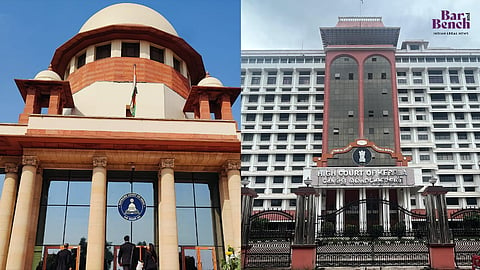
The Supreme Court on July 15 set aside the Kerala High Court's direction to send a trial judge for training [Lakshmi v. Gopi & Ors.]..A Bench of Justices Sanjay Karol and Vipul M Pancholi also quashed the adverse remarks made by the High Court against the trial judge, a principal sub-judge at Thrissur. The apex court said that adverse remarks against judicial officers cannot be passed lightly and appellate courts should adopt an attitude of friend, philosopher and a guide towards lower court judges."The attitude to be adopted by appellate courts should be that of a friend, philosopher and a guide rather than wielding the heavy-handed baton of superior authority pointing out errors committed by its underlings," the apex court said.The Court was hearing an appeal against a Kerala High Court judgment which, while reversing a trial court's findings in a family will dispute, had also directed that the trial court judge be sent for training since he was "unable to understand the controversy in issue."The Supreme Court found this remark impermissible. The Court relied on its long-settled position in State of UP v. Mohd. Naim, which requires courts to consider whether the officer whose conduct is criticised, had an opportunity to explain themselves, and whether there was evidence on record justifying such remarks against the judge."Judicial pronouncements must be judicial in nature, and should not normally depart from sobriety, moderation and reserve," the Bench reiterated.The Court also drew on Justice Karol's own earlier ruling in State of Punjab v. Shikha Trading Co., cautioning that such remarks, "due to the great power vested in our robes, have the ability to jeopardise and compromise independence of judges.".The dispute arose from a suit filed by the appellant, Lakshmi, against her siblings after their mother Thankam died in 2011, leaving behind a disputed will that excluded Lakshmi from the property. The Thrissur principal sub-court held that the will was not proved in accordance with Section 63 of the Indian Succession Act and passed a preliminary decree granting Lakshmi 2/10th share in the property.On appeal by the siblings, the Kerala High Court reversed this finding.This led to the appeal before the top court.The apex court noted that the High Court judgment was barely three-and-a-half pages long and much of it simply extracted the trial court's reasoning before dismissing it as flawed. There was no independent examination of the evidence by the High Court, the top court noted.The Supreme Court held that this approach fell short of what is expected of a first appellate court, particularly when reversing a lower court's findings. "Non-reasoned conclusions by appellate courts are not appropriate, more so, when views of the lower court are differed from. Reason is the heartbeat of every conclusion. Without the same, it becomes lifeless," the Supreme Court said..The attitude to be adopted by appellate Courts should be that of a friend, philosopher and a guide.Supreme Court.While general agreement with a trial court may not need elaborate reasoning, a reversal certainly does, the top court underscored.The Court also laid down the settled requirements for proving a will including due attestation under Section 63 of the Indian Succession Act and the testator's sound mind. It found that the High Court had engaged with none of them before overturning the trial court's decision.On the remarks against the trial judge, the Bench invoked State of U.P. v. Mohd. Naim to hold that adverse observations against judicial officers must be guided by justice, fair play and restraint..Therefore, the Court set aside the High Court's judgment in its entirety including the direction against the trial judge and restored the appeal to the Kerala High Court to be heard afresh..Advocate Nishe Rajen Shonker appeared for the appellant. Advocate Venkita Subramoniam appeared for the respondents.[Read Judgment]