Bhojshala-Kamal Maula case: Supreme Court allows Muslims to offer prayers on Fridays near disputed site

The Court was hearing a petition challenging the Madhya Pradesh High Court's decision to declare that the religious character of the disputed area is that of a Hindu temple.
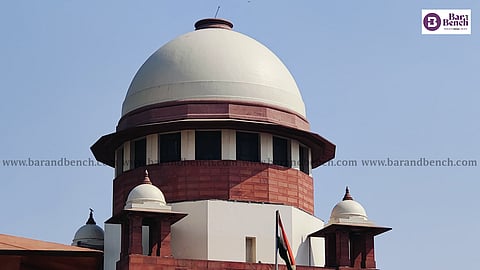
Supreme Court of India
Published on
5 min read
Listen to this article

The Supreme Court on Tuesday granted limited interim relief Muslims who have challenged the Madhya Pradesh High Court's May 15 verdict declaring the Bhojshala-Kamal Maula Mosque complex in Dhar as a Hindu temple.

A Bench of Chief Justice of India (CJI) Surya Kant and Justices Joymalya Bagchi and V Mohana said that Muslims will be allowed to offer prayers at an area near the disputed site on Fridays between 1 and 3 PM.

"As an interim measure and without prejudice to the rights of both sides.. it is directed that separate open space adjacent /near to the site is provided to the appellants (muslims) for offering namaz on Fridays between 1 to 3 pm. List the case before a Bench assigned by CJI. The arrangment shall be ad hoc in nature subject to final outcome," the Court ordered.

Pertinently, the Bench also said that any alterations made to the complex by the Archaeological Survey of India (ASI) pursuant to the High Court's May 15 verdict must not be given effect without the Court's permission.

CJI Surya Kant, Justice Joymalya Bagchi, Justice V Mohana

The matter concerns the High Court's May 15 ruling regarding the religious character of the Bhojshala complex. The verdict was passed on a batch of petitions that sought to reclaim the Bhojshala complex for Hindus and to prohibit Muslims from offering namaaz in its premises.

On May 15, the High Court held that the religious character of the disputed area within the complex, which also housed the Kamal Maula Mosque, was Bhojshala with a temple of Goddess Saraswati.

In light of the same, the High Court quashed an order passed by the ASI in 2003 by which Muslims had been granted permission to hold prayers at the site. Muslims may apply to the State for an alternative site for the construction of a mosque, the High Court said.

The High Court reasoned that historical literature and archaeological references established the site as a centre of Sanskrit learning with the existence of a temple dedicated to Goddess Saraswati.

One Qazi Moinuddin has now approached the top court against this High Court's verdict.

Senior Advocate Huzefa Ahmadi, representing Moinuddin, today and told the Supreme Court that the High Court had erred in giving a verdict that overlooked highly disputed questions of fact, without even properly examining ASI officials.

He questioned how the High Court could have "suddenly" overturned long-standing permissions given for Muslims to offer prayers on some days of the week, when the site was not being used for Hindu prayers.

"Suddenly, the High Court has nullified all of this. How can this happen? We submit that the writ petition itself could not have been entertained. The writ is not maintainable at all in this case," he contended.

Senior Advocate AM Singhvi added that he is not going into whether a temple existed or not, but that "nothing would be left" if every such claim is given merit.

"India is a country of layers, and if we start going beneath every layer, there will be nothing left ... Even in this case, there may be a temple. I am not saying there is a temple, but there may be one. But if an eye for an eye is adopted in every case, then nothing will be left. This is a much larger issue."

He also questioned the High Court's decision to rely on the course taken by the Supreme Court earlier in the Ayodhya case.

"This Court had made it clear that its decision was confined to Ayodhya alone and would not apply to any other case. An exception was made only for Ayodhya... There is one word in the Preamble (of the Constitution) that is of the utmost importance - fraternity, followed by secularism. Fraternity and secularism cross-fertilise each other. I am asking one question. If the Places of Worship Act, 1991 provides a one-time exception for Ayodhya, and there was a 2003 order of this Court that continued to operate for 23 years, then that arrangement ought to have continued," he said.

CJI Kant, in turn, observed that these are very sensitive matters and that the Court would have to be careful on what it says.

"Our view is that whatever arrangement is presently in place, the matter can be listed before an appropriate Bench within 10 to 15 days," he suggested.

Solicitor General Tushar Mehta urged the Court not to disturb the arrangement put in place pursuant to the High Court order.

"They have approached this Court after two months of the passing of the order. A lot of things have happened in the meantime. There may now be administrative issues because they are virtually seeking restoration of the status quo ante through an interim order, which cannot be granted," he said.

Senior Advocate Meenakshi Arora, appearing for the Muslim side, argued that there was a mutual understanding earlier by which both Hindu and Muslim communities agreed to use the site as a place of worship.

She joined Singhvi in questioning how the High Court entertained the dispute at all, when related proceedings were pending before a civil court.

She recounted that before the Division Bench's May 15 verdict, a single-judge of the High Court had ruled that a similar writ petition was not maintainable before it.

"How can a writ petition be entertained, particularly when a civil suit is already pending?" she asked.

She added,

"Today, when there is an understanding between the two communities, evidenced by the 1995 Sahmati document, and both communities have acted upon it for the last 30 or 31 years, and there is also a judgment (single judge ruling) that has attained finality on the maintainability of the writ petition, while a civil suit is pending (could High Court have given its May 15 verdict)? "

"This is an issue on which we are inclined to grant a hearing. We will examine all of this," replied CJI Kant.

The Court eventually asked all present if there was any public space near the disputed site, where Muslims can be permitted to offer namaz as interim relief.

"Yes, definitely, milord," replied SG Mehta.

Ahmadi added that such an area can be earmarked for the purpose of offering namaz, and that this arrangement can continue without prejudice to the rights of either side.

"The adjoining area has religious significance for the purposes of Friday prayers. This particular complex has a pulpit from where prayers have traditionally been offered. It has religious significance for us. Therefore, if we are permitted, even on one Friday every week, to offer those prayers, which we have been doing since 1935," he added.

The Court then proceeded to direct that Muslims be permitted to offer their prayers on Friday afternoons in a space near the complex, and without prejudice to both sides to the dispute.

Today's hearing also briefly dwelt on a prayer made by the Hindu petitioner before the High Court to bring back the idol of Goddess Saraswati which was taken away by British. The High Court had earlier observed that the petitioner can make a representation to the government for it.

Today, the top court observed that it is not going to issue any directive that could be interpreted to mean that the Central government is under a mandate to bring the statue back to India.

"The idol of the Goddess is presently in the London Museum. It was taken away. Tomorrow, somebody may say the Government must bring back the idol from London, and someone may even file a contempt petition. We do not want a constitutional court to make observations that could be interpreted as directing the Government of India to bring back all artefacts lying in foreign museums of former colonial powers," said Justice Bagchi.

[Live Coverage]

Bar and Bench - Indian Legal news
www.barandbench.com