

The Chhattisgarh High Court recently dismissed a petition challenging a June 12 State government circular directing the recital of Saraswati Vandana, Gayatri Mantra, Guru Mantra and other Hindu prayers in schools [Abdul Salam Rizvi & Ors. v State of Chhattisgarh & Ors.].
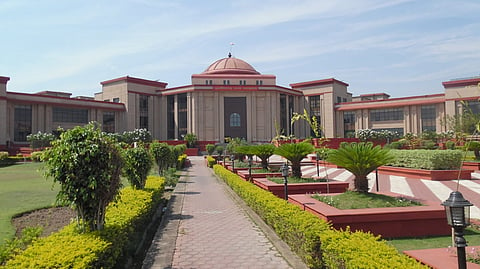
Justice Amitendra Kishore Prasad dismissed the petition as premature, holding that the petitioners had failed to demonstrate any actual violation of fundamental rights or any instance of students being compelled to participate in the prescribed recitations.
The Court found that a plain reading of the circular did not indicate any compulsory participation by students or any interference with their freedom of religion.
"A careful perusal of the impugned order... reveals that it does not contain any mandatory or coercive direction compelling students to act in a manner contrary to their respective religious beliefs, conscience or faith. The contents of the impugned order, read as a whole, do not disclose any express requirement obligating students to participate in any activity that would interfere with their constitutionally protected freedom of religion or freedom of conscience," said the Court.
The Court further ruled that the circular did not violate Article 28(1), of the Constitution which bars religious instruction in educational institutions wholly maintained out of State funds. Moral instructions are not banned under this provision, the Court reasoned.
"The expression 'religious instruction' used in Article 28(1) has a restricted meaning. It signifies that the teaching of religious customs, rituals, practices and modes of worship is strictly prohibited in educational institutions wholly maintained out of State funds. However... clause (1) of Article 28 makes it clear that the provision does not ban moral instruction, disassociated from any denominational doctrines, which remains an essential part of training in citizenship, maintenance of law and order in the State and growth of social cohesion," observed the Court.
The Court, however, indicated that the petitioners can file a fresh petition in the matter if the need arises in future, with cogent evidence of their allegations.
"The writ petition is dismissed as being premature. However, liberty is reserved in favour of the petitioners to approach this Court afresh by way of an appropriate petition, supported by cogent and relevant material, if any exigency arises in the future," it said.
The petition was filed by former Chhattisgarh Waqf Board chairman Abdul Salam Rizvi, former Minority Department chairman Mahendra Chhabda and Bilaspur-based social activist Shafique Ahmed, who challenged the constitutional validity of the School Education Department's circular.
The circular directed government schools across the State to conduct the recital of the National Anthem, National Song, Deep Mantra, Saraswati Vandana and Guru Mantra during the morning assembly. It also prescribed reading biographies of great personalities, recitation of the Bhojan Mantra before mid-day meals, and the Gayatri Mantra and Shanti Mantra before dispersal.
The plea argued that the circular neither provided an exemption mechanism nor safeguarded the freedom of conscience of students who did not wish to participate in the prescribed prayers. It also alleged that by prescribing prayers associated with one religion while excluding others, the State had breached its constitutional obligation of religious neutrality.
The State opposed the petition, arguing that the prescribed verses reflected India's civilisational heritage and universal moral values rather than religious instruction. They submitted that the recitals were intended to promote discipline, gratitude, environmental awareness and social harmony.
The State also contended that the circular had already been implemented without complaints from students, parents or teachers.
Holding that the petitioners had failed to show any actual violation of rights and had approached the Court based only on apprehensions, the Court observed,
"In light of the foregoing, this Court is of the opinion that the petition is entirely premature, based on mere apprehension rather than any actual grievance. Thus, at this stage, the reliefs sought by the petitioners cannot be granted."
The petition was accordingly dismissed, with liberty to the petitioners to file a fresh challenge supported by cogent material if any constitutional violation arises in the future.
Advocates Aamir Khan and Sitara Khan appeared for the petitioners.
Deputy Advocate General Anand Dadariya appeared for the State.
Advocate Anadi Sharma represented the Managing Director, State Project Office, Samagra Shiksha.
[Read Order]