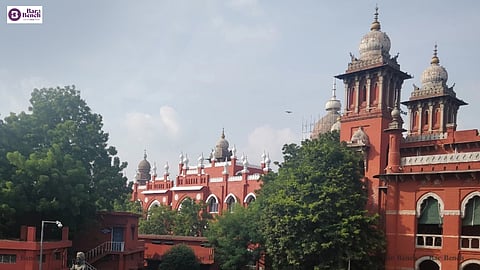

The Madras High Court recently held that denying members of a marginalised community access to a public burial or cremation ground amounts to untouchability and attracts the provisions of the Scheduled Castes and Scheduled Tribes (Prevention of Atrocities) Act, 1989. [KS Balakrishnan v. District Collector]
Delivering judgment in a batch of writ petitions concerning disputed land in Karumandisellipalayam, Erode district, Justice V Lakshminarayanan observed that access to burial and cremation grounds cannot be restricted in a manner that excludes Scheduled Caste communities.
"...denying a person from a marginalised community access to the public burial or cremation ground is a criminal offence. It is a form of practicing untouchability, which has been declared as unconstitutional under Article 17 of the Constitution of India,” the Court held.
The judge further noted that the District Collector, who is vested with powers under the SC/ST Act, must act when such violations occur, especially where members of Scheduled Castes are treated unfairly in matters relating to burial grounds.
The case revolved around lands in Thiruvengadampalayam hamlet. Though revenue records classified the land as cart track poromboke (barren land), residents claimed it had been used as a burial ground for decades.
One set of petitioners sought to restrain authorities from reclassifying the land as a burial ground and to stop burials and cremations there. Another petitioner sought formal recognition of the land as a burial/burning ground and action against those alleged to have levelled graves using machinery.
The district collector’s report placed before the Court stated that portions of the land had been used as a burial ground for over 70 years and that graves had been disturbed by levelling operations. It also recorded that members of the Arunthathiyar community (a Scheduled Caste) were using parts of the land for burial and for rituals connected to a “Mala Temple” located within the survey number.
The Court described the Collector’s report as “extremely disturbing” and remarked:
“On account of the rivalry between siblings, the dead have not been left at peace.”
The Court reiterated that the right to dignity extends beyond life.
“Not only are the living entitled to live with dignity, but the dead too are entitled for a dignified burial."
It also noted that disturbing graves not only affects the deceased, but also deeply impacts surviving relatives.
The Court observed that when allegations of grave desecration were brought to the authorities’ notice, the State ought to have initiated criminal proceedings under Section 301 of the Bharatiya Nyaya Sanhita (corresponding to Section 297 of the IPC), which deals with trespass on burial places and indignity to human corpses.
Further, in the context of Scheduled Caste usage of the burial ground, the Court said that the collector should have invoked powers under the SC/ST Act where necessary.
“The report of the District Collector showing that the graves of the persons belonging to the Scheduled Caste have been levelled. Necessarily he should have invoked the powers vested in him and initiated appropriate action,” the judgment noted.
The Court also clarified that Karumandisellipalayam, being a Special Grade Town Panchayat, is governed not by the Tamil Nadu Panchayats Act, 1994 but by municipal law under the Tamil Nadu Urban Local Bodies Act, 1998 and corresponding rules.
Under Section 172 of the 1998 Act, burial and cremation grounds must be registered or licensed. The Court held that long-standing customary use, supported by town panchayat resolutions dating back to 2000 and official records describing a “cemetery road”, established that a burial ground existed at the site.
The mere existence of a modern crematorium 1.5 kilometres away, the Court said, does not automatically prohibit burials at the disputed site unless the municipal council issues a specific notification banning cremations elsewhere.
“It is not for this court to decide as to where body must be buried or cremated,” the judge observed.
Allowing the petition seeking formal recognition and protection of the burial ground and dismissing the other two, the Court directed:
The District Collector to ensure the burial/cremation areas are segregated and properly fenced.
The Town Panchayat to maintain the site free from encroachment and garbage dumping.
Revenue authorities to act on the Panchayat’s resolution to reclassify land used for burial and exclude it from “cart track” classification.
Initiation of appropriate action against those responsible for levelling graves.
The petitioners were represented by Advocates Jhansi Greeta, M Sidhardhan, M Guruprasad and CSK Satish.
The private respondents were represented by Advocates Arun Anbumani, Abrar Mohammed Abdullah, K Kathir
The State authorities was represented by Advocates LSM Hasan Fazil and T Chezhian.