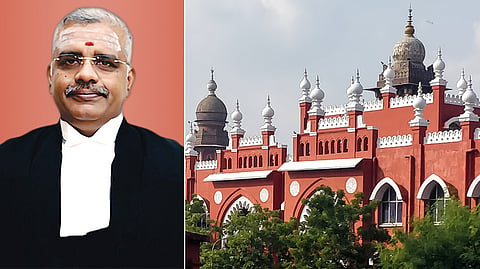
"Ignorance is no justification to normalise discrimination:" How a Madras High Court judge overcame his prejudices against the LGBTQ community

The judgment by Justice N Anand Venkatesh captured the outlook of society towards same-sex relationships and how he himself had to get over personal prejudices to better understand the issue.
"Ignorance is no justification to normalise discrimination:" How a Madras High Court judge overcame his prejudices against the LGBTQ community
Justice Anand Venkatesh, Madras High Court

Ignorance is no justification for normalizing any form of discrimination, the Madras High Court observed while issuing a slew of directions to further the cause of the LGBTQIA+ community (S Sushma v. Commissioner of Police).

The judgment by Justice N Anand Venkatesh, which ran into 104 pages, captured the outlook of society towards same-sex relationships and how he himself had to get over personal prejudices to better understand the issue.

The judgment was rendered in a plea by a lesbian couple seeking protection from their relatives.

“I have no hesitation in accepting that I too belong to the majority of commoners who are yet to comprehend homosexuality completely. Ignorance is no justification for normalizing any form of discrimination,” the judgment stated.

In this regard, the judge recounted how he attended a counselling session with Vidya Dinakaran, a psychologist, in order to understand the subject better and to counter his prejudices. The judgment also extracted the entire report of that session.

The judgment noted how difficult it is for an individual to understand something which he/she has not experienced personally.

“To begin with, if someone had approached me saying that they are attracted to or are in a relationship with a person of the opposite sex, I would have had no difficulty in understanding them, since I have experienced the same personally. Similarly, I would have probably had no difficulty in understanding or sharing someone’s happiness, joy or anguish and sadness. This is because, I have personally experienced those emotions as well,” the judge observed.

Also Read
"I am not fully 'woke' on this aspect:" Madras High Court Judge fixes appointment with psychologist to understand same-sex relationships better

But society and his upbringing have always treated the terms “homosexual”, “gay”, “lesbian” as anathema, the judge conceded.

“I have never personally known homosexual persons, and ‘what do any other know about the shoes he has never walked’, for I have not walked in their shoes. A majority of the society would stand in the same position of ignorance and preconceived notions. I have, at the best, read or come across people talking about the LGBTQIA+ community, but not to an extent where it made a positive impact on me or influenced me,” he added.

That, coupled with what society deems as “fit and proper”, impacts our sub-conscious, the judge said.

“Growing up, the societal impact has a lot of bearing in our understanding of relationships right down to our subconscious, and we involuntarily vouch only those relationships which the society deemed ‘fit and proper’,” he said.

When two persons of the same sex are friends and continue that relationship for their entire lives, the world does not see anything abnormal in it. In fact, the world encourages such a friendship and it is treated to be one of the greatest of relationships between two human beings, the judgment goes on to note.

However, the society take objection when the same two individuals slightly alter their stand and instead of being just friends, get involved in a partnership i.e. a homosexual relationship which in normal parlance is understood as same-sex relationship, the Court noted.

But the judge noted that course correction is possible only through changes at the societal level and law alone cannot work wonders.

“I strongly feel that the change must take place at a societal level and when it is complemented by a law there will be a remarkable change in the outlook of the society by recognising same-sex relationships,” he said.

In this regard, he cited the examples of persons with disabilities and mental illnesses and how they used to be treated sometime back and how the awakening in society, complemented with enactment of appropriate laws, have brought in a huge change in recognising the rights of such differently abled persons.

“A law cannot be effective without it being acknowledged by the society and such an awakening in the society is not going to happen overnight. It requires regular deliberation and it has to necessarily fall out very strongly from the constitutional institutions and I believe that the judiciary and particularly the constitutional courts have a major role to play in spreading this awareness and awakening the society,” the Court said, proceeding to issues directions to further the rights of LGBTQIA community.

In the last hearing in the matter, Justice Venkatesh said that he undergo an educational session with a psychologist to understand same-sex relationships better and pave the way for his evolution.

Previously, he had stated,

"To be open, I am also trying to break my own preconceived notions about this issue and I am in the process of evolving, and sincerely attempting to understand the feelings of the Petitioners and their parents."

When the matter was heard in March this year, the judge had decided to hear this case in-camera after observing that the case has to be dealt with more sensitivity and empathy.

[Read Judgment]

Attachment
PDF
S Sushma v Commissioner of Police.pdf
Preview
No stories found.
Bar and Bench - Indian Legal news
www.barandbench.com