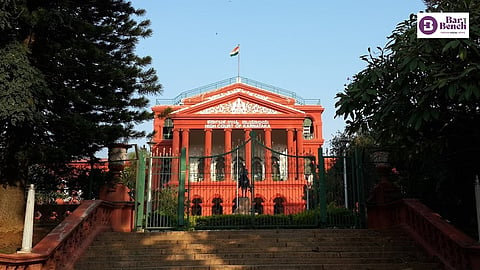

The Karnataka High Court has ruled that a petition seeking criminal contempt action which does not have the written consent of the Advocate General (AG) should be placed before the Chief Justice for initiation of suo motu contempt proceedings. [New Space Research and Technologies v. Prabhat Sharma & Ors].
A Bench of Justices Anu Sivaraman and Venkatesh Naik T held,
"This case, at the outset, points out that the complainant has filed the complaint under Section of 15 the Contempt of Courts Act, 1971, and Article 215 of the Constitution of India read with Rule 3 of the High Court of Karnataka (Contempt of Court proceedings) Rules, 1981, which should not be justified as a petition and should not be placed for admission on the judicial side. Such a petition should be placed before the Hon'ble Chief Justice for orders and the Hon'ble Chief Justice may decide either by himself or in consultation with the other Hon'ble Judges of this Court, whether to take any cognizance of the information."
The case stems from a suit filed in 2024 by the complainant company seeking a perpetual injunction to prevent the defendants from directly or indirectly copying, sharing, or using confidential or proprietary information or material that belonging to the company. The company had prayed for the appointment of a Court Commissioner to conduct a search and seizure on the respondent's premises, which was refused by the trial court.
The complainant company then approached the High Court via a writ petition and secured an order for the search and seizure of data storage media, files, folders, documents at the premises of the respondents. However, the respondents refused to comply with the Court's warrant and refused to let the Court Commissioner and his team inside their property.
The Court Commissioner's report listed the obstacles he faced, after which the Court disposed of the writ petition and directed the trial judge to issue orders on the Court Commissioner's report.
The complainant company then filed a contempt petition and a notice on the maintainability of the petition without the Advocate General's consent was issued. The notice was overruled in order to specify the procedure through which the High Court could take cognizance of criminal contempt.
The Court relied on a precedent of the Supreme Court to note that a petition that contains information must be submitted as a judicial admission before the Chief Justice for consideration.
It further noted that the petition was filed under Article 215 of the Indian Constitution, but did not fulfil the procedure of obtaining consent from the Advocate General as provided under Section 15 of the Contempt of Courts Act, 1971.
The Court observed that when the petitioner does not approach the Advocate General for written consent to initiate contempt proceedings, they could still approach the Court by making a judicial admission before the Chief Justice.
"Apart from the fact that, in the present case, the complainant has not approached the Advocate General on the premise that his advice is not at all necessary and it is not open to him to seek such consent, Section 15 of the Contempt of Courts Act, 1971 is quite clear that the written consent of the Advocate General as have been specifically authorised by the section, would be taken note of for entertaining a petition under the said section. But this does not, in any manner, deprive the complainant of his remedy as he can come before the Court, as indeed he has done, requesting the Court to take suo motu action. However, the procedure as approved by the Hon'ble Apex Court in the case of PN Duda (supra) has to be followed as there cannot be a numbering of the information given before this Court as a Contempt of Court Case (Criminal) and the issuance of notice to the accused without following such procedure."
The Court directed the Registry to place the petition as information before the Chief Justice and closed the contempt petition. A previous order that was overruled office objections on the maintainability of the petition was also recalled.
The contempt petitioner was represented by Advocate Angad Kamath.
Senior Advocate Dhananjaya Joshi and Advocates Kavitha Damodaran and Rahul Krishna Reddy P represented the respondents.
[Read Order]