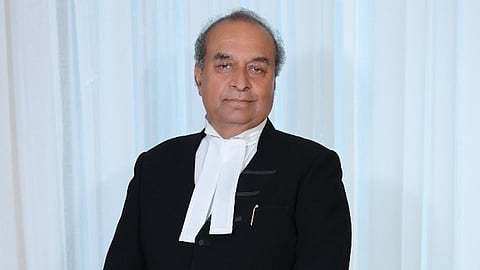

The Income Tax Appellate Tribunal (ITAT) at Delhi has set aside a revision order passed against Senior Advocate Mukul Rohatgi, holding that the tax authorities had no material to reopen his income assessment of ₹133.46 crore for Assessment Year 2020–21. [Mukul Rohatgi v. Principal Commissioner of Income Tax]
A coram of Vice President Mahavir Singh and Accountant Member Manish Agarwal allowed Rohatgi’s appeal and quashed the Principal Commissioner of Income Tax’s (PCIT) revision order, ruling that the power to revise an assessment cannot be used merely to conduct fresh enquiries or take a different view.
"...there is no material available with the learned PCIT for revision of assessment order under Section 263 of the Act, which enabled him to form a prima-facie opinion that the assessment order passed by the Assessing Officer is erroneous insofar as it is prejudicial to the interest of the Revenue," the Tribunal held.
Rohatgi was assessed under scrutiny for Assessment Year 2020–21 and his income was determined at ₹133,46,92,080 after disallowances of ₹44.77 lakh under Section 24(b) (home loan interest deduction) and ₹40.10 lakh under Section 14A (expenses linked to exempt income).
In March 2025, the Principal Commissioner of Income Tax issued a notice proposing revision of the completed assessment. The revision was based on three broad issues: the tax treatment of capital gains from mutual fund investments, the annual letting value (ALV) declared for multiple properties in India and abroad, and the non-initiation of penalty proceedings for alleged failure to deduct tax at source.
The PCIT alleged that certain mutual funds treated as equity-oriented and taxed as long-term capital gains should instead be taxed at normal rates. It also questioned the ALV disclosed for several properties, including properties in London, Goa and Delhi, and proposed re-computation of rental income.
Additionally, the Commissioner directed initiation of penalty proceedings for non-deduction of TDS on payments of ₹9.20 lakh.
Before the Tribunal, Rohatgi submitted that details of the mutual funds had been provided during the original assessment and that one London property had been sold in March 2019 with capital gains offered to tax in an earlier year. He also stated that another London property was used for professional purposes and that rental values for other properties had been consistently declared and accepted in prior assessments.
One of the key issues raised by the PCIT was the tax treatment of gains from certain mutual funds. The PCIT alleged that the funds were not equity-oriented and should be taxed at normal rates instead of the concessional rate applicable to long-term capital gains.
The Tribunal disagreed, noting that the Assessing Officer had already examined the details during the original assessment and taken a plausible view that the funds were equity-oriented. It held that once the Assessing Officer had adopted one possible view after considering the material, the assessment could not be revised simply because the PCIT preferred another view.
"We also noted that these details were filed by the assessee before the Assessing Officer during the course of scrutiny assessment and the Assessing Officer, after examining all these details, reached to a conclusion that these are equity-oriented funds and he formed an opinion," ITAT held.
The Tribunal rejected the revision based on ALV of properties. It recorded that one London property had already been sold in an earlier year and taxed accordingly, while another was used as an office for professional purposes and therefore did not attract ALV. It also found that the PCIT had relied on a generic “rental yield overview” to estimate rental income for a London property, which could not form the basis for revising the assessment.
"We have gone through the case records including the revision order and could not find any observation by the PCIT that what should be the basis for ALV and how the ALV declared by the assessee is not correct and without that, the order of the Assessing Officer cannot be treated as erroneous insofar as prejudicial to the interest of the Revenue," ITAT held.
The PCIT had also directed initiation of penalty proceedings for alleged failure to deduct tax at source on certain payments. The Tribunal held that such a direction could not be issued in revision proceedings.
The Tribunal delivered strong observations on the limits of the tax department’s revision powers and emphasised that completed assessments cannot be reopened merely to conduct fresh enquiries.
“The revisional power under Section 263 of the Act is not meant to be exercised to correct every error of fact, but the error must be of such a nature that it is erroneous and prejudicial to the interest of the Revenue."
The coram stressed that revision cannot be used as a tool for fishing enquiries or fresh investigation in the absence of material demonstrating error in the original assessment.
“The PCIT, in revisional proceedings under Section 263 of the Act, has no jurisdiction to set aside the order of assessment merely to conduct another investigation without finding the basis or without any material that the order is erroneous one and also prejudicial to the interest of the Revenue.”
Rohatgi was represented by Senior Advocate Sachit Jolly with Advocate Mansha Anand.