Karnataka High Court declares Belagavi's ancient Yallamma Devi Temple a public trust

Justice Geetha KB found that the ancient temple satisfied all the requirements for a temple to be registered as a public trust under the Bombay Public Trusts Act.
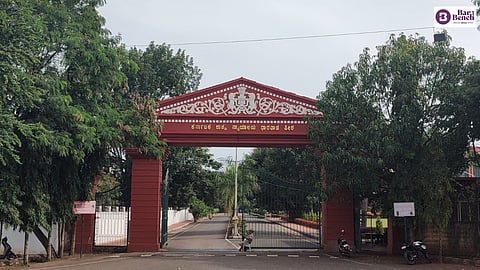
Karnataka High Court, Dharwad Bench
Published on
3 min read

The Karnataka High Court recently ordered the registration of the Sri Yallamma Devi Temple in Belagavi district as a public trust [Mallari Vs Laxman Raju Poojari].
Justice Geetha KB found that the temple satisfied all the requirements for a temple to be registered as a public trust under the Bombay Public Trusts Act, 1950.

The Court observed that going by the provisions of the Act, an ancient temple used by the Hindu public as a matter of right is eligible to be registered as a public trust.

The Court, therefore, set aside orders passed by the Charity Commissioner and the Belagavi District Court which had refused to recognise the temple as a public trust.

"It is established that Sri Yallamma Devi Temple is an ancient temple; place of public religious worship; dedicated to Hindu community for their benefit and Hindu community people are having right to use it as of right for their offerings to the deity and worship the deity. Thus, the ingredients of Section 2(17) of the BPT Act are fulfilled. Thus, Sri Yallamma Devi Temple comes under the definition of ‘Temple’ as per Section 2(17) of BPT Act …  Trust as per Section 2(13) of the BPT Act is an inclusive definition. It includes temples. If ‘Temple’ as per Section 2(17) of the BPT Act is in existence, then it will be a public trust as per Section 2(13) of the BPT Act," the Court held.

Justice Geetha KB
Justice Geetha KB

The case is tied to a petition filed before the Assistant Charity Commissioner in 1994 seeking the registration of the Sri Yallamma Devi Temple as a public trust. The petitioners said the temple was ancient and that devotees had resolved to form a managing committee to look after its religious and developmental activities.

The Assistant Charity Commissioner accepted the plea in 1997 and allowed registration of the temple as a public trust. However, the Charity Commissioner reversed that order in 2001. The District Court later upheld the Charity Commissioner’s decision in 2005.

The dispute later reached the Supreme Court, which remanded the matter to the High Court. The Supreme Court clarified that an earlier High Court decision on poojari rights would not affect the present issue of whether the temple was a public trust.

The High Court pronounced its verdict on whether the temple can be registered as a trust on June 22.

TheCourt noted that the temple was admittedly ancient and that members of the public had a right to enter and offer worship. It also noted that government records, except for one year, showed the property in the name of Sri Yallamma Devi Temple.

The Court rejected the argument that the temple was private property merely because some families had hereditary rights to perform pooja.

The Court proceeded to order the registration of the temple as a public trust under the Bombay Public Trusts Act, noting that it satisfied all the criteria for such status.

Further, the Court also held that archaks or poojaris were not barred from becoming trustees. It disagreed with the Assistant Charity Commissioners view that such persons cannot become trustees.

There is no rule that archak of the temple cannot be trustee of the temple,” the Court said.

The Court observed that poojaris perform pooja on behalf of devotees and act as “middlemen between the devotee and the deity.” It opined that the appointment of such persons as trustees could also be helpful in the long run.

"If they are also made as trustees, definitely it would help the overall development of the temple because they are the pillars of the temple."

The Court, therefore, ordered that the named trustees in the original inquiry petition from 1994, along with one person each from the two families of archaks, be treated as trustees of the temple.

Advocate Ramachandra A Mali appeared for the appellants.

Advocates Shivakumar S Badawadagi and Ravikumar D Gokakakar appeared for the respondents.

High Court Government Pleader Abhishek Malipatil appeared for the State of Karnataka.

[Read Judgment]

Attachment
PDF
Mallari Vs Laxman Raju Poojari
Preview
Bar and Bench - Indian Legal news
www.barandbench.com