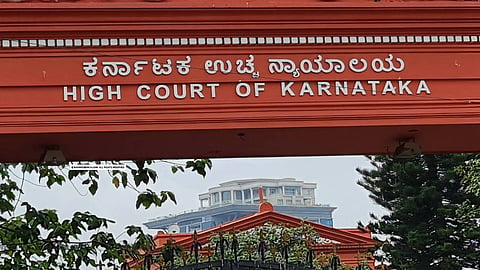
The Karnataka High Court on Wednesday upheld the 2023 legal amendments assigning first appeals against decrees and orders of senior civil judges to district courts..A Division Bench of Chief Justice Vibhu Bakhru and Justice CM Poonacha found the Karnataka Civil Courts (Amendment) Act, 2023 and the Karnataka High Court (Amendment) Act, 2023 to be constitutionally valid.The 2023 amendments removed the earlier distinction under which appeals from suits valued above ₹10 lakh were to be filed before the High Court. Under the amended regime, all appeals from decrees and orders passed by senior civil Judges in civil matters will lie before the district court.While the Court upheld the amendments, it read down Section 4 of the Civil Courts Amendment Act, which gave retrospective effect to the amendments from August 28, 2007. “We find no difficulty in reading down Section 4 of the Civil Courts Amendment Act so as to exclude from its retrospective operation (i) all appeals that stand concluded by final judgments and orders; and (ii) all orders passed in proceedings that are pending,” the Court held..The Bench said the retrospective operation of the amendments would apply only to pending appellate proceedings. Such appeals will continue from the stage at which they are transferred to the competent court.It also clarified that proceedings already conducted before the amendments came into force, and those which continued because of the interim order passed by the High Court on July 3, 2024, will not be treated as illegal, non-est or a nullity..The petitions before the Court challenged the amendments as manifestly arbitrary, discriminatory and violated Article 14 of the Constitution. The petitioners contended that parties have a vested right to have their appeals heard by the High Court and that retrospective operation would render past judgments without jurisdiction.The State defended the amendments, saying they were enacted to reduce pendency in the High Court and further the object of “justice at the doorstep.” It also relied on the Karnataka Law Commission’s view that transferring old pending regular first appeals to district courts would reduce the burden on the High Court..In the judgment passed on July 8, the High Court held that while the right to appeal may be a substantive right, the forum before which an appeal is heard is a matter of procedure.It added that procedural amendments are generally retrospective unless the statute shows a contrary intention. In this case, Section 4 of the Civil Courts Amendment Act expressly stated that the amendment would operate retrospectively from August 28, 2007.However, the Court said the law cannot be interpreted in a manner that would unsettle final judgments.“It is common ground that the concluded appeals cannot be reopened, and it is not the legislative intent to render the decisions delivered in Regular First Appeals a nullity or without jurisdiction,” the Court observed..The Court rejected the argument that the amendment discriminated between litigants in Bengaluru and the rest of Karnataka because appeals from Bengaluru City Civil Court would continue before the High Court.It held that there was a clear distinction since city civil judges in Bengaluru are district judge-cadre officers, unlike senior civil judges in the districts.“Article 14 of the Constitution of India permits reasonable classification and as noted above, there is sufficient reason for excluding appeals arising from Courts of the Bengaluru Urban District,” the Court said..Senior Advocate SM Chandrashekar appeared as Amicus Curiae. .The petitioners were represented by Senior Advocates KN Phanindra, Vivek Reddy and DR Ravishankar along with advocate Rohith R Kumar..The State Government was represented by Additional Advocate General Kiran V Ron along with Additional Government Advocate Niloufer Akbar..[Read Judgment]