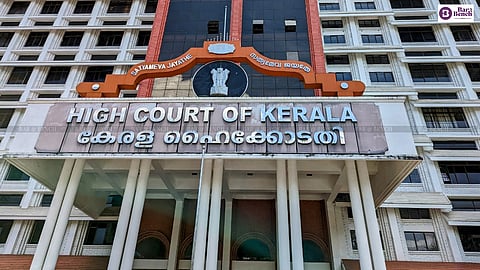

The Kerala High Court on Wednesday restrained the Kerala State Waqf Board from taking any major decisions, incurring capital expenditure or making policy decisions until the Court decides on the batch of petitions challenging the board's composition [Shone George v State of Kerala and connected cases].
A Division Bench of Chief Justice Soumen Sen and Justice Syam Kumar VM passed the interim order while considering the Public Interest Litigation (PIL) petitions challenging the constitution of the present board.
The Bench observed that the board's existing composition prima facie appeared to be contrary to Section 14 of the 2025 Waqf Amendment Act, which mandates the inclusion of at least two non-Muslim members in every State Waqf Board.
The Court proceeded to direct that the present board shall not take any major decisions, incur any capital expenditure or take any policy decision without the express leave of the Court.
It further directed that for the time being, the board shall function under the administration and supervision of the Joint Secretary to the State government who deals with Waqf matters.
Representing the State, Kerala Advocate General Jaju Babu also conceded that there are some infirmities in the constitution of the Board. The Court recorded this as well in its order passed today.
"The State Government in its affidavit affirmed in July 14 has submitted that there is a requirement to reconstitute the Board in compliance with the mandate of Section 14 of the Waqf Act," it said.
The matter will be heard next after two weeks.
The petitions before the Court include those filed by the State Vice President of the Bharatiya Janata Party (BJP), Shone George, a Christian trust named the Assembly of Christian Trust Services (ACTS) and one by retired Indian Army Force Junior Warrant officer and former Kerala government under secretary, Stalin VM.
The petitioners have contended that since the State Waqf Board has not yet appointed two non-Muslim members as required under the 2025 Waqf Amendment Act, its functioning is unconstitutional. This also renders all of its administrative, supervisory, and quasi-judicial decisions null and void, the petitioners argue.
The 2025 Waqf Amendment Act came into force on April 8 last year. Among other provisions, it introduced a mandatory requirement under Section 14(1) to include at least two non-Muslim members in the Waqf Board, excluding ex officio members.
While considering challenges to the amendment, the Supreme Court did not stay the operation of this requirement. Instead, it imposed an upper limit of three non-Muslim members on State Waqf Boards.
According to George's PIL, the Kerala government has deliberately flouted this statutory condition by nominating a Board consisting of only Muslims.
The petition filed by ACTS additionally challenges the board's decision to upload the details of the heavily disputed land in Munambam to the UMEED Portal, a centralised digital platform with details of waqf properties.
The petition by Stalin questions the continued membership of former CPI(M) MLA Kunhammed Kutty Master to a waqf board seat reserved for an MLA, despite him ceasing to be an MLA after the 2026 Assembly elections.
George is being represented by Senior Advocate Santhosh Mathew and advocates Shinto Mathew Abraham, Anil Sebastian Pulickel, Mathew Nevin Thomas, Kurian Antony Mathew, Karthik Rajagopal, Leah Rachel Ninan, Noel Ninan, Aparnna S, Adeen Nazar, Arun Joseph Mathew, Rohan Mathew, Veena Raveendran, and Karthika Maria.
ACTS is represented by advocate Joseph Joy.
Advocate Lakshmi Sreedhar appeared for Stalin.
Additional Solicitor General P Sreekumar appeared for Union of India.
[Live Coverage]