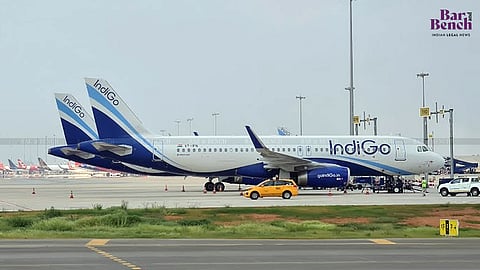
Madras High Court asks DGCA if it will continue fatigue norms exemption granted to IndiGo

Chennai resident YR Rajaveni has challenged the DGCA’s order dated December 5, 2025, which granted IndiGo an exemption from compliance with certain portions of the Civil Aviation Requirements.
Indigo
Indigo
Published on
4 min read

The Madras High Court on December 26 asked the Directorate General of Civil Aviation (DGCA) to clarify whether it is planning to extend its recent decision to exempt InterGlobe Aviation Limited, the operator of IndiGo airlines, from complying with certain pilot fatigue norms prescribed under India’s aviation safety regulations [Rajaveni Vs Director General of Civil Aviation].

Justice V Lakshminarayanan was hearing a writ petition filed by Chennai resident YR Rajaveni, who has challenged the DGCA’s order dated December 5, 2025.

The said DGCA order granted IndiGo an exemption from compliance with paragraphs 3.11 and 6.14 of the Civil Aviation Requirements (CAR) for a particular class of aircraft.

This exemption relates to fatigue-management norms introduced under CAR 2024, which prescribe stricter limits on night operations, landings, and mandatory weekly rest for flight crew.

Justice V Lakshminarayanan

The petitioner has sought the quashing of the exemption and an interim stay on its operation, contending that the DGCA lacked the statutory authority to dilute mandatory safety norms through an executive order.

The Court, on December 26, observed that the petitioner’s request for interim relief could be considered only after hearing IndiGo, which has been impleaded as the second respondent. The airline has not yet entered appearance in the matter.

Representing the DGCA, Additional Solicitor General ARL Sundaresan, submitted that the exemption was granted after considering the airline’s inability to immediately comply with the revised fatigue norms.

He told the Court that strict enforcement of the CAR provisions had resulted in large-scale flight cancellations, necessitating regulatory intervention to stabilise airline operations.

Senior Advocate ARL Sundaresan

The ASG submitted that the exemption was not intended to permanently dilute safety standards and that the DGCA was working with IndiGo to ensure compliance with the fatigue-management framework. These submissions were recorded by the Court.

The ASG also told the Court that the DGCA will place its submissions on record by way of a counter-affidavit. The DGCA has been directed to file this counter-affidavit by January 5, 2026.

Notably, the Court specifically called upon the aviation regulator to clarify whether it proposes to extend the exemption granted to IndiGo on December 5, 2025, beyond the period already specified.

"Mr.ARL.Sundaresan states that the first respondent shall go on record by way of counter affidavit on 05.01.2025. The counter shall specifically state whether the first respondent intends to extend the exemption granted on 05.12.2025 for a further period," the order states.

The matter has been listed for further hearing on January 6, 2026.

In December 2025, IndiGo experienced significant operational disruption, cancelling hundreds of flights over a short period.

Media reports attributed the cancellations to difficulties in complying with the revised fatigue norms, particularly restrictions on night operations and enhanced weekly rest requirements, which reportedly strained crew availability and flight rostering during the winter schedule.

The DGCA’s exemption order dated December 5, 2025, was issued against this backdrop, with the regulator citing the need to stabilise airline operations.

The petitioner who challenged this exemption was represented by Senior Advocate Sanjoy Ghose, who argued that under Rule 133A(1) of the Aircraft Rules, 1937, any direction or exemption issued by the DGCA under Rule 133A(4) must be consistent with the parent legislation, namely the Aircraft Act, 1934.

According to the petitioner, the CAR provisions relating to pilot fatigue management are mandatory in nature and form part of a regulatory regime intended to safeguard flight crew and passengers. Granting an exemption from these requirements, it was argued, amounts to impermissibly rewriting binding safety regulations.

Sanjoy Ghose
Sanjoy Ghose

The revised aviation safety norms were introduced in 2024 following prolonged litigation initiated before the Delhi High Court by pilot unions, who sought the alignment of India's aviation norms with international aviation safety standards.

While earlier litigation concerning the notification of CAR 2024 had concluded after the government assured phased implementation of the revised framework, the present case squarely concerns the legality of a post-notification exemption granted to a specific airline, and whether such relaxation falls within the DGCA’s statutory powers.

A contempt petition challenging DGCA's earlier exemptions granted to various airlines is also pending before the Delhi High Court.

In the case before the Madras High Court, Central Government Standing Counsel KB Arun also appeared for DGCA.

Senior Advocate Ghose, who appeared for the petitioner, was instructed by Advocate M Ramesh.

[Read Order]

Attachment
PDF
Rajaveni Vs DGCA
Preview
Bar and Bench - Indian Legal news
www.barandbench.com