
Subscribe
Subscribe
- Latest Legal News
- News
- Law Firms
- Columns
- Interviews
- Law School
- Legal Jobs
- हिंदी
- ಕನ್ನಡ
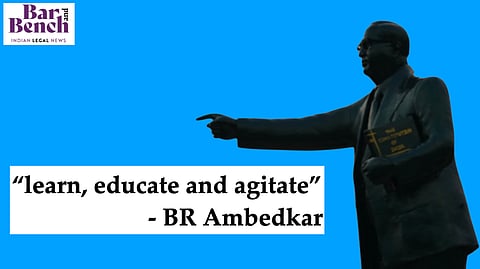
The Madurai Bench of the Madras High Court recently directed the Tamil Nadu government to introduce lessons on Dr. BR Ambedkar in the social science curriculum for students from classes III to X [Rajesh Vs State of Tamil Nadu].
In a judgment delivered on April 30, Justice L Victoria Gowri directed that the curriculum must cover Dr. Ambedkar’s role as Chairman of the Drafting Committee of the Constitution of India, his contribution to justice, liberty, equality and fraternity, his role in the freedom movement and nation-building and his scholarly work in law, economics and social thought.
The Court clarified that the direction is aimed at “constitutional education” and not political glorification. It asked the State to endeavour to implement the changes from the 2027–2028 academic year, subject to administrative feasibility.
"Though this Court is fully aware that it is not for the judiciary to command the State to adopt a particular policy or to dictate, as a matter of compulsion, what must find place in the curriculum of school education, this Court is nevertheless constrained to emphasise that the constitutional value of fraternity cannot be left to chance or to the uncertainties of social transmission," the single-judge said.
The Chief Secretary and Principal Secretary to the School Education Department were made parties to the case and were directed to file a compliance report. The matter has been posted for compliance on January 21, 2027.

The directions came in a petition to quash criminal proceedings arising from a 2018 incident in Sivagangai district.
According to the prosecution, the accused had torn a poster of Dr. Ambedkar during his birth anniversary celebrations, urinated on it and circulated a video of the act on WhatsApp.
A first information report (FIR) was registered under the Scheduled Castes and Scheduled Tribes (Prevention of Atrocities) Act and the case was pending trial before a special court.
Though the parties entered into a compromise, the Court did not immediately accept it. Instead, it adopted a reformative approach.
By an earlier order, the Court directed the accused to read books on Dr. Ambedkar, distribute copies to school students, return compensation paid to the complainant, pay costs to the Adayar Cancer Institute and appear before the Court for an oral assessment.
On a subsequent hearing, the Court conducted an in-camera interaction and found that the accused had understood Dr. Ambedkar’s life and contributions and expressed genuine remorse.
The Court stressed that the case involved larger constitutional values.
“Dr. Ambedkar represents the constitutional promise made by this nation… To insult his image is to exhibit indifference towards the very values of justice, liberty, equality and fraternity,” the Court observed.
At the same time, it held that the reformative steps had substantially achieved the purpose of law.
“The present matter has moved beyond the stage of mere compromise. The corrective purpose of law has already been substantially achieved,” the Court said
Taking note of the settlement, the conduct of the accused and the complainant’s consent, the Court quashed the criminal proceedings, holding that continuation of the trial would serve no useful purpose.
The Court also underscored that constitutional literacy must be proactively promoted through education and warned that ignorance among young citizens can lead to prejudice and social division.
"This Court therefore considers it necessary to remind the State of Tamil Nadu that constitutional literacy is not an ornamental aspiration. It is part of the State’s social responsibility. A welfare State cannot confine itself to administration and infrastructure while neglecting civic education, constitutional memory and social ethics," Justice Gowri held.
The petitioners were represented by advocate N Ananda Kumar.
The State was represented by Government Advocate (Criminal Side) M Sakthi Kumar.
The de facto complainant was represented by advocate S Paul Murugan.
[Read Judgment]