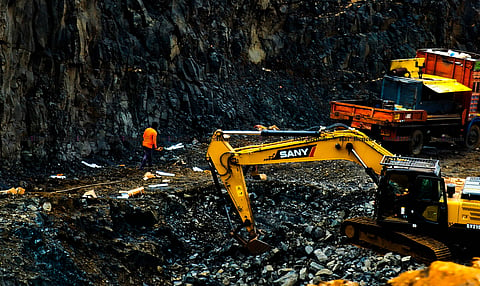
Mining, construction vehicles not liable for motor vehicle tax if not used on public roads: Supreme Court

The Court clarified that if any such vehicle is found actually using public roads, it will immediately lose its immunity and become subject to registration and taxation.
Coal Mine
Coal Mine
Published on
4 min read

The Supreme Court recently held that heavy earth-moving machinery and construction vehicles/ equipment such as dumpers, loaders, excavators, surface miners and dozers, when used exclusively within factory or enclosed industrial premises, do not qualify as “motor vehicles” liable to road tax under State motor vehicle taxation laws [Ultratech Cement Vs State of Gujarat'[

However, a Bench of Justices Pankaj Mithal and PB Varale clarified that if any such vehicle, despite being "off-road" by design, is found actually using public roads, it will immediately lose its immunity and become subject to registration, taxation and potential seizure/penalties.

Justice Pankaj Mithal and PB Varale

"They are off-road equipments and as such stand excluded not only from the purview of the “motor vehicle” as defined under Section 2 (28) of the Act but also from tax as Entry 57 of List II of the Seventh Schedule of the Constitution only authorizes taxation of vehicles suitable for use on roads only," the Court said.

The Court was hearing an appeal filed by Ultratech Cement Ltd which operates cement manufacturing units in the State of Gujarat.

It uses heavy construction and mining machinery such as dumpers, loaders, excavators, surface miners, drills and rock breakers. These machines are deployed exclusively within the enclosed premises of its cement plants for mining limestone and other captive operations.

The machinery is transported to the factory sites in a dismantled condition on trailers and is not driven on public roads. According to Ultratech, the equipment is incapable of regular road use and is designed specifically for off-road and industrial operations within factory boundaries.

Initially, the Regional Transport Authorities did not require the registration of these vehicles under the Motor Vehicles Act, 1988. However, pursuant to directions issued by the Transport Commissioner of Gujarat, the authorities later took the view that the machinery fell within the definition of “motor vehicle” and was liable for registration and motor vehicle tax under the Gujarat Motor Vehicles Tax Act.

Show cause notices were issued to Ultratech, followed by assessment orders raising tax demands running into more than ₹1 crore. Ultratech deposited part of the tax under protest and challenged the demands before the Gujarat High Court.

The Gujarat High Court dismissed Ultratech’s petitions, holding that the machinery was capable of movement and therefore, fell within the scope of “motor vehicles” liable to tax.

Aggrieved by the High Court’s decision, Ultratech approached the Supreme Court.

The Supreme Court held that the machinery used by Ultratech squarely falls within the statutory exclusion under Section 2(28) of the Motor Vehicles Act.

“The vehicles used by the appellants are special type of vehicles meant to be used as construction equipment vehicles within the enclosed premises and as such ex facie stand excluded from the definition of the motor vehicle,” the top court said.

On the scope of State's taxing power, the Bench emphasised that Entry 57 of List II of the Seventh Schedule authorises taxation only of vehicles suitable for use on roads.

Entry 57 of List II of the Seventh Schedule of the Constitution only authorizes taxation of vehicles suitable for use on roads,” the judgment said.

The Court reiterated the settled law that motor vehicle tax is linked to road usage.

If a vehicle does not use the public roads, it cannot be subjected to motor vehicle tax.”

The Court also noted that the Gujarat Motor Vehicles Tax Act does not prescribe any specific rate of tax for construction equipment vehicles, reinforcing the conclusion that such machinery was not intended to be taxed as motor vehicles.

The Supreme Court made it clear that the exemption applies only so long as such machinery is not used on public roads.

However, if any such kind of vehicles are found using roads, they would not be free from the rigors of Section 2 (28) of the Act and Section 3 of the Gujarat Tax Act and may also be subject to proceedings for seizure and penalty in accordance with the law.

Hence, the Court allowed the appeals and quashed the motor vehicle tax demands raised against Ultratech Cement.

It held that off-road mining and construction machinery used exclusively within factory or enclosed premises is not liable to motor vehicle tax.

Ultratech Cement was represented by Senior Advocates P Chidambaram and Nakul Dewan along with Advocates Mahesh Agarwal, Ankur Saigal, Rohan Talwar, Himanshu Saraswat, Uday Aditya Jetley Pocha, Naman Agarwal, Adya Joshi, Satyender Saharan, Rohan Andrew Naik, Ishika Garg, Sathvik Chandrashekar and EC Agrawala.

Senior Advocates P Chidambaram and Nakul Dewan

State of Gujarat was represented by Senior Advocate K Parameshwar, with advocates Deepanwita Priyanka, Prasad Hegde, Veda Singh and Priyal Sheth.

K Parameshwar
K Parameshwar

Interestingly, the Kerala High Court had recently held that forklifts and cranes used exclusively inside a factory are considered 'motor vehicles' under Section 2(28) of the Motor Vehicles Act, 1988 (MV Act) as they are structurally capable of being driven on public roads.

Hence, they have to be registered under the Kerala Motor Vehicles Taxation Act, 1976 and taxes should be paid on them under Kerala Motor Vehicles Taxation Act, the High Court had ruled.

[Read Judgment]

Attachment
PDF
Ultratech cement Vs State of Gujarat
Preview
Bar and Bench - Indian Legal news
www.barandbench.com