
Subscribe
Subscribe
- Latest Legal News
- News
- Law Firms
- Columns
- Interviews
- Law School
- Legal Jobs
- हिंदी
- ಕನ್ನಡ
The Madras High Court recently ruled that non-Hindus cannot enter Agamic temples in Tamil Nadu without affirming their reverence for the presiding deity and agreeing to follow the customs and practices of the temple [Thangam Venkatesh Vs State of TN].
A Division Bench of Justices GR Swaminathan and P Murugan held that non-Hindus who fail to furnish such an undertaking affirming their reverence for the temple's deity cannot enter the temple.
"Even entry into the temple premises, cannot be permitted for non-Hindus who sport their religious markers and who do not subscribe their reverence for the deity concerned. This subscription (undertaking) must be in the format prescribed by the institution concerned," the Court's October 23 judgment states.

The Court clarified that this ruling is confined to Agamic temples (Hindu temples whose construction, rituals, and worship follow the rules prescribed in the Agamas or traditional Hindu scriptures).
The Court contrasted such temples with institutions associated with Lord Ayyappa and Shirdi Sai Baba, which attracted devotees across religious communities.
"Lord Ayyapa has devotees cutting across religions. Shirdi Sai Baba is also beyond religion. Both Hindus as well as Muslims claimed him as their own. Of course now, he is more a part of the Hindu pantheon," it observed.
The Bench also clarified that temple entry restrictions historically imposed on certain Hindu castes under Agamic practices could no longer withstand constitutional scrutiny.
"Constitution ranks paramount and such regressive theological injunctions have to necessarily give way," the Court held.
However, the same cannot be said of non-Hindus, it added.
"We hasten to add that those injunctions (temple entry restrictions) will hold good in respect of non-Hindus who do not sign the undertaking," the Court said.
The Court was hearing a petition filed by Thangam Venkatesh seeking the enforcement of the Tamil Nadu Temple Entry Authorisation Act, 1947, and the Tamil Nadu Hindu Religious and Charitable Endowments Act, 1959.
The petitioner sought action against individuals allegedly violating temple entry restrictions and the establishment of mechanisms to prevent unauthorised entry into restricted sanctums and mandapams.
By its October 23 ruling, the Court agreed with the petitioner.
"The petitioner herein is a Hindu. He is entitled to insist that the trustees of the various Agamic temples in Tamil Nadu uphold the Agamic injunctions by not permitting non-Hindus who do not sign the undertaking from crossing the flag-pole. If such entry is permitted, it would defile the sanctity of the temple," it held.
The Bench also noted that earlier rulings of the High Court had already addressed the question of non-Hindu entry into temples. However, it considered an authoritative pronouncement necessary in view of certain recent incidents.
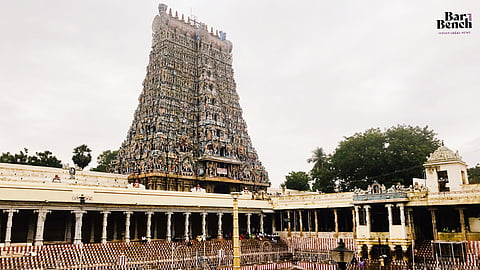
In this regard, the Court referred to instances involving political leaders entering temples without adhering to prescribed requirements. It specifically referred to Badrudeen Mustafa, an MLA representing Madurai Central, who had entered the Meenakshi temple premises and climbed its towers during Kumbabishekam (temple consecration ceremony).
"He claimed that he had a right to inspect if proper amenities are being provided. He also went up the temple towers on the occasion of Kumbabishekam. It is ironical that the said MLA proclaimed that Sanatana Dharma ought to be eradicated," the Court said.
The Bench also took judicial notice of an incident involving a Christian minister entering the Thiruchendur temple without furnishing the undertaking required of non-Hindus.
In contrast, the Court noted that Chief Minister Joseph Vijay, despite being Christian, gave the undertaking before entering a Meenakshi temple.
"We have the illustrious instance of the Hon'ble Chief Minister of Tamil Nadu Shri Joseph Vijay who worshipped Goddess Meenakshi after signing the undertaking. The Hon'ble Chief Minister who is a Christian by faith was not asked to convert to Hinduism. He was only requested to affirm his reverence for the deity. This is what we call as an inclusive approach," the Court said.
The Court went on to note that when politicians enter temples, their sycophants often try to accompany them. While discussing this tendency, the Court took critical note of a video that showed people "wearing skull caps" pushing their way into a Hindu temple's premises, despite opposition from temple devotees.
"We take judicial notice of a video doing rounds in the social media of persons wearing skull caps, pushing their way through in Thiruvannamali Arunachaleswarar temple, notwithstanding the vigorous protests of the devotees. The HR&CE staff stood as mute spectators," the Court lamented.
The Court criticised such lapses, as well as the tendency of politicians to visit Hindu temples only to "play to the gallery" and garner votes.
"We hold that usages and customs of temple cannot kneel down before such display of Chamchagiri and optics," it said.
The Bench also disagreed with a part of the reasoning in a 1972 Madras High Court judgment that struck down a rule permitting the unrestricted entry of non-Hindus to temples. In the said ruling, the Court had also suggested that no disturbances, including through music and processions, be permitted near mosques.
In the October 23 judgment, the High Court expressed that no such restrictions on processions should be put in place, whether it is passing by a mosque, church or temple.
"The right of the other communities and religionists to take their processions cannot be curtailed by citing the situs of mosques and churches. Likewise, Hindus also cannot prevent the other religionists from taking their processions in the customary manner on the ground that they pass in front of temples," it held.
Advocate G Aravinthsamy appeared for the petitioner.
Additional Advocate General PV Balasubramanian, assisted by Government Pleader M P Senthil, appeared for the State authorities.
[Read Judgment]