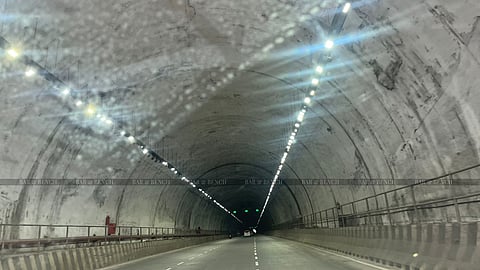

The Karnataka High Court on Thursday directed the State government to inform all prospective contractors about the pendency of petitions challenging the proposed Bengaluru Twin Tunnel Road project and clarified that any contract awarded for the project would remain subject to the outcome of the litigation [Prakash Belawadi & others v. State of Karnataka].
A Bench of Chief Justice Vibhu Bakhru and Justice KS Hemalekha passed the direction while hearing a batch of petitions questioning the legality of the ambitious tunnel road project.
The Court made it clear that it would not examine the wisdom of the government's policy decision, but only whether the decision had been taken in accordance with law.
"There is huge traffic in Bengaluru. They say this is one of the solutions. Whether a tunnel is the answer or not is not for us to decide. We are not substituting our views for that of the government. But the decision must be in accordance with law," Chief Justice Bakhru observed.
82-year-old Dr. Adikesavalu Ravindra and others sought to quash the tender floated for construction of the Bengaluru Twin Tunnel Road project. The Court also heard a connected petition filed by Prakash Belawadi challenging the proposed 17-km North-South tunnel corridor connecting Hebbal and Silk Board Junction.
During the hearing, counsel for the petitioners handed over a pen drive containing a compilation of nearly 7,000 pages of documents to assist the Court in adjudicating the matter.
Appearing for the petitioners, Senior Advocate DR Ravishankar contended that the project was being implemented contrary to Bengaluru's Master Plan and the statutory framework governing urban transport planning. According to the petitioners, the tunnel project is inconsistent with the city's planning framework and applicable urban land transport laws.
Appearing for petitioner Prakash Belawadi, Member of Parliament and Advocate Tejasvi Surya submitted that the challenge was not to the government's policy choice, but to the manner in which the decision had been arrived at.
"We are not challenging the policy decision. We are questioning the manner in which the decision has been arrived at," Surya argued.
Surya further submitted that the project suffers from several legal infirmities, including the absence of an environmental impact assessment and procedural irregularities in the approval process.
The Bench responded that this was precisely the limited issue before the Court - whether the decision-making process complied with the requirements of law.
It observed that no third-party rights should be created during the pendency of the proceedings.
"To ensure that no further equities are created during the pendency of the present petitions, the pendency of these proceedings shall be communicated to any third parties/contractors. Any contract awarded shall be subject to the outcome of these petitions," the Court ordered.
The matter has been posted for further hearing on August 20.