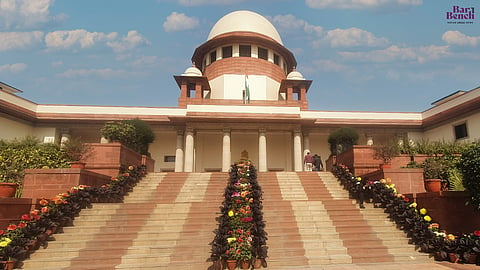
The Supreme Court on Thursday revealed that there was huge public interest in the issues surrounding governance and regulation of private higher education in India [Ayesha Jain vs. Amity University, Noida & Ors.]. .A Bench of Justices Ahsanuddin Amanullah and NV Anjaria said that it received a large number of letters and petitions from across the country raising concerns regarding private universities and its functioning. "We are not taking this issue totally as a judge or as just an issue before the court. It is taken only in public interest. On the next date, larger picture will emerge and take you (counsel for parties) into confidence regarding what is going on in our minds. We will require you all to be proactive then. Mr. [Tushar] Mehta will not believe how many letters and petitions I have received from all over India. We are getting some petitions with evidence," Justice Amanullah orally remarked. When a counsel said that education should not be an industry, Justice Amanullah concurred, saying,"Exactly! We are creating the future of the country. Whatever we do today is meaningless if we don’t ensure that the baton is passed on to the right hands."The Court was hearing a case in which it had earlier directed a nationwide audit of private universities across the country after it found that Amity University had harassed a student for changing her name..The Court today took a dim view of the manner in which the Union and State governments responded in the case.In November 2025, the Court had directed the Union government, all States and Union Territories, and the University Grants Commission (UGC) to file detailed affidavits disclosing how private universities across the country were established, regulated and monitored The Court had specifically directed that the affidavits must be personally affirmed by the Cabinet Secretary to the Union of India, Chief Secretaries of all States and Union Territories, and the Chairman of the UGC, without any delegation.However, Solicitor General (SG) Tushar Mehta, appearing for the Central government, told the Court today that while affidavits have been filed on behalf of the Union and UGC, the Union's affidavit was not filed by the Cabinet Secretary but by the Secretary of Higher Education.The Court took strong objection to this and recorded the same in its order stating,"Solicitor General appearing on behalf of Union of India and UGC submits that both entities have filed affidavits but the Centre’s affidavit has not been filed by the Cabinet secretary of the Union of India and has instead been filed by Secretary of Department of Education due to hierarchy in work order. We pause here to indicate that we are really surprised as to how the Cabinet Secretary was any under misconception that despite a categorical order of the Court that the affidavit has to be affirmed by him, he has not filed it. We are also unable to understand what has been said by the Secretary Higher Education department in the affidavit filed. Learned SG states that he will be filing for exemption for Union Cabinet Secretary."While the SG asked the Court to show magnanimity by excluding remarks regarding the Cabinet Secretary, Justice Amanullah orally responded,“This is how we are showing magnanimity. We would have called him here by 4 o’clock otherwise. We cannot allow Cabinet Secretary to be so casual. He could have read it. I was very clear in my order. I drafted it very carefully. Because there are so many departments concerned in this matter, that is why the direction was for the Cabinet Secretary.”The Court asked the Cabinet Secretary to file the affidavit as directed and further explain why he ought to be exempted from the proceedings. It also directed the Secretaries of the States which had not yet filed affidavits to explain why action should not be taken against them. .Supreme Court orders nationwide audit of private universities after Amity University harasses student for changing her name.The issue regarding private universities came to the notice of the court when it was considering a petition moved by 23-year-old student, one Ayesha Jain, who approached the Court alleging that Amity University was refusing to change her name in its rolls despite her furnishing all legal documents. She claimed that university officials harassed her, barred her from attending classes and even taunted her for changing her name to a muslim name. Her petition detailed a series of complaints made to the UGC and the Ministry of Education, alleging that despite their intervention, the university refused to take corrective action. The petition also accused Amity of misusing its authority and said that she lost a year of studies because of its conduct.The controversy dates back to 2021, when the petitioner changed her name from Khushi Jain to Ayesha Jain and published it in the Gazette of India. In 2023, she completed a certificate course at Amity Finishing School under her new name and later joined Amity Business School for an MBA (Entrepreneurship) programme in 2024. However, the university allegedly refused to update her records, preventing her from attending classes and sitting for exams.After multiple unanswered representations and complaints, Jain approached the Supreme Court in mid-2025, accusing the university of arbitrariness and discrimination..During earlier hearings, the Court had expressed strong disapproval of the university’s conduct.In November 2025, officials for the university appeared before the Court submitted their affidavits. However, instead of concluding the matter, the Bench expanded its scope significantly, observing that the issues involved in the case carried wider implications for governance and regulation of private higher education in India.It emphasised that it wished to examine how private universities came into existence, what statutory provisions or notifications enabled their creation, and what benefits they receive from governments.The Court directed the Centre and all State and Union Territory administrations to disclose the legal basis under which each private, non-government or deemed university was established. The Court also sought complete information on the benefits granted to these institutions, including land allotments, statutory relaxations, preferential treatment and any financial or administrative concessions.It further sought full details of the organisations and individuals who run such institutions, including the composition and selection process of their governing bodies.The UGC was also asked to explain its regulatory authority over private universities and the actual mechanism it follows to ensure compliance with statutory and policy requirements.The order also called for disclosures on admissions policies, recruitment of faculty, checks on compliance with legal obligations, whether institutions claiming to operate on a “no profit, no loss” basis are doing so in reality, grievance redressal systems for students and faculty, and whether minimum statutory salaries are being paid..The Court today granted an additional three weeks to all the respondent authorities to file affidavits as directed. The matter will be considered next on January 28. .[Read Live Coverage]