Right to dignity doesn't vanish with arrest: Rajasthan HC raps police for shaming arrestees, publishing their photos

After being told that the police were publicly shaming arrested individuals. including by uploading their photos on social media, the Court ordered the immediate takedown of such photos.
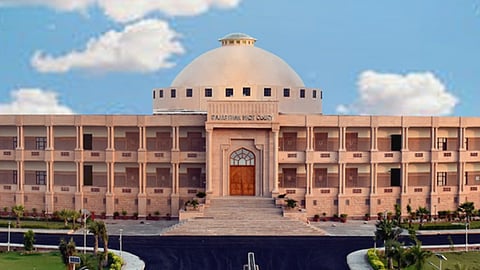
Rajasthan High Court
Rajasthan High Court Rajasthan High Court
Published on
3 min read

The Rajasthan High Court recently criticized the Jaisalmer police for publicly shaming arrested individuals by making them sit at police station gates, photographing them, sometimes in undergarments, and circulating such images on social media and in newspapers [Islam Khan & Ors. v. State of Rajasthan & Ors.].

The Court has ordered the immediate removal of such photographs. Justice Farjand Ali further stressed that an arrest does not take away the basic rights guaranteed under the Constitution, including the right to dignity.

“The right to dignity does not evaporate upon arrest. Even a person accused of an offence continues to be clothed with basic human rights. Forcing an arrestee to sit on the floor, stripping or partially disrobing such person, photographing him or her in a degrading condition, and thereafter circulating those images on social media or in newspapers, amounts to institutional humiliation and a direct assault on human dignity," the order passed on Tuesday stated.

Justice Farjand Ali
Justice Farjand Ali

The Court was dealing with a petition filed by ten Jaisalmer residents.

It took a serious view of the allegations made by them against the police, including that arrested persons are often made to strip down to their undergarments before being confined to imprisonment cells in such a state.

"Such conduct is plainly inhuman, degrading, and violative of the bare minimum human rights guaranteed to every individual, irrespective of the accusations against him. This Court is of the view that the alleged act is not only inhumane in nature but also strikes at the very root of basic human rights and amounts to a clear infraction of the constitutional guarantees enshrined under the law," the Court said.

The Court proceeded to seek responses from senior police officials to the petition, noting that the allegations raised serious concerns about adherence to constitutional safeguards.

The case will be heard next on January 28.

In the meantime, the Court has made it clear that any photo of arrested persons made public by the police through publication on various platforms must be removed within 24 hours.

"The Commissioner of Police, Jodhpur, is directed to immediately remove the photographs of Advocate Mohan Singh Ratnu from all web portals, social media platforms, and any other medium where the same are available. The compliance shall be ensured within 24 hours and shall be reported to this Court on the next date of hearing," it ordered.

The Court has also directed the Commissioner of Police to file a reply outlining safeguards put in place to prevent a repeat of such incidents.

The petitioners before the Court had alleged that police officials routinely make accused individuals sit at the entrance of police stations, photograph them, and circulate such images publicly.

They claimed that such practices extend to women as well, including unmarried young girls, whose photographs are allegedly shared without any formal determination of guilt.

The petitioners presented photographic evidence, showing several women seated at the entrance of a police station. It was submitted that the images were circulated on social media platforms and published in local newspapers, creating a public perception of guilt.

Justice Ali noted that the presumption of innocence is a cornerstone of criminal law and that publicly portraying an accused as a criminal before trial undermines this principle.

The Court observed that once such images are circulated, especially online, the impact can be lasting, remaining accessible in the public domain. It observed that even if an accused is later acquitted, the harm to their reputation and social standing may never be fully undone.

The Court pointed out that there is no law that authorises police officials to engage in such conduct. It opined that the actions of the police appeared unfair, unjustified, and beyond their legal powers.

During the hearing, advocate Devkinandan Vyas, appearing for the petitioners, pointed out that similar practices were being reported from other districts as well.

He referred to a recent newspaper report about the arrest of a practising advocate by the Udaimandir Police Station in Jodhpur, where the advocate was allegedly made to sit outside the police station and photographed.

The Court took judicial notice of this report, observing that it raised serious concerns relating to fundamental rights.

The Court has now ordered the Superintendent of Police, Jaisalmer, to submit an affidavit addressing the allegations and directed immediate removal of photographs and related content of arrested persons from web portals and social media platforms.

The Court appointed advocate Devkinandan Vyas as an amicus curiae in the case as well.

Advocates Sarwar Khan, and Rajak Khan also appeared for the petitioners.

The State was represented by Additional Advocate General Deepak Choudhary and Public Prosecutor SR Choudhary.

[Read Order]

Attachment
PDF
Islam Khan & Ors. v. State of Rajasthan & Ors
Preview
Bar and Bench - Indian Legal news
www.barandbench.com