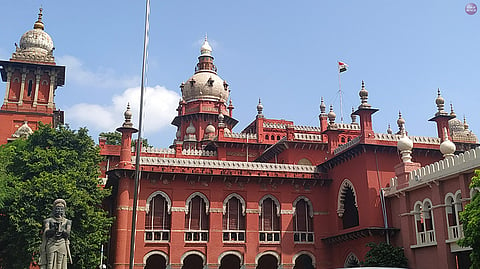

A democracy cannot treat criticism as a disorder or satire as sedition, said the Madras High Court recently while staying a Tamil Nadu Police notice directing X (formerly Twitter) to block multiple political posts uploaded by a regional unit of the Vishwa Hindu Parishad (VHP) [Chockalingam Vs Additional Chief Secretary].
A Division Bench of Justices L Victoria Gowri and N Senthilkumar said that political criticism, satire, dissent and robust public debate are protected under Article 19(1)(a) of the Constitution.
“A democracy cannot treat criticism as disorder, satire as sedition, dissent as danger or opinion as offence,” the Court observed.
It also reminded that in a constitutional democracy, the right to criticise the government, its functionaries, political actors and public policies is not a concession granted by the State.
"It is a constitutional guarantee," the Court said.
The Court proceeded to stay the blocking notice under challenge.
"On a prima facie consideration, we find that the impugned notice is bereft of post-wise reasons, does not disclose individualised application of mind, invokes Section 79(3)(b) (of the IT Act) in a manner requiring deeper judicial scrutiny, and appears to trench upon the safeguards recognized in Shreya Singhal v. Union of India," stated the May 13 interim order.
The Court was hearing a writ petition filed by P Chockalingam, President of the North Tamil Nadu unit of the Vishwa Hindu Parishad, challenging a May 8 notice issued by the Cyber Crime Wing of the Tamil Nadu Police.
The notice had directed X to remove or block multiple URLs under Section 79(3)(b) of the Information Technology Act, 2000 read with Rule 3(1)(d) of the Information Technology (Intermediary Guidelines and Digital Media Ethics Code) Rules, 2021.
Chockalingam argued that the notice clubbed together several URLs belonging to different users under one common blocking direction. He said the authorities had not separately examined the content, context or constitutional status of each post.
It was also argued that the affected users were not informed of the allegations against them and were not given any meaningful opportunity to respond before the blocking direction was issued.
The Bench said that the blanket direction went against the Constitution not only because of the broad nature of the order, but also the absence of reasons.
“The constitutional infirmity in a blanket direction lies not merely in its width, but in its silence. When the State restricts speech, it must speak through reasons. A citizen’s liberty cannot be curtailed by a cryptic command. A content creator cannot be silenced by an omnibus formula. A political opinion cannot be removed merely because it is sharp, inconvenient, satirical, dissenting or unpalatable,” the Court said.
An omnibus blocking direction issued without reasons, without explaining how it is a proportional measure and without following due legal procedure cannot be treated merely as an administrative act, the Court further said, but would become a constitutional concern.
"Silence imposed without reasons is antithetical to the culture of justification that sustains constitutional democracy," the Court added.
The Court emphasised that Article 19(1)(a) protects not only polite or agreeable speech.
“Article 19(1)(a) of the Constitution of India protects not only polite speech, agreeable speech or speech which is comfortable to those in power. It protects criticism, dissent, satire, political disagreement and robust public debate,” the Bench observed.
It went on to add,
“The constitutional value of free speech is tested most severely when the speech in question is inconvenient to authority.”
The Bench relied on the Supreme Court’s judgment in Shreya Singhal v. Union of India, which drew a distinction between discussion, advocacy and incitement.
The Court said that discussion and advocacy, even of unpopular or disagreeable causes, remain protected speech. State interference is permissible only when such speech reaches the level of incitement.
“Discussion is the soul of democracy. Advocacy is the instrument of public persuasion. Incitement alone crosses the constitutional boundary,” the Court said.
The Court also warned that vague and open-ended restrictions on online speech can create a chilling effect on free expression.
“A chilling effect is not always visible. It operates silently. It compels citizens to self-censor. It makes a content creator pause not because the law prohibits speech, but because the consequences of speaking are uncertain, sudden and opaque,” the Bench said.
The Bench also said Section 79(3)(b) of the IT Act deals with intermediary safe harbour and is not an independent source of blocking power.
The Court criticised the three-hour deadline given in the blocking order under challenge for compliance as well. Such urgency appeared disproportionate in the absence of any disclosed emergency or imminent threat, the Court pointed out.
The State had argued that the notice was issued in the interest of law and order and public tranquillity. However, the Court noted that no counter-affidavit had been filed explaining the specific offending content, post-wise reasons or the basis for requiring removal within three hours.
The Court, therefore, stayed the May 8 notice and directed the Cyber Crime Wing to communicate with X Corp to unblock and restore all URLs mentioned in the notice.
It clarified that the State could still act against any specific content if it independently satisfied Article 19(2) (restrictions to free speech) and if the procedure under the IT Act was followed with recorded reasons.
The matter will be heard next on June 8.
By then, the Court has also directed the State to file a response detailing the reasons for which it sought to block the X posts in question, the law based on which it issued the blocking order, the grounds on which it had ordered the emergent blocking of the posts within three hours, as well as information on whether the authors of the X posts were given an opportunity to be heard before the blocking was ordered.
Advocates Sunny Sheen and C Gunasekaran appeared for the petitioner.
Additional Government Pleader LSM Hasan Fizal appeared for the State's Home Department.
Additional Public Prosecutor S Raja Kumar appeared for the police authorities.
[Read Order]