
Subscribe
Subscribe
- Latest Legal News
- News
- Law Firms
- Columns
- Interviews
- Law School
- Legal Jobs
- हिंदी
- ಕನ್ನಡ
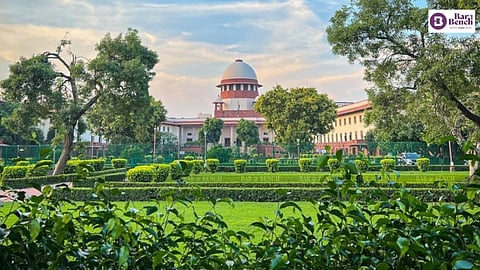
The Supreme Court on September 24 upheld a Bombay High Court verdict which had ruled that the act of saying Dua (Muslim prayer) for success in the election neither amounts to exercise of undue influence nor soliciting votes in the name of the religion [Shaan E Hind vs. Muft Mohammad Ismail Abdul Khalique].
A Bench of Justices Vikram Nath, Augustine George Masih and Sandeep Mehta dismissed the appeal filed against the Bombay High Court’s June 8 judgment which had upheld the election of AIMIM MLA Mufti Mohammad Ismail Abdul Khalique’s from the Malegaon Central Assembly constituency in the 2024 Maharashtra elections.

The dispute arose from the November 2024 Maharashtra Assembly election in Malegaon Central. Khalique, the AIMIM candidate, secured 1,09,563 votes, while Shaikh Asif Shaikh Rashid secured 1,09,491 votes, leaving a margin of 72 votes. Shaan-e-Hind Nihal Ahmed, who contested on a Samajwadi Party ticket, secured 9,624 votes.
Rashid subsequently challenged Khalique’s election before the Bombay High Court, alleging corrupt practices during the campaign.
The High Court rejected the election petition. Ahmed then approached the Supreme Court against that decision.
A major part of the challenge concerned the use of religious references during the campaign.
The election petition alleged that Khalique, who was described as an Imam, repeatedly invoked Islam and Islamic religious texts while campaigning. It referred to a Dars-e-Quran at Malegaon’s Jama Masjid on October 16, 2024, where Khalique was alleged to have spoken against electing a woman as a ruler.
The challenge also cited several instances of “dua” being offered during the campaign. The appeal referred to prayers at Gandhinagar Chowk, Fateh Maidan and Noori Tower Machli Bazar where the same was done.
Other allegations concerned campaign speeches and pamphlets that projected Khalique as representing Muslims and as the “voice of Islam”. One speech was alleged to have linked pressing the number five button on the electronic voting machine with the five pillars of Islam and offering namaz five times a day.
It was further alleged that one campaigner asked Muslim voters to swear in the name of Allah that they would vote for kite, AIMIM’s election symbol.
The election petition also alleged that 1,082 persons who were dead remained on the electoral rolls and were shown as having voted, which, according to the challenger, was significant given the narrow victory margin.
The Bombay High Court nevertheless rejected the election petition at the threshold.
It also held that the act of saying dua for election victory does not constitute solicitation of votes in the name of religion.
"As indicated above, the act of saying Dua (prayer) and the response thereto by "Amen" does not amount to pledge. As the Dua is essentially a form of the communication by the believer with the God, saying prayer for success in the election neither amounts to exercise of undue influence nor soliciting votes in the name of the religion. Respondent No.1 could have been accused of playing the sympathy card on account of the illness which he claimed to have suffered. But that is completely besides the point," the High Court ruled.
The appeal before the Supreme Court was filed by Samajwadi Party candidate Shaan-e-Hind Nihal Ahmed.
It argued that the High Court had improperly examined individual speeches in isolation instead of considering the campaign material as a whole.
However, the top court dismissed the appeal.
Ahmed was represented by Senior Advocate Mukul Rohatgi.
Ismail Abdul Khalique was represented by Senior Advocate Shadan Farasat with advocates Ashwin Hirulkar and Shakul Ghatole.