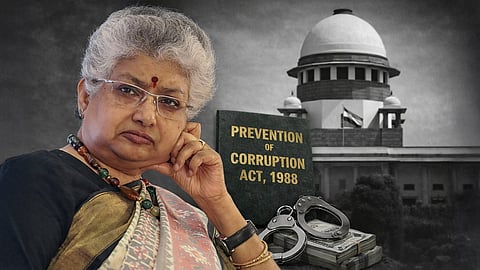

While striking down Section 17A of the Prevention of Corruption Act, 1988, Justice BV Nagarathna of the Supreme Court held that the requirement of prior approval before any investigation into corruption allegations is unconstitutional and undermines the very object of the anti-corruption law.
In her strongly-worded verdict, Justice Nagarathna rejected the argument that the provision could be saved by routing approval through independent bodies such as the Lokpal or Lokayukta. She held that courts cannot rewrite the statute to cure its defects, nor can constitutional infirmity be removed by merely shifting the approving authority.
Her opinion forms the basis of a split verdict, with the Supreme Court directing that the matter be placed before the Chief Justice of India for constitution of an appropriate Bench.
Here are six reasons why Justice Nagarathna struck down the provision.
1. No judicial rewriting of Section 17A
A central strand of Justice Nagarathna’s reasoning is rooted in statutory interpretation. She held that Section 17A consciously vests the power of granting prior approval in the “government” or the authority competent to remove the public servant from office. Where the legislative language is clear, courts cannot substitute it with words of their own choosing, she held.
“The expressions ‘Government’ and ‘of the authority competent to remove him from his office’ in Section 17A of the Act cannot be substituted, in light of no persisting ambiguity, absurdity or alternative meanings ascribable by any other expression as this would be an instance of judicial legislation."
She added that even shifting the approval mechanism to an independent body does not cure the defect:
“...by merely shifting the authority which is to grant prior approval i.e. from Government to the Lokpal or Lokayukta, unconstitutionality does not vanish.”
2. Executive cannot judge its own officers
Justice Nagarathna examined how government departments function in practice, noting that officers involved in policy formulation and implementation cannot be expected to impartially decide whether those very decisions should be investigated. She warned that Section 17A violates the foundational principle against bias.
“The maxim nemo judex in re sua literally means that a man should not be a judge in his own cause, meaning the deciding authority must be impartial which is exemplified as the rule against bias. Though, this maxim is essentially with regard to judicial or quasi-judicial adjudication and is applicable to courts of law and quasi-judicial authorities, in my view, the same would also apply in a matter such as where prior approval has to be given within the meaning of Section 17A of the Act,” she observed.
She noted that decision-making within departments is often collective, involving multiple officers across levels, making it unrealistic to expect neutrality when approval is sought from within the same institutional framework.
3. A disguised classification
Although Section 17A appears to apply uniformly to all public servants, Justice Nagarathna found that in substance, it shields only those who make recommendations or take decisions - functions typically discharged by senior officers.
“Though apparently, the protection of prior approval is extended to all classes of public servants in substance, it extends only to those public servants who take decisions and make recommendations in the discharge of their official duties,” she held.
She explained that the phrase “recommendation made” draws its meaning from “decision taken”, and both operate at the same hierarchical level.
“They are actions taken by higher-level officers after scrutinising the notings made by the lower-level officers,” the judgment notes.
4. Old wine in a new bottle
Justice Nagarathna held that Section 17A is not a fresh legislative experiment, but a return to an approval regime already struck down by larger benches of the Supreme Court.
“Section 17A is in fact a resurrection of Section 6A of the DSPE Act, 1946 though in a different avatar, in other words, it is old wine in a new bottle,” she wrote, holding that the amendment fails to remove the very basis on which earlier provisions were invalidated.
5. Protecting corrupt public servants
The judgment repeatedly stresses that preventing even a preliminary inquiry undermines both accountability and honest governance. Justice Nagarathna warned that the law in its present form sacrifices the core purpose of corruption control.
“Is the option then to strike down Section 17A and throw the baby out with the bathwater? Certainly not. If honest public servants are not given a basic assurance that decisions taken by them will not be subjected to frivolous complaints, it is the nation that will suffer,” she observed.
She rejected the argument that prior approval is necessary to filter false complaints, stating that truth can only emerge through inquiry.
“If approval is not granted to even make a preliminary enquiry, the truth and genuineness of the complaint would not be known and the matter would be hanging in suspense.”
In a particularly blunt assessment, she concluded:
“In my view, Section 17A of the Act is, in fact, to grant protection to corrupt public servants.”
6. Honest officers already protected under the law
Justice Nagarathna also pointed out that safeguards for honest officials already exist at a later stage. Under Section 19 of the Act, sanction for prosecution is required before cognisance is taken, allowing governments to prevent motivated or baseless cases after material has been gathered.
“Any prejudice that could be caused by a false or frivolous complaint could be prevented, at the stage of taking of cognizance, by the denial of sanction under Section 19 of the Act,” she noted.
Justice KV Viswanathan, on the other hand, upheld the constitutional validity of Section 17A by reading the provision narrowly, emphasising its limited application to decisions taken in discharge of official duties, the existence of timelines and safeguards and the overriding role of the Lokpal under the Lokpal and Lokayuktas Act, 2013.
In view of these divergent opinions, the Court directed that the matter be place before the Chief Justice of India for constitution of a larger bench that will settle the issue.